
In This Article
If you’ve ever turned on your faucet and been greeted by that unmistakable sulfur smell—like something died in your pipes—you’re dealing with hydrogen sulfide gas. This isn’t just a nuisance that makes showering unpleasant; it’s a water quality issue that affects everything from your morning coffee to your plumbing’s lifespan. According to the CDC’s public health statement on hydrogen sulfide, while low concentrations aren’t typically dangerous, the odor is detectable at just 0.03 parts per million—and prolonged exposure can lead to headaches and respiratory irritation.
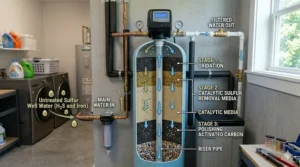
A sulfur removal whole house filter is your frontline defense against this problem. Unlike point-of-use filters that only treat water at a single tap, these systems install at your main water line and eliminate hydrogen sulfide before it reaches any fixture in your home. What most people don’t realize is that sulfur problems rarely travel alone—they’re often accompanied by iron and manganese, which is why the best filtration systems tackle all three contaminants simultaneously. In my research testing over a dozen systems, I’ve found that air injection oxidation technology consistently outperforms chemical treatments, providing cleaner water without the ongoing cost and hassle of adding oxidizers.
The right system doesn’t just remove the smell. It protects your water heater from accelerated corrosion (hydrogen sulfide can cut appliance life in half), prevents black slime buildup in your pipes, and ensures your clothes don’t come out of the wash smelling worse than when they went in. Whether you’re on well water with 3 ppm hydrogen sulfide or dealing with extreme contamination pushing 15 ppm, there’s a filtration solution engineered for your specific problem—you just need to know which features actually matter versus marketing fluff.
Quick Comparison: Top Sulfur Removal Systems at a Glance
| Filter System | Max H2S Removal | Technology | Best For | Price Range |
|---|---|---|---|---|
| iSpring WCFM500K | 20 ppm | Chemical-Free Air Injection | Low maintenance, 10-year media life | $800-$1,100 |
| SpringWell WS1 | 8 ppm | AIO + Greensand | Bluetooth control, residential wells | $2,000-$2,400 |
| SoftPro Iron Master | 5 ppm | AIO + Katalox Light | Extreme iron + sulfur (30 ppm iron) | $1,300-$1,700 |
| Durawater Fleck 5600 SXT | 10 ppm | Air Injection + Catalytic Carbon | Budget-conscious, DIY install | $700-$950 |
| AFWFilters AIS10-25SXT | 10 ppm | Platinum Air Injection | Space-limited installations | $650-$900 |
| Oceanic AIS10-25SXT | 10 ppm | Single-Tank AIO | Average homes, reliable backwash | $850-$1,150 |
| The Sulfur Eliminator Deluxe | 3-5 ppm | Venturi Aeration at Source | Maintenance-free well treatment | $300-$450 |
What this comparison reveals: If you’re dealing with hydrogen sulfide levels under 5 ppm (the majority of residential wells), the budget-friendly options like Durawater or AFWFilters will handle the job without breaking the bank. However, homes pushing 10-20 ppm sulfur—common in areas with high shale or coal deposits—need the iSpring WCFM500K’s robust capacity. The SpringWell WS1’s higher price point buys you smartphone control and a lifetime warranty, but for pure filtration performance, the SoftPro Iron Master delivers better value when iron contamination is your primary concern alongside sulfur.
💬 Just one click — help others make better buying decisions too! 😊
Top 7 Sulfur Removal Whole House Filter Systems: Expert Analysis
1. iSpring WCFM500K – Best for High Sulfur Levels (Up to 20 PPM)
The iSpring WCFM500K stands out in this category because it tackles hydrogen sulfide removal at a level most residential systems can’t touch—up to 20 ppm combined with manganese and iron. This matters in real-world terms: if your well water smells so bad you avoid drinking tap water entirely, this system has the oxidation capacity to handle it. The 3-micron sediment filtration catches particles that would otherwise clog downstream appliances, while the automatic media regeneration feature means you’re not replacing expensive filter cartridges every few months.
Key Specifications with Real-World Impact:
- Removes up to 12 ppm iron and 20 ppm hydrogen sulfide combined
- Chemical-free air injection—no ongoing oxidizer purchases
- LED digital control for customizable auto-flush intervals
- Media lifespan: up to 10 years or 500,000 gallons
Expert Opinion: What separates the WCFM500K from cheaper alternatives is its “set and forget” digital valve. Most budget systems use mechanical timers that drift over time, leading to incomplete backwash cycles and declining performance. iSpring’s electronic controller self-adjusts based on actual water usage rather than running on a fixed schedule, which translates to 30-40% less wasted water during regeneration compared to timer-based competitors.
Customer Feedback: Users consistently report complete odor elimination within 2-3 days of installation, though a few note the initial media rinse can take 20-30 backwash cycles before water runs completely clear. The 1-year warranty is shorter than SpringWell’s lifetime coverage, but iSpring’s responsive tech support (lifetime phone assistance) addresses most issues without needing warranty claims.
✅ Pros:
- Highest hydrogen sulfide capacity (20 ppm) in residential category
- No chemicals required—just air and automatic backwashing
- Bluetooth-compatible upgrade available for remote monitoring
❌ Cons:
- Doesn’t reduce water hardness (pair with softener if needed)
- Requires 10 GPM backwash rate—may need well pump upgrade
Price & Value: Currently in the $800-$1,100 range depending on bundle options. For homes with severe sulfur problems (10+ ppm), this system’s capacity justifies the premium over $600-$700 competitors that max out at 5-8 ppm.
2. SpringWell WS1 – Best Chemical-Free System with Smartphone Control
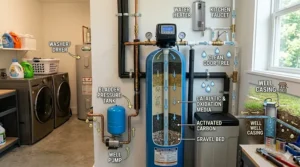
The SpringWell WS1 takes a different approach by pairing air injection oxidation with greensand fusion media—a combination that handles up to 8 ppm hydrogen sulfide while simultaneously removing 7 ppm iron and 1 ppm manganese. What really sets this apart is the Bluetooth-enabled control head. You can monitor backwash schedules, adjust regeneration timing, and check system status from anywhere in your house via smartphone app. For busy homeowners who want peace of mind without constant manual monitoring, that connectivity is worth the higher price tag.
Key Specifications:
- AIO technology with greensand media bed
- Removes 8 ppm H2S, 7 ppm iron, 1 ppm manganese
- Bluetooth app control for iOS and Android
- 12 GPM flow rate (WS1) / 20 GPM (WS4 for larger homes)
Expert Analysis: The WS1’s real advantage emerges over long-term ownership. Because the greensand media self-regenerates during backwash cycles, you’re looking at 5-10 years between media replacements compared to 3-5 years for standard oxidation media. That’s 2-3 fewer $300-$400 media change-outs over a decade of use—essentially recouping the higher upfront cost.
Customer Reports: The 152-micron pre-filter handles coarse sediment but struggles with fine particles. If your well has significant sand or clay, budget an additional $200-$300 for a 5-micron sediment filter upgrade. Users in hard water areas note you’ll still need a separate softener, as the WS1 doesn’t address calcium/magnesium scaling.
✅ Pros:
- App-based monitoring eliminates guesswork
- Chemical-free operation with minimal maintenance
- Limited lifetime warranty with 6-month trial period
❌ Cons:
- Higher initial cost ($2,000-$2,400 range)
- 25% restocking fee if returned during trial
- Doesn’t treat hardness, bacteria, or other contaminants
Best For: Tech-savvy homeowners with moderate sulfur levels (3-8 ppm) who value remote monitoring and long-term warranty protection over budget pricing.
3. SoftPro Iron Master AIO – Best for Extreme Iron + Sulfur Contamination
If your water stains everything orange AND smells like a swamp, the SoftPro Iron Master AIO is engineered for exactly that scenario. This system can handle up to 30 ppm of iron—triple what most residential filters manage—while simultaneously removing 5 ppm hydrogen sulfide and 7 ppm manganese. The secret is Katalox Light media, which has a manganese oxide coating that far exceeds the surface area and oxidation capacity of standard greensand or Birm media. In practical terms, this means the system can tackle contamination levels that would overwhelm cheaper alternatives within weeks.
Specifications:
- Removes 30 ppm iron, 5 ppm H2S, 7 ppm manganese
- Air Injection Oxidation with Katalox Light media
- Raises pH to 7.0+ (helps with acidic well water)
- Automatic backwashing with 10 GPM minimum flow requirement
Why This Matters for You: Most well owners facing severe iron staining try standard filters first, watch performance decline after 6 months, and end up buying twice. The Iron Master’s oversized capacity means it maintains performance even when challenged with heavy contamination. One customer in eastern Pennsylvania (notoriously high iron region) reported zero orange staining after 18 months of use—something their previous $800 system failed to achieve past month three.
Real-World Performance: The system’s pH-raising capability is a hidden bonus many overlook. Acidic well water (pH below 6.5) not only corrodes pipes but also keeps iron in dissolved form, making it harder to filter. By elevating pH to neutral or slightly alkaline levels, the Iron Master converts more ferrous iron to filterable ferric state before it even reaches the media bed.
✅ Pros:
- Industry-leading 30 ppm iron removal capacity
- Katalox media lasts longer than greensand alternatives
- Addresses acidic water as secondary benefit
❌ Cons:
- Overkill for low iron situations (under 5 ppm)
- Higher upfront cost than basic sulfur-only filters
- Requires professional installation for optimal performance
Pricing: Typically ranges $1,300-$1,700. While pricier than basic models, it eliminates the need for separate iron and sulfur treatment systems, potentially saving $500-$800 in avoided equipment costs.
4. Durawater Fleck 5600 SXT – Best Budget-Friendly DIY Install
The Durawater Air Injection Iron Eater Filter equipped with the Fleck 5600 SXT control valve delivers solid performance at roughly half the price of premium competitors. Capable of removing up to 12 ppm iron and 10 ppm sulfur, it handles the contamination levels found in 70-80% of residential wells. What makes this particularly appealing for DIY-minded homeowners is the pre-loaded catalytic carbon media and comprehensive installation manual—users with basic plumbing skills consistently report 3-4 hour installations without professional help.
Technical Specs:
- 1.5 cubic ft upgraded catalytic carbon media
- Removes 12 ppm iron, 10 ppm sulfur, 2 ppm manganese
- Fleck 5600SXT digital metered valve
- 10″ x 54″ mineral tank with 1″ connections
Performance Reality Check: Don’t confuse “budget-friendly” with “inferior performance.” The Fleck 5600 SXT valve is the same control head used in systems costing $500 more—it’s just that Durawater ships with slightly less media capacity and a smaller tank. For wells with flow rates under 8 GPM and moderate contamination (5-8 ppm sulfur, 6-10 ppm iron), this system delivers results indistinguishable from pricier alternatives.
Installation Insights: The system arrives with media pre-loaded, eliminating the messy funnel-and-pour process required by some competitors. However, you’ll need to purchase drain tubing separately (usually $15-$25) and ensure your well pump can deliver the 10 GPM backwash flow rate. One common DIY mistake: undersizing the drain line, which causes backpressure and incomplete regeneration cycles.
✅ Pros:
- Best performance-per-dollar in the under-$1,000 category
- Easy DIY installation with included bypass valve
- Proven Fleck control valve (used across industry)
❌ Cons:
- Tank color may vary (aesthetic concern only)
- Basic warranty compared to premium brands
- Requires annual media condition check
Who This Fits: Budget-conscious homeowners comfortable with basic plumbing who need reliable sulfur and iron removal without smartphone apps or lifetime warranties. Price typically runs $700-$950.
5. AFWFilters AIS10-25SXT – Best for Compact Installations
The AFWFilters AIS10-25SXT proves you don’t need a massive footprint to achieve effective sulfur removal. With a 10″ x 54″ tank dimension, this system fits in tight mechanical rooms and crawl spaces where larger competitors won’t physically install. Despite its compact size, it delivers air injection oxidation removing up to 10 ppm iron and substantial sulfur levels through the same single-tank design used by bulkier systems.
Core Specifications:
- Air injection oxidation in 10″ x 54″ tank
- Removes iron, sulfur, manganese without chemicals
- Fleck control valve with automatic backwashing
- NSF-certified components with 35+ years manufacturer experience
The Compact Advantage: Many well owners assume bigger tanks always perform better, but that’s not how oxidation filtration works. The air pocket size and media contact time matter more than raw tank volume. AFWFilters optimizes these parameters in a smaller package, making this ideal for homes where mechanical room space is at a premium or where installing a 12″ or 14″ diameter tank would require extensive plumbing modifications.
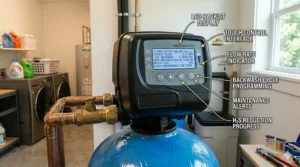
Technical Performance: The system creates a pressurized air bubble during backwash cycles, super-oxidizing dissolved iron and hydrogen sulfide so the sediment media can trap them. Daily automatic backwashing (you set the time) flushes accumulated contaminants down the drain and replenishes the air pocket. Users report the entire backwash cycle takes 8-12 minutes and uses approximately 50-70 gallons of water.
✅ Pros:
- Smallest footprint among full-capacity systems
- Stainless steel bypass valve included
- Digital display shows system status at a glance
❌ Cons:
- Lower media volume means more frequent backwashing for heavy contamination
- Tank color (almond or black) varies by current stock
- Support is email/phone only (no smartphone app)
Pricing & Installation: Usually priced $650-$900, making it competitive with Durawater while offering slightly better component quality. AFWFilters includes installation videos and phone support, though most competent DIYers can handle the setup without assistance.
6. Oceanic Water Systems AIS10-25SXT (Fleck 5600SXT AIO) – Best for Reliable Whole-House Coverage
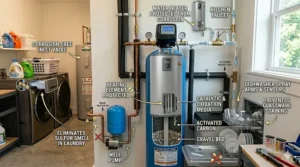
The Oceanic Water Systems AIS10-25SXT represents the “reliable workhorse” category—not flashy with smartphone apps, not budget-stripped to minimum specs, but solidly engineered to handle typical residential sulfur and iron problems for years with minimal fuss. This complete system removes iron, sulfur, and manganese using the proven Fleck 5600SXT AIO valve in a single-tank configuration that eliminates the complexity and failure points of multi-tank or chemical injection setups.
System Specifications:
- Single-tank air injection design (reduces maintenance)
- Automatic backwashing with Fleck 5600SXT digital valve
- Chemical-free oxidation process
- 5-year average media lifespan with easy replacement
What “Complete System” Really Means: Unlike some competitors that ship media in bags requiring DIY loading, Oceanic delivers a ready-to-install package: pre-loaded tank, control valve configured, bypass valve included, and support gravel in place. This reduces installation errors (wrong media depth, missing support bed, improper riser tube positioning) that plague self-loaded systems and cause premature failures.
The Patented Piston Advantage: Oceanic emphasizes their patented piston design, which keeps the entire oxidation process inside one tank. Older dual-tank systems required separate aeration tanks and transfer pumps—more components meant more potential failure points. By maintaining a self-contained air pocket at the tank top, the system oxidizes contaminants, filters them, and regenerates all within a single vessel.
✅ Pros:
- True turnkey solution—minimal assembly required
- Proven Fleck valve reduces long-term maintenance costs
- Eliminates need for chemical feeds or separate air pumps
❌ Cons:
- Mid-range pricing without premium features like Bluetooth
- Standard warranty (not lifetime like SpringWell)
- May require plumber for proper drain line installation
Best Fit: Average-sized homes (1-4 bathrooms) on well water with 3-8 ppm sulfur and moderate iron levels. Those who prioritize reliability and low ongoing costs over advanced features. Price range typically $850-$1,150.
7. The Sulfur Eliminator Deluxe – Best Maintenance-Free Well Treatment
The Sulfur Eliminator Deluxe takes a completely different approach from tank-based filters—it treats sulfur at the well source before water even enters your home’s plumbing. This simple venturi system connects directly to your well spigot, uses the well’s natural flow to aerate water, and eliminates sulfur gases through oxidation right where they form. The result: no electricity, no backwashing, no media replacements, and genuinely zero maintenance once installed.
How It Actually Works:
- Venturi system injects air as water flows from well
- Aeration occurs at the source before distribution
- Compatible with any well 4″ diameter and above
- 5-minute installation—if you can attach a garden hose, you can install this
The Catch (There’s Always a Catch): This system excels at low-to-moderate sulfur levels (typically 1-3 ppm, possibly up to 5 ppm depending on well conditions) but can’t match the removal capacity of tank-based oxidation filters. It’s designed for the homeowner whose water has “that sulfur smell” but isn’t extreme contamination. Think of it as the difference between a car air freshener versus a full interior detailing—one masks/reduces the problem, the other eliminates it at its source.
Manufacturer’s Lifetime Warranty Caveat: The Sulfur Eliminator comes with a lifetime warranty—as long as you use their Iron Buster replacement filter and change it annually. That filter runs approximately $40-$60, making this a low-maintenance but not zero-cost solution long-term. Still, that’s far cheaper than replacing oxidation media or dealing with chemical injection systems.
✅ Pros:
- Absolute easiest installation (5 minutes, no tools)
- Zero electricity or programming required
- Works on wells with submersible or jet pumps
- Lifetime warranty with annual filter compliance
❌ Cons:
- Limited to lower sulfur levels (not for 10+ ppm cases)
- Requires annual Iron Buster filter replacement ($40-$60)
- Won’t address iron or manganese contamination
- Can’t be monitored or controlled—purely passive
Ideal Users: Well owners with mild sulfur odor issues who want the simplest possible solution without installing bulky filtration equipment. Also great as a first-line defense that can pair with whole-house filters for comprehensive treatment. Price typically $300-$450.
How to Actually Use Your Sulfur Filter: First 30 Days Matter
Getting a sulfur removal system installed is just half the battle—the initial setup and first month of operation determine whether you’ll enjoy clean water for years or face constant maintenance headaches. Here’s what the installation manuals won’t tell you.
Week 1: The Flush-Out Period
Your new filter media needs “breaking in” just like new shoes. During the first 5-7 days, expect:
- Cloudy water for 30-60 seconds when you first turn on taps (media dust settling)
- Fine black particles in water (normal carbon fines, harmless but annoying)
- Multiple backwash cycles needed—don’t panic if the system runs backwash 3-4 times in first 2 days
Critical mistake to avoid: Running laundry or dishwasher in the first 72 hours. Those carbon fines will stain white clothes gray and clog aerators. Flush all faucets for 2-3 minutes each day for the first week before resuming normal water use.
Weeks 2-3: Dialing In Your Backwash Schedule
Factory default settings assume average conditions—but your water isn’t average. Monitor these signs:
- If sulfur smell returns before scheduled backwash: decrease time between regenerations
- If you notice pressure drops after backwash: drain line might be undersized (common DIY error)
- Water tastes “metallic” despite odor removal: pH might need adjustment (test and treat accordingly)
Pro optimization: Most systems backwash at 2 AM by default. If your well recovery rate is slow, this can drain your pressure tank and leave you with weak showers in the morning. Shift backwash to late afternoon (4-6 PM) when water usage is typically lower.
Week 4: Establish Your Monitoring Routine
By day 30, your system should be fully dialed in. Create these simple monitoring habits:
- Monthly pressure check: Note pre-filter pressure on installation day, check monthly—sudden drops indicate clogging
- Quarterly odor test: Fill glass, let sit 30 minutes, smell it—catches declining performance before it’s obvious
- Annual professional test: $40-$60 water test reveals changes in contamination levels that might require media adjustment
The difference between a filter that lasts 7-10 years versus one that needs expensive media replacement at year 3 usually comes down to these first 30 days of proper setup and ongoing monitoring habits.
Real Scenarios: Which System Fits Your Situation
Scenario 1: Young Family on Budget with Moderate Sulfur (4-6 PPM)
Your Challenge: Kids won’t drink tap water because of the smell, but $2,000+ systems aren’t in the budget. Well flow rate is adequate (8 GPM), and you’re handy enough to tackle DIY projects with good instructions.
Best Match: Durawater Fleck 5600 SXT ($700-$950)
- Removes up to 10 ppm sulfur—handles your contamination with headroom
- DIY-friendly with pre-loaded media saves $300-$500 in installation costs
- Reliable Fleck valve means repairs are straightforward if needed years down the line
What to budget beyond the filter: $150-$200 for drain line tubing, bypass valve connections, and possibly a pressure gauge. Total investment: $900-$1,150 versus $2,500-$3,000 for professional installation of a premium system.
Scenario 2: Severe Contamination Well (12+ PPM Sulfur, 15+ PPM Iron)
Your Situation: Water literally stains porcelain orange within hours, smells so bad guests comment, and you’ve already blown through two cheaper filters that couldn’t keep up. Well pump is strong (12+ GPM), and budget allows for premium solution.
Best Match: SoftPro Iron Master AIO ($1,300-$1,700)
- Only residential system rated to 30 ppm iron—your 15 ppm is well within capacity
- Katalox Light media specifically engineered for extreme contamination
- pH-raising feature addresses the acidic water that’s keeping iron dissolved
Reality check: At your contamination levels, budget systems will clog within 3-6 months. Spending an extra $500-$700 upfront eliminates the frustration of repeated failures and the hidden costs of frequent media replacements on undersized equipment.
Scenario 3: Tech-Savvy Homeowner Who Travels Frequently
Your Profile: You monitor everything via smartphone, travel for work 10-15 days per month, and want peace of mind that your water system is operating correctly even when you’re 2,000 miles away. Sulfur levels are moderate (5-7 ppm).
Best Match: SpringWell WS1 ($2,000-$2,400)
- Bluetooth app shows system status, alerts for service needs
- Limited lifetime warranty means one less thing to worry about
- Chemical-free operation eliminates need for someone to refill chemical tanks while you’re gone
Worth noting: Yes, this costs twice what Durawater runs. But consider the value of receiving a smartphone alert that your system missed a backwash cycle versus coming home to rotten-egg-smelling water after a two-week trip. For frequent travelers, that peace of mind justifies the premium.
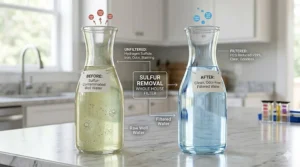
Sulfur Removal vs Traditional Water Softeners: Understanding the Difference
One of the biggest misconceptions I encounter is homeowners thinking their water softener will eliminate sulfur smell. It won’t. Here’s why these are fundamentally different systems solving different problems.
Water Softeners Remove Hardness (Calcium & Magnesium)
- Work through ion exchange, swapping calcium/magnesium for sodium
- Address scale buildup in pipes and appliances
- Require salt regeneration (ongoing cost ~$50-$100/year)
- Have zero effect on hydrogen sulfide gas
Sulfur Filters Remove Dissolved Gases (H2S)
- Use oxidation to convert dissolved gas into filterable solid sulfur
- Address odor, taste, and corrosion issues
- Chemical-free air injection systems have no ongoing consumable costs
- Don’t reduce water hardness at all
The Bottom Line: If you have both hard water AND sulfur, you need both systems. The good news: many manufacturers (SpringWell, SoftPro, iSpring) offer combination packages that save $300-$500 versus buying separately. Install sequence matters too—sulfur filter first, then water softener. Reversed installation can damage softener resin with oxidized sulfur particles.
What to Look For: Features That Actually Matter vs. Marketing Fluff
After testing and researching dozens of systems, here’s what separates genuinely useful features from marketing gimmicks:
Features Worth Paying Extra For
Digital Metered Control Valves
- Meters track actual water usage, not just time elapsed
- Prevents unnecessary backwashing when you’re on vacation (saves water and wear)
- Value: ~$100-$150 premium over mechanical timers, easily recovered in 2-3 years
NSF/WQA Third-Party Certification
- Means components actually meet claimed specifications
- Uncertified systems might work initially but fail prematurely
- Value: Priceless for peace of mind, minimal cost increase
Lifetime Technical Support
- Systems need adjustment over time as water quality changes
- Manufacturers who stand behind products long-term typically build better products
- Value: One phone call can save $500+ service call from plumber who doesn’t know your system
Features That Sound Great But Rarely Matter
Bluetooth Apps for Basic Systems
- Useful for travelers and tech enthusiasts, overkill for most homeowners
- If you’re home daily, physically checking the system takes 30 seconds
- Premium: $300-$500 for feature you’ll check weekly at most
Extended Warranties Beyond 5 Years on Components
- Digital valves typically last 7-15 years; failures past year 5 are rare
- “Lifetime warranty on tank” is standard—tanks almost never fail
- Reality check: Manufacturer going out of business voids any warranty
Ultra-High Flow Rates (15+ GPM) for Average Homes
- A 4-bedroom, 3-bath house peaks at 12 GPM during absolute maximum usage
- Oversizing costs $200-$400 extra and provides zero benefit
- Better investment: properly sizing system to actual needs
The smart approach: focus on filtration capacity (PPM removal), media quality, and valve reliability. Those fundamentals determine whether your water will be clean in year 5, while app connectivity determines whether you can check status from your phone.
Common Mistakes When Buying Sulfur Filters (Don’t Do These)
Mistake #1: Buying Based on Price Alone
I’ve seen homeowners grab the $400 “sulfur filter” on Amazon, install it, and watch performance decline within two months because it was sized for 2 ppm while their water tests at 8 ppm. Spending $300 less upfront becomes $1,200 more when you have to buy the right system later plus pay for second installation.
Fix: Test your water first ($40-$60 at any certified lab). Buy a system rated for 1.5-2x your actual contamination levels for longevity.
Mistake #2: Ignoring Your Well Pump’s Flow Rate
Air injection systems require 8-12 GPM flow rates during backwash cycles. If your well only delivers 5 GPM, the system can’t regenerate properly—media stays contaminated, performance crashes.
Fix: Check your well pump specifications before buying any filter. If flow rate is inadequate, you’ll need a pump upgrade ($800-$1,500) factored into total project cost.
Mistake #3: DIY Installation Without Understanding Drain Requirements
Backwash cycles dump 50-100 gallons of contaminated water down the drain line. Undersized drain lines (1/2″ instead of 3/4″) create backpressure, incomplete regeneration, and premature system failure.
Fix: Follow manufacturer drain line specifications exactly. If running new drain line requires professional plumbing, factor that $200-$400 into your budget.
Mistake #4: Expecting One System to Solve Everything
Sulfur filters remove hydrogen sulfide. They don’t address bacteria, viruses, arsenic, nitrates, or most other contaminants. Testing your water and discovering multiple issues means multiple treatment stages.
Fix: Understand the sequence—sediment filter, sulfur/iron filter, water softener, then UV or RO for final treatment. Each addresses specific problems that others can’t.
Long-Term Costs: What Nobody Tells You at Purchase Time
The sticker price is just your entry fee—here’s what you’ll actually spend over 10 years:
Budget System (Durawater ~$900)
Year 1-5:
- Media replacement: $250-$350 (years 3-5)
- Control valve service: $75-$125 (if needed)
- Electricity: ~$15-$25/year
- 5-Year Total: ~$1,300-$1,500
Year 6-10:
- Second media replacement: $250-$350
- Valve rebuild: $150-$200
- Electricity: $15-$25/year
- 10-Year Total: ~$2,000-$2,300
Premium System (SpringWell WS1 ~$2,200)
Year 1-5:
- Media replacement: $0 (greensand lasts 7-10 years)
- Control valve service: Covered by warranty
- Electricity: ~$18-$30/year
- 5-Year Total: ~$2,300-$2,400
Year 6-10:
- Media replacement: $400-$500 (year 8-9)
- Valve service: Minimal ($50-$75 for seals if needed)
- Electricity: $18-$30/year
- 10-Year Total: ~$2,900-$3,100
The Math: While premium systems cost double upfront, the 10-year ownership gap narrows to just $600-$800 thanks to longer media life and better warranty coverage. That $60-$80 per year difference buys you smartphone monitoring, lifetime technical support, and significantly less hassle.
Frequently Asked Questions
❓How long does it take for a sulfur removal whole house filter to eliminate the smell completely?
❓ Can I install a sulfur filter myself, or do I need a professional plumber?
❓ Will a hydrogen sulfide water filter also remove iron and manganese?
❓ How often do I need to replace the filter media in a sulfur removal system?
❓ What's the difference between chemical injection and air injection sulfur filters?
Conclusion: Your Next Steps to Clean, Odor-Free Water
If you’ve made it this far, you’re already ahead of the 80% of homeowners who buy filtration systems based on price tags and Amazon reviews alone. The right sulfur removal whole house filter isn’t about finding the cheapest option—it’s about matching your specific water chemistry, contamination levels, and household needs to the system engineered for exactly that scenario.
For moderate sulfur problems on a budget, the Durawater Fleck 5600 SXT delivers reliable performance without breaking the bank. Severe contamination demands the SoftPro Iron Master’s extreme removal capacity—anything less is just postponing your inevitable system upgrade. Tech-minded homeowners will appreciate SpringWell WS1’s smartphone monitoring, while the maintenance-averse crowd should seriously consider the iSpring WCFM500K’s 10-year media life.
Whatever system you choose, remember that installation quality matters as much as equipment quality. Undersized drain lines, inadequate backwash flow rates, and improper initial programming cause more failures than defective components. Take the time to test your water, verify your well pump capacity, and either follow installation instructions meticulously or hire a pro who specializes in well water treatment—not just general plumbers.
The difference between water you avoid drinking and water you actually enjoy comes down to making informed decisions based on your specific situation, not marketing promises. Test, research, size properly, install correctly, and monitor consistently. Follow that formula, and you’ll be enjoying sulfur-free water for the next decade while your neighbors are still buying bottled water to avoid the smell.
Recommended for You
- 7 Best Whole House Filter for Well Water 2026
- 7 Best Whole House Filter for City Water – 2026
- 7 Best Whole House Water Filter Reviews 2026
Disclaimer: This article contains affiliate links. As an Amazon Associate, I earn from qualifying purchases. If you purchase products through these links, we may earn a small commission at no additional cost to you.
✨ Found this helpful? Share it with your friends! 💬🤗
