
In This Article
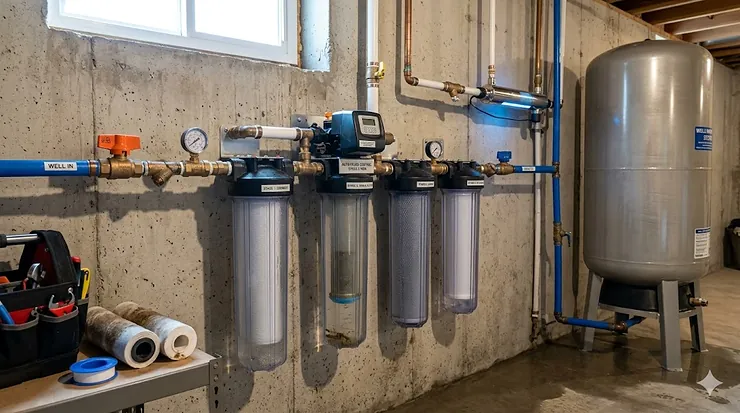
If you’ve ever noticed orange stains circling your toilet bowl or caught a whiff of that unmistakable rotten-egg smell when turning on the tap, you already know well water presents challenges municipal systems don’t face. Unlike treated city water that arrives pre-filtered at your doorstep, private well water pulls directly from groundwater — bringing iron, manganese, sulfur, sediment, and sometimes bacteria along for the ride.
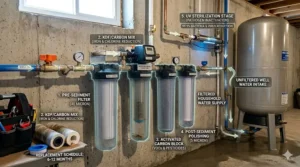
The real issue isn’t just aesthetics. Iron and manganese can be removed through aeration and conventional filtration treatments, but without proper whole-house filtration, these contaminants damage water heaters, stain fixtures, clog pipes, and leave your family bathing in water that hasn’t been vetted by any municipal treatment plant. The EPA’s secondary standard recommends keeping iron below 0.3 mg/L and manganese below 0.05 mg/L to prevent aesthetic issues like staining and metallic taste.
This guide breaks down the seven best whole house filter for well water systems available in 2026 — from budget-friendly cartridge filters to premium air-injection oxidation setups. What most buyers overlook is that not all well water problems are created equal. A system designed to crush iron won’t touch bacteria, and a sediment filter alone won’t eliminate that sulfur stench. The key is matching your specific contaminant profile to the right filtration technology, and that’s exactly what we’re here to help you figure out.
Quick Comparison: Top 7 Whole House Filters for Well Water
| Product | Best For | Removes | Flow Rate | Price Range |
|---|---|---|---|---|
| SpringWell WS1 | High iron/sulfur | Iron (7 PPM), Sulfur (8 PPM), Manganese (1 PPM) | 12 GPM | $2,000-$2,500 |
| iSpring WGB32BM | Budget iron filtration | Iron (3 PPM), Manganese (1 PPM), Sediment | 15 GPM | $400-$550 |
| Aquasana EQ-WELL-UV-PRO-AST | Bacteria concerns | Bacteria, Viruses, Iron, Sediment | 7 GPM | $2,200-$2,500 |
| Express Water 3-Stage | General contaminants | Heavy metals, Chlorine, Sediment | 15 GPM | $300-$450 |
| Home Master HMF3SDGFEC | Balanced performance | Iron (3 PPM), Sediment, Chemicals | 15 GPM | $550-$750 |
| Waterdrop WD-WHF21-FG | Entry-level iron removal | Iron (96.4%), Manganese (98.2%) | 15 GPM | $150-$280 |
| PUREPLUS 3-Stage 20″ | Heavy sediment + iron | Iron, Manganese, Sediment | 12 GPM | $200-$350 |
Looking at this comparison, the divide becomes clear: homeowners facing extreme iron and sulfur contamination need the oxidation power of the SpringWell WS1, while those dealing with moderate contamination paired with bacteria concerns will find the Aquasana EQ-WELL-UV-PRO-AST‘s UV sterilization stage worth the investment. Budget-conscious buyers with manageable iron levels under 3 PPM should lean toward the iSpring WGB32BM or Waterdrop WD-WHF21-FG, both of which handle typical well water issues without the premium price tag.
The real differentiator isn’t just removal capacity — it’s ongoing cost. Tank-based systems like SpringWell use self-regenerating media that lasts 10-20 years with minimal maintenance, while cartridge-based options require filter swaps every 6-12 months at around $40-$120 per replacement set. That annual cost difference compounds over a decade of ownership.
💬 Just one click — help others make better buying decisions too! 😊
Top 7 Whole House Filter for Well Water: Expert Analysis
1. SpringWell WS1 — Best Overall for High Iron and Sulfur
The SpringWell WS1 uses air injection oxidation (AIO), which is a fancy way of saying it creates an oxygen-rich environment inside the tank that transforms dissolved iron, manganese, and hydrogen sulfide into solid particles before trapping them in greensand media. This chemical-free process handles up to 7 PPM iron, 8 PPM hydrogen sulfide, and 1 PPM manganese — significantly higher concentrations than cartridge-based competitors can touch.
What stands out in real-world use is the Bluetooth control head that lets you monitor backwash cycles from your phone. The system automatically flushes accumulated contaminants down a drain every night (typically set for 2-3 AM when water usage is zero), refreshing the air pocket and greensand bed without any hands-on intervention. For well owners tired of manually regenerating filters or dealing with chemical additives, this set-and-forget automation is worth the upfront investment.
Customer feedback consistently praises the immediate elimination of sulfur odor and iron staining, though some users report flow rate drops from the advertised 12 GPM to closer to 4-5 GPM during simultaneous high-demand scenarios like running two showers plus the dishwasher. This pressure limitation is something to verify against your well pump’s output PSI before purchasing — SpringWell recommends at least 40 PSI inlet pressure for optimal performance.
✅ Pros:
- Handles severe iron/sulfur contamination (up to 7 PPM iron, 8 PPM sulfur)
- Chemical-free air injection process
- Self-cleaning with automatic backwash cycles
❌ Cons:
- Premium pricing (around $2,200-$2,500)
- Potential flow rate reduction under high demand
Price Range: Around $2,000-$2,500 | Who This Is For: Well owners with confirmed high iron (above 3 PPM) or sulfur contamination who want a low-maintenance, long-term solution and can accommodate a 50-60″ wide dual-tank setup in their utility space.
2. iSpring WGB32BM — Best Budget Option for Moderate Iron
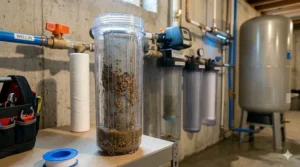
The iSpring WGB32BM takes a different approach with its three-stage cartridge design: a 5-micron sediment pre-filter, coconut shell carbon block, and the specialized FM25B catalytic iron/manganese filter. That third stage is what separates this from standard whole-house filters — it uses catalytic media that lasts up to three times longer than traditional greensand because the media itself isn’t consumed during the oxidation process.
The practical advantage here is cost management. Each complete filter set (all three cartridges) runs in the $80-$120 range and handles approximately 100,000 gallons or 12 months of use for an average family of four. That annual replacement cost is substantially lower than many competitors, and the DIY-friendly design means you won’t be calling a plumber for routine maintenance. The clear first-stage housing lets you visually monitor sediment buildup, so you know exactly when replacement time approaches.
Users dealing with iron levels up to 3 PPM consistently report effective stain elimination and taste improvement, though anything above that threshold will shorten filter life dramatically. One frequently mentioned limitation: this system won’t soften water or address hardness — for that, you’d need to pair it with a separate softener upstream.
✅ Pros:
- Affordable entry point (around $400-$550)
- Catalytic media lasts 3x longer than greensand
- 15 GPM flow rate with minimal pressure drop
❌ Cons:
- Limited to 3 PPM iron maximum
- Requires filter replacement every 6-12 months
Price Range: Around $400-$550 | Who This Is For: Homeowners with moderate iron and manganese contamination (under 3 PPM) who prefer a cartridge-based system with lower upfront costs and are comfortable with biannual filter changes.
3. Aquasana EQ-WELL-UV-PRO-AST — Best for Bacteria and Comprehensive Protection
The Aquasana EQ-WELL-UV-PRO-AST combines carbon and KDF filtration media with UV purification and salt-free scale control in a four-component system. The standout feature is the Sterilight UV filter that addresses the one contaminant category most well water systems ignore: microbiological threats. UV light at 254 nanometers disrupts the DNA of bacteria, viruses, and cysts, providing up to 99.99% reduction without adding chemicals to your water.
This multi-stage approach handles 500,000 gallons or five years before the main tank media needs replacement, making it one of the longest-lasting options reviewed. The salt-free conditioner uses Template Assisted Crystallization (TAC) to prevent scale buildup on pipes and fixtures without removing beneficial minerals — a crucial distinction for those who want to avoid the slippery feel and sodium addition of traditional water softeners.
The tradeoff for this comprehensive protection is a relatively modest 7 GPM flow rate, which can be limiting for larger homes with 4+ bathrooms or frequent simultaneous water use. Installation also requires more space (59-69 inches wide depending on configuration) and an electrical outlet for the UV lamp, which needs replacement every 12 months at around $80-$100.
✅ Pros:
- UV sterilization kills bacteria and viruses
- 500,000-gallon / 5-year tank capacity
- Salt-free scale control included
❌ Cons:
- Limited 7 GPM flow rate
- Requires annual UV lamp replacement
Price Range: Around $2,200-$2,500 | Who This Is For: Well owners with confirmed or suspected bacterial contamination, those in flood-prone areas where surface water intrusion is a risk, or anyone who wants the most comprehensive multi-contaminant protection available.
4. Express Water 3-Stage Heavy Metal — Best for General Well Water Contaminants
The Express Water 3-Stage system targets a broader range of heavy metals beyond just iron and manganese — including lead, mercury, arsenic, chromium, and cadmium — through its KDF (Kinetic Degradation Fluxion) second-stage filter. KDF uses a copper-zinc alloy that triggers a redox (oxidation-reduction) reaction to neutralize metals and control bacteria growth in the filter media itself.
The free-standing stainless steel frame with three pressure gauges makes this one of the easiest systems to monitor and maintain. Those gauges show inlet, mid-stage, and outlet pressure, allowing you to pinpoint exactly which filter is clogging and needs replacement rather than guessing. The clear first-stage housing adds visual confirmation of sediment buildup.
Where this system excels is versatility — it handles chlorine, chloramine, PFAS, and various organic contaminants that many well-specific systems don’t prioritize. That makes it a solid choice for wells near agricultural areas where pesticides and herbicides might be present alongside traditional iron and sulfur. The 15 GPM flow rate and minimal pressure drop (around 1-2 PSI) preserve water pressure throughout even large homes.
✅ Pros:
- Broad contaminant removal (heavy metals, PFAS, chloramine)
- Three pressure gauges for easy monitoring
- Stainless steel frame with clear housing
❌ Cons:
- Filters require replacement every 6-12 months
- Not specialized for extreme iron/sulfur
Price Range: Around $300-$450 | Who This Is For: Well owners concerned about agricultural runoff, those who’ve tested positive for multiple heavy metals, or homeowners who want a general-purpose system that addresses more than just iron and sediment.
5. Home Master HMF3SDGFEC — Best Balanced Performance for Multiple Contaminants
The Home Master HMF3SDGFEC uses radial flow technology in its second and third stages, which directs water through the filter media from the outside in rather than straight through. This increases contact time with the iron-reducing and carbon filtration media, leading to more thorough treatment at higher flow rates. The four-layer sediment filter in the first stage captures particles from 25 microns down to 1 micron nominal, holding three times more dirt than standard pleated filters.
What separates Home Master from competitors is their customer support philosophy — they require you to submit your well water test report before purchase and will consult (via phone, chat, or email) to confirm this system matches your specific contaminant profile. That screening process prevents the frustration of buying a filter that wasn’t designed for your water chemistry, particularly important for wells with iron bacteria or acidic water below 7 pH (both of which this system doesn’t address).
The heavy-gauge steel mounting bracket is engineered to reduce flex and stress on the filter housing connections, a detail that might seem minor until you’ve dealt with slow leaks from vibration damage in cheaper systems. Filter replacement is genuinely annual for most families of four, making maintenance planning straightforward.
✅ Pros:
- Radial flow increases contact time with media
- Four-layer sediment filtration (25 to 1 micron)
- Pre-purchase consultation confirms compatibility
❌ Cons:
- Not suitable for iron bacteria or acidic water
- Moderate price point
Price Range: Around $550-$750 | Who This Is For: Well owners dealing with iron, manganese, and hydrogen sulfide in the 3 PPM combined range who value expert guidance and want a cartridge system that balances filtration power with annual (rather than biannual) filter changes.
6. Waterdrop WD-WHF21-FG — Best Entry-Level Iron and Manganese Removal
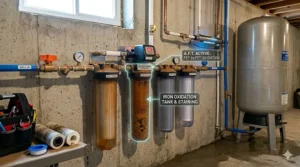
The Waterdrop WD-WHF21-FG delivers impressive reduction rates — 96.4% iron, 98.2% manganese, and 95.6% chlorine according to third-party testing — at roughly half the price of premium competitors. The two-stage design combines an iron/manganese reducing filter with natural coconut shell GAC (granular activated carbon), providing five layers of filtration within those two cartridges through embedded PP cotton and carbon granules.
The compact 10″ x 4.5″ filter size makes this one of the easiest systems to retrofit into existing plumbing without major modifications. Installation takes about 30-60 minutes for someone comfortable with basic plumbing, and the included wrench and red pressure relief valve simplify filter replacement. The system passed 300 PSI pressure tests and 100,000 water hammer tests, giving it durability credentials that budget options often lack.
The limitation here is capacity and lifespan — filters last 6 months or around 30,000-40,000 gallons, meaning more frequent replacements than higher-capacity systems. Users report this works exceptionally well for iron levels in the 1-3 PPM range but struggles with anything approaching the maximum rated capacity.
✅ Pros:
- Affordable price point (around $150-$280)
- Compact design fits tight spaces
- NSF/ANSI 372 certified lead-free materials
❌ Cons:
- Shorter 6-month filter lifespan
- Not ideal for extreme contamination
Price Range: Around $150-$280 | Who This Is For: First-time well owners or renters who need an effective iron/manganese solution without a major investment, those with space constraints in their utility area, or homeowners testing the waters before upgrading to a premium system.
7. PUREPLUS 3-Stage 20″ — Best for Heavy Sediment Plus Iron
The PUREPLUS 3-Stage 20″ uses larger 20″ x 4.5″ cartridges (versus the more common 10″ size) to increase dirt-holding capacity and extend time between filter changes. The first-stage pleated sediment filter captures particles down to 5 microns, the second stage employs granular activated carbon to remove chlorine and organic compounds, and the third stage contains specialized iron/manganese reducing media rated to drop iron from 3.0 PPM to 0.01 PPM.
This system particularly shines in high-sediment environments — think wells near construction sites, sandy soil regions, or areas with aging well casings that allow particulate infiltration. The oversized filters mean you’re replacing cartridges closer to 9-12 months rather than every 6 months, and the heavy-duty steel frame mounting system can handle the extra weight without sagging or stressing connection points.
Customer reviews from well owners in rural areas frequently mention the elimination of both visible sediment and iron staining within days of installation. The clear first-stage housing provides instant visual feedback on sediment load, though that transparency also means the housing can develop algae growth if installed in direct sunlight — something to plan for during placement.
✅ Pros:
- Larger 20″ cartridges for extended capacity
- Handles heavy sediment + iron simultaneously
- Steel frame construction for durability
❌ Cons:
- Replacement cartridges cost more ($80-$120 per set)
- Larger footprint requires more space
Price Range: Around $200-$350 | Who This Is For: Well owners in high-sediment areas, those with older well systems prone to particulate infiltration, or homeowners who want to minimize filter change frequency through increased capacity rather than premium filtration technology.
Practical Usage Guide: Installing and Maintaining Your Well Water Filter
Installing a whole house filter for well water isn’t as intimidating as the plumbing supply aisle might suggest, but there are critical steps that determine whether your system operates at peak efficiency or becomes a source of ongoing frustration.
Location Matters More Than You Think
Install your filtration system after the pressure tank but before any branching to fixtures or appliances. This “point of entry” placement ensures every drop of water in your home passes through filtration, including water to your hot water heater (which will thank you by not accumulating sediment). The area needs to be level, protected from freezing temperatures, and have adequate drainage for backwash discharge if you’re installing a regenerating system like the SpringWell.
For air injection oxidation systems, the drain line is non-negotiable — these units flush 10-15 gallons of contaminated water during each backwash cycle, and that needs somewhere to go. A floor drain is ideal, but a utility sink or sump pump discharge works if you’ve got the vertical clearance. Cartridge-based systems don’t require drainage, but you’ll want at least 18-24 inches of clearance below the housings for filter changes.
The First 48 Hours: What to Expect
Don’t panic when your water runs cloudy or slightly discolored during the first few flush cycles — that’s carbon fines from new filters or media settling in the tank, not a sign something’s wrong. Run cold water taps for 5-10 minutes to clear the system, and avoid using hot water until the initial flush is complete (you don’t want carbon dust settling in your water heater).
For iron removal systems, you might notice staining actually worsen temporarily as oxidized iron that was sitting in your pipes gets pushed through. This clears within 3-5 days as the system cycles through your household plumbing. If you’re switching from untreated well water, plan to clean toilets and fixtures once after the first week to remove any loosened existing stains.
Maintenance That Actually Matters
Sediment pre-filters take the brunt of the abuse and typically need changing every 3-6 months depending on your particulate load. If you notice pressure drops before the scheduled interval, swap them early — a clogged sediment filter forces water to bypass or restricts flow to the entire system. Set a phone reminder rather than relying on memory; filter replacements are cheaper than appliance repairs from contaminated water.
For tank-based systems, verify the backwash cycle is running (you should hear it at the scheduled time, usually 2-3 AM). If backwashing isn’t occurring, check that the drain line isn’t kinked and the power connection is secure. Most automatic systems have a manual backwash button for forcing a cycle if needed — run one every 2-3 months even if the automatic schedule is working to ensure the system stays fresh.
UV lamps require annual replacement regardless of whether they appear to be working — their effectiveness degrades over time even though the light remains visible. Mark the replacement date on your calendar when you install a new lamp, as forgetting this maintenance point defeats the entire purpose of having UV purification.
Real-World Scenario Guide: Matching Your Water Problems to the Right System
The Stainer — Iron Between 1-4 PPM with Minimal Other Issues
Your symptoms: orange-brown rings in toilets, rust-colored laundry spots, slight metallic taste. Water test shows iron at 2.5 PPM, manganese at 0.3 PPM, no sulfur odor, no bacterial contamination. You’re looking at the iSpring WGB32BM or Waterdrop WD-WHF21-FG territory. These cartridge systems excel at moderate iron removal without the cost and complexity of air injection. The iSpring offers better long-term value if you’ve got the budget ($400-$550), while the Waterdrop ($150-$280) is the smart entry point if you’re testing whether filtration solves your problem.
The Sulfur Sufferer — Rotten Egg Smell with High Iron
Your symptoms: hydrogen sulfide odor when running hot water, iron staining, possible black slime in toilet tanks. Test results: 5 PPM iron, 6 PPM hydrogen sulfide, 0.8 PPM manganese. This is SpringWell WS1 territory. Cartridge filters can’t handle this level of sulfur — you need the oxidation power of air injection. The $2,200-$2,500 investment eliminates the smell completely within days and removes iron concentrations that would clog standard filters monthly. For wells this contaminated, there’s no effective budget alternative that won’t become a money pit through constant filter replacement.
The Bacteria Worrier — Shallow Well or Post-Flood Concerns
Your symptoms: well is less than 50 feet deep, located downslope from livestock or septic, or you’ve recently experienced flooding. Coliform bacteria test came back positive or you want prevention even if current tests are clean. You need the Aquasana EQ-WELL-UV-PRO-AST. Iron filters can’t kill bacteria — they just trap them until the filter becomes a breeding ground. UV purification is the only whole-house method that addresses biological contamination without adding chlorine, and this system combines it with iron/sediment removal and scale control.
The Multi-Contaminant Challenge — Agricultural Area with Various Pollutants
Your symptoms: well located within 2 miles of farms using pesticides or herbicides, possible PFAS contamination from industrial runoff, iron and sediment present but not extreme. The Express Water 3-Stage or Home Master HMF3SDGFEC makes sense here. The Express Water’s KDF stage targets heavy metals beyond just iron, including lead and arsenic, while the carbon filtration addresses organic chemicals. Home Master’s radial flow design provides better contact time for removing chemical contaminants that pass through standard filters.
How to Choose a Whole House Filter for Well Water: Decision Framework
Start by testing your water — and not with a free kit from a filter company that happens to sell exactly what your “test results” require. Use an independent certified lab or state extension office. You need actual PPM numbers for iron, manganese, hydrogen sulfide, hardness, pH, and total coliform. The CDC recommends testing well water at least once annually for total coliform bacteria, nitrates, total dissolved solids, and pH levels. Everything else is guesswork.
If your test shows:
Iron 1-3 PPM, no sulfur: Cartridge systems (iSpring, Waterdrop, PUREPLUS) handle this easily. Choose based on budget and desired filter change interval. Higher upfront cost = longer time between replacements.
Iron 3-7 PPM OR any hydrogen sulfide: Air injection oxidation (SpringWell) is the only practical solution. Trying to handle this with cartridges means changing filters monthly and spending more annually than the SpringWell costs upfront.
Bacteria or viruses present: UV sterilization (Aquasana EQ-WELL-UV-PRO-AST) is non-negotiable. You can add UV to other systems, but this comes with it integrated. Don’t skip this for biological contamination.
Heavy sediment plus iron: Large-cartridge systems (PUREPLUS 20″) extend replacement intervals. Standard 10″ filters clog too quickly in high-sediment environments.
Multiple heavy metals beyond iron: KDF filtration (Express Water) or activated alumina removes lead, arsenic, mercury. Standard iron filters won’t touch these.
Hardness over 7 GPG: Add a softener. No filter removes hardness effectively — you need ion exchange. Salt-free conditioners prevent scale but don’t soften water.
Flow rate requirements: Count bathrooms and simultaneous usage patterns. Smaller homes (1-2 baths) can work with 7 GPM systems, but 3+ bathrooms need 12-15 GPM minimum to avoid pressure drops during peak demand like morning shower rush.
Common Mistakes When Buying a Whole House Filter for Well Water
Mistake #1: Buying Based on Brand Recognition Instead of Contaminant Match
Having a “good brand” means nothing if it’s the wrong technology. A top-rated municipal water filter won’t address well water iron, and the most expensive system available might not remove the specific contaminants in your water. Brand reputation matters for reliability, but only after confirming the filtration method matches your needs.
Mistake #2: Undersizing Flow Rate for Your Home
A 7 GPM system works fine until three people shower simultaneously while the dishwasher runs — then everyone’s complaining about weak water pressure. Map your absolute worst-case scenario (all bathrooms in use, laundry running, someone filling a tub) and size for that. It’s better to have excess capacity than to discover your filter creates a bottleneck during peak demand.
Mistake #3: Ignoring Total Cost of Ownership
A $200 system that needs $120 in filters every six months costs $1,640 over five years. A $2,200 system with $40 annual maintenance costs $2,400 over the same period — a difference of $760, not $2,000. Factor replacement costs and frequency into your decision, not just the checkout price.
Mistake #4: Installing Before the Pressure Tank
This creates two problems: the filter sees incoming pressure surges every time the pump kicks on (accelerating wear), and if the pump cycles frequently due to leaks, you’re wasting filtered water. The pressure tank should buffer pump cycles before water reaches your filtration system.
Mistake #5: Skipping Professional Installation for Complex Systems
Cartridge systems are generally DIY-friendly, but air injection oxidation, UV purification, and whole-home softening systems involve electrical connections, drain lines, and precise pressure requirements. Unless you’re experienced with plumbing and electrical work, the $300-$500 for professional installation is cheaper than fixing what goes wrong during an amateur attempt.
What to Expect: Real-World Performance Beyond the Spec Sheet
The Iron Learning Curve
Even the best whole house filter for well water won’t make iron stains disappear from existing fixtures overnight. The filter stops new staining, but what’s already bonded to porcelain needs manual cleaning. Expect to scrub toilets, tubs, and sinks once about two weeks after installation to remove old staining, then you’ll notice no new stains form. Laundry takes longer — plan on 3-4 wash cycles before the rust-colored residue is completely flushed from your washing machine.
Sulfur Smell Elimination Isn’t Always Instant
Hydrogen sulfide dissolves into hot water more readily than cold, so even after installing an air injection system, you might smell sulfur from your water heater for several days as it cycles through the existing contaminated water. Some users drain their water heater immediately after installation to accelerate this process, though it’s not necessary — just be patient and let the system work through your household plumbing.
Pressure Changes Are Subtle but Real
No filter improves water pressure, they all add some restriction. High-quality systems minimize this (typically 1-3 PSI drop), but you might notice the shower isn’t quite as forceful immediately after installation. Your perception usually adjusts within a week, and if the pressure drop is severe enough to be problematic, it indicates undersizing or a clogged pre-filter that needs immediate replacement.
Seasonal Variations in Filter Life
Spring runoff and heavy rain periods introduce more sediment into wells, shortening filter life during these months. You might get 8 months from a filter during winter when the ground is frozen solid, but only 4 months during spring thaw. This is normal — adjust your replacement schedule based on actual pressure drop rather than blindly following the manufacturer’s timeline.
Long-Term Cost and Maintenance Reality Check
The 10-Year Ownership Cost Breakdown
Let’s run real numbers on total cost of ownership for three common scenarios:
Budget Cartridge System (iSpring WGB32BM):
- Initial cost: $500
- Annual filter replacement (2x per year): $200
- 10-year total: $2,500
Premium Cartridge System (Home Master HMF3SDGFEC):
- Initial cost: $700
- Annual filter replacement (1x per year): $100
- 10-year total: $1,700
Air Injection Oxidation (SpringWell WS1):
- Initial cost: $2,200
- Annual sediment pre-filter: $40
- 10-year total: $2,600
The surprising finding: the premium cartridge system with annual (rather than biannual) filter changes costs less over a decade than either the budget option or the air injection system. However, this calculation assumes your water chemistry remains stable — if iron levels increase beyond 3 PPM, the cartridge systems won’t function at all, while the SpringWell continues operating up to 7 PPM.
Hidden Costs Most Calculators Miss
Water heater longevity improves dramatically with filtered water — the typical 8-12 year lifespan extends to 15-20 years when sediment and mineral buildup are eliminated. That’s a $1,200-$2,000 replacement cost deferred for a decade. Appliances like dishwashers and washing machines similarly last longer, though the savings are harder to quantify precisely.
Energy costs drop when your water heater isn’t fighting through sediment accumulation to heat water — some utilities estimate a 10-15% reduction in heating costs for homes that filter well water. For a household spending $100 monthly on water heating, that’s $120-$180 annually or $1,200-$1,800 over ten years.
Maintenance Time Investment
Cartridge changes take 15-30 minutes including cleanup, required 1-2 times yearly depending on the system. Tank-based systems need annual inspections (checking backwash operation, verifying drain flow, testing pressure) that take about 20 minutes. Factor this into the “cost” if your time has value — a professional annual service call runs $75-$150 in most markets.
Features That Actually Matter (And Those That Don’t)
Must-Have Features for Well Water Systems
Pressure gauges tell you when filters are clogging before water pressure becomes noticeably weak. Inlet and outlet gauges let you pinpoint which stage is causing restriction. This feature saves money by preventing premature filter changes (replacing based on calendar rather than actual condition) and catching problems early.
Clear first-stage housing provides visual confirmation of sediment load. Seeing the brown/orange accumulation gives you confidence the filter is working and alerts you when replacement is due. Opaque housings require guessing based on pressure drop, which can lead to running clogged filters too long and damaging downstream stages.
Bypass valve is essential for maintenance and emergencies. If a filter housing cracks or you need to replace media while waiting for parts, the bypass lets you continue using unfiltered water temporarily rather than having zero water supply. This seems obvious until you’re in the situation without it.
Overhyped Features That Add Cost Without Value
Digital displays and WiFi connectivity rarely justify their cost for simple filtration systems. Knowing your water usage in real-time or getting app notifications about filter status sounds useful until you realize manual pressure gauge checks work just as well and never require troubleshooting a connectivity issue.
Pre-filter spin-down sediment traps are marketed as extending main filter life, but for moderate sediment loads, they’re redundant with the first-stage filter. They make sense for extremely high sediment (construction zone wells, deteriorating well casings), but average well owners pay for complexity that doesn’t improve results.
Multiple micron ratings in sediment filters (50-micron, 20-micron, 5-micron progression) seem thorough but accomplish little more than a single 5-micron pleated filter with graded density. The multi-stage sediment approach is more marketing than engineering for typical well water scenarios.
Safety and Regulatory Considerations for Well Water Filtration
NSF Certification: What It Really Means
You’ll see NSF/ANSI Standard 42 (aesthetic effects like chlorine, taste, odor), Standard 53 (health effects like cysts and heavy metals), and Standard 61 (material safety — the product won’t leach contaminants). These certifications matter because they’re third-party verified, not just manufacturer claims.
However, “NSF certified components” is different from “NSF certified system.” A filter housing might use NSF-certified parts but the complete assembled unit hasn’t been tested. Look for whole-system certification when possible, particularly for systems making health-related claims about bacteria, lead, or cyst removal.
The EPA’s Safe Drinking Water Act doesn’t regulate private wells — it’s the homeowner’s responsibility to ensure water safety. Your state might require periodic testing or have guidelines, but federal law doesn’t mandate well water treatment standards the way municipal systems are regulated.
When Filtration Isn’t Enough
Filters can’t solve every well problem. High arsenic requires reverse osmosis or specialized media like activated alumina. Nitrates (common near agricultural areas) need ion exchange or RO. Bacteria and viruses require UV or chlorination. If your water test shows these contaminants, don’t expect a standard iron filter to address them — you need targeted treatment methods.
Testing Frequency After Installing Filtration
Retest your water annually even with a filter in place. Well chemistry changes over time due to seasonal variations, drought conditions, nearby land use changes, or natural aquifer shifts. An annual test ($50-$150 depending on what you’re testing for) confirms your system is still removing what you initially installed it to address.
Frequently Asked Questions
❓ Can a whole house filter for well water remove hardness?
❓ How often should I replace filters in a well water filtration system?
❓ Will a whole house filter reduce water pressure throughout my home?
❓ Can I install a whole house well water filter myself or need professional help?
❓ Do whole house filters for well water remove bacteria and viruses?
Conclusion: Finding Your Perfect Well Water Solution
The difference between well water you tolerate and well water you trust comes down to matching filtration technology to your specific contamination profile, not buying the most expensive system or the one with the best Amazon reviews. Start with water testing, identify your primary contaminants, then work backward to the system designed to address those issues.
For severe iron and sulfur contamination above 3 PPM, the SpringWell WS1‘s air injection oxidation is the only technology that handles this consistently without becoming a filter-replacement money pit. Moderate contamination under 3 PPM works perfectly with cartridge systems like the iSpring WGB32BM or Waterdrop WD-WHF21-FG, where you’ll balance upfront cost against filter replacement frequency.
Bacterial concerns make UV purification essential, and the Aquasana EQ-WELL-UV-PRO-AST integrates this with iron removal and scale control in one package. For wells near agricultural areas dealing with pesticides and multiple heavy metals, the Express Water 3-Stage‘s KDF filtration provides broader contaminant coverage than iron-specific systems.
Remember that total cost of ownership matters more than purchase price — calculate 10-year costs including filter replacements and energy savings from protected appliances. The “cheapest” system often costs more over time than investing in the right solution upfront, and the “most expensive” system might not address your specific water chemistry at all.
Whatever system you choose, commit to the maintenance schedule. A $2,000 filter that doesn’t get serviced performs worse than a $300 filter that’s properly maintained. Set reminders for filter changes, monitor pressure gauges monthly, and retest your water annually. Well water quality changes over time, and staying ahead of those changes protects both your investment and your family’s health.
Recommended for You
- 7 Best Whole House Filter for City Water – 2026
- 7 Best Whole House Water Filter Reviews 2026
- 7 Best Water Softener and Filter Combo Systems 2026
Disclaimer: This article contains affiliate links. As an Amazon Associate, I earn from qualifying purchases. If you purchase products through these links, we may earn a small commission at no additional cost to you.
✨ Found this helpful? Share it with your friends! 💬🤗
