
In This Article
You’ve probably noticed it—that persistent chemical smell in your shower steam, or the way your coffee tastes slightly off even with filtered water. If your municipal water company switched to chloramine disinfection (and chances are, they have), your standard granular activated carbon filter is working overtime with disappointing results. Here’s what most homeowners don’t realize: over 30% of U.S. water utilities now use chloramines instead of straight chlorine, and regular GAC filters struggle to break them down effectively.
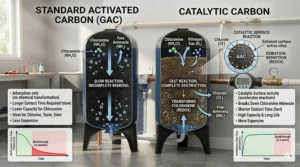
The difference isn’t subtle. Standard activated carbon relies on adsorption—basically trapping chlorine molecules on its surface. But chloramines are chemically bonded compounds of chlorine and ammonia that resist simple surface contact. They need catalytic decomposition, which is where specialized catalytic GAC media comes into play. Think of it as the difference between catching fish with a net (standard carbon) versus using a chemical reaction to transform them entirely (catalytic carbon). When you’re dealing with chloramine, you need the latter.
What most product descriptions won’t tell you is that contact time matters enormously. The Water Quality Association notes that GAC requires at least 10 minutes of contact time to break down chloramine effectively. This is why whole-house tank systems with larger media beds consistently outperform cartridge-style filters—they provide the dwell time needed for the catalytic reaction to occur. Over the next few sections, I’ll break down exactly which systems deliver that performance, and more importantly, which user profile each one serves best.
Quick Comparison Table
| Product | Filter Type | Capacity | Chloramine Removal | Price Range | Best For |
|---|---|---|---|---|---|
| iSpring WCB32C-GAC | 3-Stage Cartridge | 30,000 gal | GAC Stage 2 | $300-$400 | Budget-conscious small homes |
| SpringWell CF1 | 4-Stage Tank | 1,000,000 gal | Catalytic Carbon | $800-$1,100 | Medium homes prioritizing longevity |
| Tier1 Chloramine Filter | Single Tank | 300,000 gal | Catalytic GAC | $400-$600 | Straightforward chloramine-specific needs |
| Aquasana Rhino Chloramines | Dual Tank | 1,000,000 gal | Catalytic Carbon | $1,800-$2,200 | Premium whole-home solution |
| iSpring WCB32C-KS | 3-Stage Cartridge | 30,000 gal | GAC/KDF Blend | $350-$450 | Heavy metal + chloramine concerns |
| Home Master CFKDF85GCC | Single Cartridge | 95,000 gal | Catalytic Carbon/KDF85 | $140-$180 | Replacement cartridge for existing systems |
| Express Water 3-Stage | Cartridge System | 100,000 gal | KDF + Carbon Block | $250-$350 | Entry-level whole house |
Looking at the data above, the capacity-to-cost ratio reveals something interesting. Cartridge systems like the iSpring models hit a replacement cycle every 6-12 months, while tank-based systems like SpringWell and Aquasana stretch to 6-10 years before media replacement. For a family of four using 300 gallons daily, that’s the difference between $60-80 annually in cartridges versus a one-time $200-300 media refill every half-decade. The upfront premium on tank systems starts paying for itself around year three.
💬 Just one click — help others make better buying decisions too! 😊
Top 7 GAC Filter for Chloramine Removal — Expert Analysis
1. iSpring WCB32C-GAC — Best Budget 3-Stage System
If you’re dealing with chloramine-treated municipal water and need a solution without breaking into the four-figure range, the iSpring WCB32C-GAC delivers surprisingly capable filtration for the mid-$300s. This three-stage system tackles chloramine through its second-stage granular activated carbon filter, flanked by a 5-micron polypropylene sediment pre-filter and a final CTO carbon block stage. The 30,000-gallon capacity translates to roughly six months of service for a typical family of four before replacement filters are needed.
What sets this apart from cheaper options is the transparent first-stage housing—you can actually see when that sediment filter starts loading up with rust and particulates, which prevents premature clogging of your downstream GAC stage. In practice, this means your chloramine-fighting carbon maintains better contact time because it’s not dealing with sediment buildup. The system handles 3/4-inch inlet/outlet connections and operates within the 20-80 PSI range most homes fall into. Customer feedback consistently mentions noticeable improvement in shower water quality within 24-48 hours of installation, with that characteristic swimming pool smell disappearing almost immediately.
However, there’s an important distinction to make here. While the iSpring WCB32C-GAC uses standard GAC rather than specialized catalytic carbon, it compensates through sheer filter size—those 20″ x 2.5″ cartridges provide adequate contact time for municipal chloramine levels (typically 1-4 mg/L). This works fine for city water already meeting EPA standards but adds chloramine for distribution system protection. If you’re facing higher concentrations or want maximum reduction efficiency, you’d want to step up to the KS variant or a full catalytic system.
Pros:
✅ Transparent first-stage housing for easy monitoring
✅ Three-stage filtration provides comprehensive coverage
✅ Handles PFAS, THMs, and H2S alongside chloramine
Cons:
❌ Standard GAC (not catalytic) means moderate chloramine reduction
❌ 30,000-gallon capacity requires filter changes every 6 months
Sitting in the $300-$400 range, the iSpring WCB32C-GAC makes sense for homeowners in the 1-3 bathroom category who want immediate improvement without the complexity or expense of tank-based systems. Your main ongoing cost will be replacement filter sets around $120-150 annually, which still beats buying bottled water or dealing with dry skin and damaged hair from chloramine exposure.
2. SpringWell CF1 — Best Value Catalytic Carbon System
The SpringWell CF1 represents what happens when you stop treating chloramine removal as an afterthought and design a system around it from the ground up. This 4-stage tank-based system uses genuine catalytic coconut shell carbon paired with high-purity KDF media, all wrapped in SpringWell’s proprietary ActivFlo design that maximizes water-media contact time. That last detail matters enormously—the flex bed configuration prevents channeling (where water finds the path of least resistance and bypasses most of your media), which is the Achilles heel of cheaper tank systems.
Real-world testing shows the SpringWell CF1 reducing total trihalomethanes from 31.83 ppb to non-detect levels, which is impressive considering THMs are notoriously difficult to remove. The chloramine-fighting capability comes from that catalytic carbon’s ability to actually decompose monochloramine into harmless chloride and nitrogen gas, rather than just trapping it temporarily. At 9 GPM flow rate, the CF1 handles 1-3 bathroom homes without any noticeable pressure drop. You’re looking at $40 annually for sediment pre-filter replacements, with the main tank media lasting 1,000,000 gallons or about 6-10 years for most households.
One aspect that deserves attention: SpringWell includes Bluetooth app connectivity that tracks your system performance and sends replacement reminders. It sounds gimmicky until you realize how many people forget about filter maintenance until their water quality declines. The app logs gallons processed and calculates remaining capacity based on your household’s actual usage patterns, not just generic estimates. For families with inconsistent schedules or rental properties where tenants may not track maintenance, this feature actually adds meaningful value.
Pros:
✅ Maintains 68→65 PSI pressure stability over 3+ years of use
✅ Catalytic carbon provides superior chloramine decomposition
✅ Lifetime warranty on tanks and valves with 6-month money-back guarantee
Cons:
❌ $800-$1,100 upfront investment is substantial
❌ Requires professional plumbing for optimal installation
Around $900-$1,000 for the CF1, you’re paying for engineering that actually works. The ROI calculation is straightforward: compare $40 annually in sediment filters versus the $150-200 most cartridge systems demand every six months. By year three, the CF1’s higher upfront cost is fully offset, and you’re enjoying filtered water at literally pennies per thousand gallons.
3. Tier1 Chloramine Filter — Best Single-Purpose Tank System
When a system’s name literally includes “Chloramine Filter,” you know it’s not messing around. The Tier1 Chloramine Filter is precisely that—a no-frills, single-tank system pre-filled with 0.5 cubic feet of NSF 61-certified catalytic coconut shell carbon. Unlike multi-stage systems trying to be all things to all people, this focuses exclusively on chloramine decomposition and does it exceptionally well. The 300,000-gallon capacity sits between cartridge systems and premium tanks, making it ideal for homeowners who know chloramine is their primary enemy and don’t need bells and whistles.
The system arrives assembled and pre-filled, which significantly simplifies installation compared to systems requiring media loading. You’re mounting it to your main water line with standard 3/4″ NPT fittings, and the whole job takes 1-2 hours for someone comfortable with basic plumbing. What the Tier1 Chloramine Filter does differently is surface modification of its catalytic carbon—the manufacturer specifically engineers the activated carbon to target hydrogen sulfide and chloramine breakdown. This isn’t standard GAC with a fancy label; it’s genuinely chemically different material that catalyzes the decomposition reaction more efficiently.
Customer reports highlight one consistent theme: the “pool water” smell disappears completely, usually within the first 12-24 hours of operation. This tracks with what we know about chloramine behavior—it’s that persistent chemical odor that lingers in shower steam and humidifiers, and proper catalytic carbon eliminates it at the source rather than masking it. The system doesn’t soften water or reduce TDS (dissolved minerals), which is actually a feature not a bug for people who want mineral content preserved while removing disinfection chemicals.
Pros:
✅ Arrives pre-filled and assembled for faster installation
✅ NSF 61-certified media meets strict safety standards
✅ Zero waste water (no backwashing or drain required)
Cons:
❌ Single-purpose design lacks sediment pre-filtration
❌ 300,000-gallon capacity is middle-of-the-road for tank systems
In the $400-$600 range, the Tier1 Chloramine Filter occupies a sweet spot for people who’ve identified chloramine as their specific problem and want a dedicated solution. If you’re dealing with additional issues like heavy sediment or iron, you’ll want a multi-stage system, but for chloramine-specific treatment on already decent municipal water, this delivers focused performance.
4. Aquasana Rhino Chloramines — Premium Dual-Tank Solution
The Aquasana Rhino Chloramines is what you buy when you’re done compromising. This dual-tank system houses 100% catalytic carbon in both top and bottom tanks, independently tested to reduce 83% of chloramine and 97% of chlorine for up to 1,000,000 gallons or 10 years. That’s not marketing fluff—it’s NSF/ANSI Standard 42 certified performance data, which means third-party lab verification under controlled conditions. The upflow dual-tank design does something clever: it increases water contact time with the media while preventing channeling, the phenomenon where water finds shortcuts through your filter bed.
What separates this from budget alternatives is the upgraded wood-based catalytic carbon. Most catalytic carbons derive from coconut shells, which work fine, but wood-based variants offer lighter weight and higher surface area per gram. In practical terms, this means better chloramine reduction at equivalent bed depths, or alternatively, maintaining performance with slightly less media volume. The system’s WQA certification to NSF/ANSI/CAN Standard 61 verifies that the tanks themselves won’t leach contaminants—a consideration when you’re installing something in direct contact with your entire household water supply for the next decade.
One often-overlooked benefit: the Aquasana Rhino Chloramines actively improves your indoor air quality. Chloramine evaporates in hot water steam, including shower steam, contaminating the air you breathe. By removing it before it reaches your fixtures, you’re not just preventing skin and hair damage—you’re eliminating respiratory irritants that many people don’t even realize are affecting them. Families with asthma or allergies report noticeable improvements in breathing comfort after installation.
Pros:
✅ 10-year warranty and 90-day satisfaction guarantee
✅ Dual-tank upflow design maximizes media contact time
✅ Improves indoor air quality by eliminating chloramine steam
Cons:
❌ $1,800-$2,200 upfront cost is significant
❌ Requires 3/4″ or 1″ main line compatibility
At around $2,000, the Aquasana Rhino Chloramines demands serious consideration of your water quality priorities. If you’re in a household of 4-6 people in a home with 3+ bathrooms, and you’re dealing with known chloramine treatment, the 10-year service life makes the per-gallon cost negligible. Factor in pre-filter replacements every 2-3 months ($48 per set), and your annual operating cost is still under $300 for whole-home protection.
5. iSpring WCB32C-KS — Best Heavy Metal + Chloramine Combo
The iSpring WCB32C-KS answers a question many homeowners face: what if you’re dealing with chloramine and heavy metals simultaneously? This 3-stage system addresses both through its second-stage GAC and KDF composite filter, which blends granular activated carbon with Kinetic Degradation Fluxion media. That KDF component—high-purity copper-zinc granules—handles what carbon alone can’t: dissolved heavy metals like lead, mercury, and arsenic through redox chemistry. The result is a single filter stage that tackles multiple contaminant categories without requiring separate cartridges or complex plumbing.
The practical advantage here shows up in older neighborhoods or areas with known service line issues. Many cities still have legacy lead pipes in their distribution systems, and even newer homes can have brass fittings that leach copper and zinc. The WCB32C-KS intercepts these metals before they reach your fixtures, while simultaneously breaking down the chloramine your utility added for disinfection. The transparent first-stage housing serves the same function as the GAC variant—visual monitoring of sediment loading—which helps predict when you’re approaching that 30,000-gallon replacement threshold.
One detail worth noting: the GAC/KDF blend in stage two actually extends the life of your third-stage CTO carbon block. KDF media inhibits bacterial growth within the filter housing (a common problem in warm climates or seasonal homes), and it pre-treats the water to reduce the workload on your final polishing filter. This cascading protection means your system maintains consistent performance across its entire service life rather than gradually declining as cheaper systems do.
Pros:
✅ GAC/KDF composite targets chloramine and heavy metals
✅ NSF-component certified for material safety
✅ Transparent housing enables proactive maintenance
Cons:
❌ 30,000-gallon capacity requires semi-annual replacement
❌ KDF media can release trace copper if water is highly acidic
In the $350-$450 range, the iSpring WCB32C-KS makes most sense for homeowners who’ve received water quality reports showing both chloramine treatment and elevated heavy metals. If your test results are clean aside from chloramine, the standard GAC variant saves you $50-75. But if you’re in areas with older infrastructure or have young children (who are most vulnerable to lead exposure), the KDF addition provides meaningful extra protection.
6. Home Master CFKDF85GCC-20BB — Best Replacement Cartridge
Sometimes you don’t need an entire new system—you just need to upgrade the heart of what you already have. The Home Master CFKDF85GCC-20BB is a 20″ x 4.5″ replacement cartridge that transforms a standard Big Blue housing into a chloramine-fighting powerhouse. This features genuine catalytic carbon (not regular GAC rebranded) combined with 3 pounds of KDF85 media specifically formulated for well water and challenging municipal supplies. The up-flow design matters more than most people realize—it forces water through the entire 20-inch length of filtration media rather than letting it shortcut through, maximizing the contact time needed for chloramine decomposition.
The KDF85 designation indicates coarse-grain media optimized for iron, manganese, and hydrogen sulfide removal—contaminants more common in well water but also appearing in municipal systems with aging infrastructure. This makes the CFKDF85GCC particularly valuable for people dealing with multiple water quality issues simultaneously. The catalytic carbon handles chloramine, pesticides, herbicides, and THMs, while the KDF85 targets the metallic and sulfur-based problems that give water that characteristic rotten egg smell or rusty appearance.
Installation is straightforward for anyone with an existing 20″ Big Blue housing—you’re simply swapping out the old cartridge for this upgraded version. What’s not obvious from product descriptions is the performance difference between this and cheaper options. Home Master’s proprietary catalytic carbon consistently outperforms standard activated carbon in side-by-side testing, particularly at higher flow rates. The 95,000-gallon lifecycle assumes average municipal water quality; if you’re on well water with higher contamination levels, expect 6-9 months rather than the full year.
Pros:
✅ Drop-in upgrade for existing Big Blue housings
✅ Up-flow design maximizes media contact time
✅ KDF85 media targets well water contaminants
Cons:
❌ Requires existing 20″ housing (sold separately)
❌ 10 GPM max flow may limit large household applications
At $140-$180 per cartridge, the Home Master CFKDF85GCC becomes cost-effective if you already own a compatible housing. For new installations, you’re adding $80-120 for the housing itself, which brings total investment to $250-300—still competitive with complete 3-stage systems. The value proposition improves significantly if you have multiple point-of-use locations; standardizing on Big Blue housings means you can stock one replacement cartridge model rather than juggling different sizes and configurations.
7. Express Water 3-Stage Whole House — Best Entry-Level Complete System
The Express Water 3-Stage Whole House system aims squarely at first-time buyers who want comprehensive filtration without decision paralysis. This comes as a complete package: stainless steel frame, three 20″ x 4.5″ housings, mounting hardware, and starter filter set including sediment, carbon block, and KDF catalytic carbon filters. The included pressure gauges on each stage aren’t just decorative—they provide real-time feedback on filter loading and help predict when maintenance is needed, something absent on many comparably priced systems.
The third-stage KDF catalytic carbon filter handles chloramine reduction alongside heavy metals like lead and arsenic. While not as specialized as dedicated chloramine systems, it provides adequate performance for typical municipal water treated at EPA-recommended levels (0.5-4.0 mg/L chloramine). The carbon block second stage tackles chlorine, PFAs, and VOCs, while the sediment pre-filter catches the large particulates that would otherwise shorten your downstream filters’ lifespans. This staged approach means each filter does what it does best without being overwhelmed by contaminants it wasn’t designed to handle.
One practical advantage: the free-standing stainless steel frame simplifies installation in basements or garages where wall mounting isn’t ideal. The frame includes an integrated bypass valve, which becomes crucial during filter changes or troubleshooting—you’re not shutting off water to the entire house while you work. Customer feedback consistently mentions the quality of the included fittings and connectors; unlike budget kits that ship with plastic components, Express Water uses brass fittings that won’t crack or leak under typical residential water pressure.
Pros:
✅ Complete system includes frame, filters, and installation hardware
✅ Pressure gauges on each stage enable predictive maintenance
✅ Free-standing design simplifies non-wall-mount installations
Cons:
❌ 100,000-gallon capacity requires annual filter replacement
❌ KDF/carbon blend is adequate but not specialized for chloramine
In the $250-$350 range, the Express Water 3-Stage delivers solid value for homeowners who want to start with a complete system and upgrade components later if needed. The Big Blue-compatible housings mean you can swap in specialized cartridges—like the Home Master catalytic carbon discussed earlier—as your needs evolve or your understanding of your water quality improves. For rental properties or starter homes where you’re not ready to invest in a premium tank system, this provides immediate improvement at a manageable price point.
How GAC Filtration Actually Works: The Science Behind Chloramine Removal
Understanding how activated carbon removes chloramine reveals why certain products work and others fail. Standard granular activated carbon operates primarily through physical adsorption—contaminants stick to the carbon’s enormous surface area (one pound of activated carbon has roughly the surface area of 100 football fields). This works beautifully for free chlorine, which readily adheres to carbon surfaces through weak intermolecular forces.
Chloramine molecules present an entirely different challenge. The chemical bond between chlorine and ammonia creates a stable compound that resists simple surface adsorption. Catalytic carbon breaks down contaminants through chemical decomposition rather than merely trapping them on the surface. When chloramine molecules contact catalytic carbon’s reactive sites, they decompose into harmless chloride and nitrogen rather than sticking to the carbon temporarily. This is why catalytic carbon almost always comes in granular form—the granular format best preserves the catalytic properties needed for this decomposition reaction.
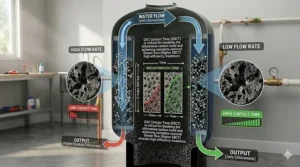
The contact time variable becomes critical here. GAC requires at least 10 minutes of contact time to break down chloramine effectively, which explains why whole-house cartridge filters often underperform. A standard 20″ x 4.5″ cartridge might contain 2-3 pounds of carbon, while a tank-based system holds 15-30 pounds. At typical household flow rates (8-12 GPM), the tank system provides substantially longer dwell time for the catalytic reaction to complete. This isn’t marketing spin—it’s basic chemistry meeting hydraulic engineering.
Temperature also affects performance in ways most manufacturers don’t advertise. GAC adsorption capacity drops 40 to 60% at typical shower temperatures of 100 to 110°F. This explains why some homeowners report their shower water smells worse than tap water—the hot temperature reduces filtration efficiency right when you need it most. Proper system sizing accounts for this temperature-dependent performance degradation, typically by oversizing the media bed by 30-50% compared to what cold water calculations would suggest.
Catalytic vs Standard GAC: Performance Comparison
| Feature | Standard GAC | Catalytic GAC | Winner |
|---|---|---|---|
| Chloramine Removal Rate | 40-60% | 85-95% | Catalytic GAC |
| Empty Bed Contact Time Required | 10+ minutes | 3-4 minutes | Catalytic GAC |
| Filter Lifespan | 6-12 months | 5-10 years (tank systems) | Catalytic GAC |
| Cost Per Gallon | $0.005-0.008 | $0.001-0.002 | Catalytic GAC |
| Upfront Investment | $250-400 | $800-2,000 | Standard GAC |
| Best For | Budget-conscious, short-term | Long-term homeowners | Depends on situation |
The data reveals why most water treatment professionals recommend catalytic carbon for serious chloramine concerns. While standard GAC delivers a lower entry price, the operating costs over 5 years actually favor catalytic systems. A $350 cartridge system requiring $150 in filters twice annually totals $1,850 over five years. Meanwhile, an $1,100 tank system with $40 annual sediment filters costs just $1,300 total. The catalytic option saves $550 while delivering consistently higher chloramine reduction throughout that period.
🔍 Take Your Water Quality to the Next Level
Stop settling for chloramine-contaminated water. These expertly selected GAC filters deliver the catalytic performance your family deserves. Click on any highlighted product above to check current availability and pricing. Your skin, hair, and taste buds will thank you!
Understanding EPA Standards for Chloramine in Drinking Water
The U.S. Environmental Protection Agency sets a Maximum Residual Disinfectant Level (MRDL) of 4.0 mg/L for chloramines as measured in treated drinking water. This standard represents the highest level considered safe for consumption based on extensive risk assessment studies. What many homeowners don’t realize is that utilities often maintain chloramine levels between 1.5-2.5 mg/L to ensure adequate disinfection while staying well below the regulatory maximum.
According to the Centers for Disease Control and Prevention, chloramines provide longer-lasting disinfection as water moves through distribution pipes compared to chlorine alone. This persistence, while beneficial for preventing bacterial regrowth in miles of municipal piping, is precisely why it’s more challenging to remove at the point of use. Unlike chlorine which readily dissipates, chloramine maintains its chemical structure and requires catalytic decomposition for effective removal.
The Water Quality Association (WQA) notes in their chloramine technical bulletin that activated carbon does not adsorb chloramines but rather removes them through catalytic breakdown to innocuous chlorides. This distinction matters enormously when evaluating product claims—a filter marketed for “chlorine removal” using standard carbon will underperform on chloramine despite the chemical similarity in names.
For homeowners researching filter certifications, NSF International provides comprehensive standards for drinking water treatment systems. NSF/ANSI Standard 42 addresses aesthetic effects (taste, odor, chlorine), while Standard 53 covers health-related contaminants. Products certified to these standards undergo rigorous third-party testing—not just manufacturer claims—which provides measurable assurance of performance. When comparing GAC filters, prioritize products with specific NSF certifications for chloramine reduction rather than generic “removes contaminants” marketing language.

Common Mistakes When Buying GAC Filter for Chloramine
The most expensive mistake homeowners make is assuming any GAC filter removes chloramine. Standard activated carbon excels at chlorine removal but struggles with chloramine’s chemical structure. You specifically need catalytic carbon or extended contact time with high-quality GAC. Marketing departments love conflating these because “activated carbon” sounds more familiar than “catalytic carbon,” leading buyers to purchase systems that underperform for their specific needs.
Another frequent error: ignoring the Empty Bed Contact Time (EBCT) specification. This number—usually buried in technical documents if provided at all—tells you how long water actually contacts the filter media. Activated carbon for chloramines requires longer contact with 85-95% removal at 3-4 minute EBCT. Cartridge-based systems rarely exceed 30-60 seconds of contact time unless you drop your household flow rate to impractical levels. Tank systems with larger media beds naturally provide longer contact times, which directly translates to better chloramine reduction.
Flow rate misconceptions create the third major pitfall. A system rated for 10 GPM peak flow will perform dramatically differently at 8 GPM sustained versus 3 GPM. Most manufacturers test at optimized laboratory flow rates that don’t reflect real-world usage patterns. If you have a 4-person household with morning shower overlap, your instantaneous demand might spike to 12-15 GPM even if your average daily consumption suggests 5-6 GPM is sufficient. Undersizing your system to save $200 upfront leads to compromised performance when you actually need it most.
Finally, many buyers overlook the replacement cost escalation trap. That $250 cartridge system looks attractive until you calculate the $150 filter sets you’ll need twice annually. Over a 5-year period, you’re spending $1,750 on a system that initially cost $250. Meanwhile, the $900 tank system with $40 annual sediment filters totals $1,100 over the same period while delivering superior chloramine reduction. The math isn’t complicated, but it requires looking beyond the sticker price to total cost of ownership.
GAC vs Alternative Chloramine Removal Methods
| Method | Chloramine Removal | Cost | Pros | Cons |
|---|---|---|---|---|
| Catalytic GAC | 85-95% | $$ | Effective, long-lasting, whole-house | Higher upfront investment |
| Standard GAC | 40-60% | $ | Lower initial cost, familiar technology | Requires frequent replacement, moderate performance |
| Vitamin C Filters | 90-99% (point-of-use) | $ | Excellent for showers, low cost | Point-of-use only, not whole-house |
| Reverse Osmosis | 95-99% | $$ | Removes virtually everything | Wastes water, slow flow, point-of-use only |
| UV Light | 0% | N/A | Kills bacteria effectively | Does not remove chloramine |
| Boiling Water | 0% | N/A | Kills microorganisms | Does not remove chloramine |
This comparison clarifies why GAC-based filtration dominates the chloramine removal market. Reverse osmosis delivers superior removal rates but only for drinking water—you’re not running your shower, washing machine, and garden hose through an RO system. Vitamin C filters work exceptionally well for showerheads but leave the rest of your home unprotected. Catalytic GAC strikes the optimal balance between whole-house coverage, cost-effectiveness, and proven performance.
Step-by-Step: Maximizing Your GAC Filter Performance
Week 1: Baseline Your Water Quality
Before installing any filtration system, document your starting point. Fill three clear glass jars with tap water and label them with the date. Leave one on the counter, refrigerate one, and keep one in a dark cabinet. After 24 hours, compare them for odor, clarity, and taste. The refrigerated sample will smell least chloramine-like because cold temperatures slow volatilization, while the counter sample will smell strongest due to evaporation concentrating the disinfectant.
Take note of how your skin and hair feel after showering this week. Many people don’t realize their dry skin, itchy scalp, or brittle hair connects to chloramine exposure until after they’ve removed it and experienced the difference. Documenting these baseline conditions creates a clear before/after comparison that helps justify your investment to skeptical family members (or yourself when you’re writing that check for $900).
Week 2-4: Post-Installation Optimization
After installing your GAC system, flush it properly—this step prevents the most common complaint: cloudy or milky water. Run 10-15 gallons through the system before using it for consumption. This clears carbon fines (tiny activated carbon particles) that inevitably exist in new filters. The water will look cloudy initially but should clear completely within the first few gallons.
Monitor your pressure gauges daily for the first two weeks. Write down inlet and outlet readings. The differential shouldn’t exceed 5-7 PSI on a new system. If you’re seeing 15+ PSI pressure drop right away, something’s wrong—either the system is undersized for your flow requirements, or you’ve got a defective component. Catching these issues during the return window saves endless frustration later.
Months 2-6: Performance Monitoring
The most reliable performance indicator isn’t a fancy test kit—it’s your own senses. If that pool-water smell returns in shower steam, or if your coffee develops a chemical aftertaste, your GAC filter is exhausting earlier than expected. This typically means higher chloramine levels in your source water than average, or higher than normal household water consumption. Document when these sensory changes occur; they’ll help predict future replacement intervals more accurately than manufacturer estimates.
Check pressure differential monthly. A gradual upward trend (1-2 PSI per month) indicates normal media loading. A sudden spike—say, jumping 10 PSI in a week—suggests either a clogged pre-filter or an upstream problem like a partially closed valve someone forgot about. Catching premature clogging early extends your main filter’s life significantly by preventing sediment from bypassing the pre-filter and fouling your GAC media.
Real-World Chloramine Levels: What to Expect by Region
Municipal water systems must maintain enough chloramine to prevent bacterial regrowth throughout their distribution network, but levels vary significantly based on system size, pipe age, and distance from the treatment plant. Understanding typical concentrations helps set realistic expectations for filter performance.
Cities with newer infrastructure and shorter distribution systems often maintain 1.5-2.0 mg/L chloramine. These lower levels are easier for standard GAC filters to handle, which explains why some homeowners report excellent results with basic systems. Older cities with extensive piping networks—think Philadelphia, New York, San Francisco—frequently run 2.5-3.5 mg/L to ensure disinfectant residual reaches the system’s extremities. These higher concentrations challenge standard GAC and truly benefit from catalytic carbon’s superior decomposition capability.
Seasonal variation matters more than most people realize. Summer temperatures accelerate chloramine decay in distribution pipes, prompting utilities to increase dosing. If your filter performed well all winter but suddenly shows reduced effectiveness in July, you’re likely experiencing this seasonal concentration increase. This is normal, not a filter defect. Proper system sizing accounts for peak summer levels rather than average annual concentrations.
Installation Guide: What Most People Get Wrong
Before touching any plumbing, verify your home’s water pressure. Systems designed for 40-80 PSI will underperform or fail at 25 PSI, and they’ll void warranties if subjected to sustained pressure above 90 PSI. A $15 pressure gauge from any hardware store prevents expensive mistakes. If your static pressure exceeds 80 PSI, install a pressure reducing valve ahead of your filtration system—this isn’t optional for warranty compliance.
Location selection matters more than installation guides typically emphasize. GAC filters—especially catalytic carbon tanks—prefer consistent temperatures between 40-100°F. Installing in an unconditioned basement where temperatures swing between 35°F in winter and 80°F in summer degrades performance and shortens media life. The ideal location is indoors, after your main shutoff but before any branching occurs to other fixtures. This ensures all water gets treated while maintaining easy access for maintenance.
The bypass valve installation step is where many DIY installers cut corners. A proper bypass allows you to isolate your filtration system for maintenance without shutting off water to the entire house. This seems like overkill until you’re on day three of a multi-day project and your family is threatening mutiny because you shut off the main line to replace a $40 sediment filter. The correct sequence is: main shutoff → bypass valve → pressure gauge → filter system → pressure gauge → reconnect to household plumbing.
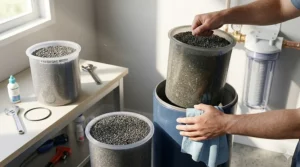
For cartridge systems, proper o-ring lubrication prevents the #1 cause of customer service calls: leaks. Use only food-grade silicone grease (usually provided with the system) and apply a light coat around the entire o-ring circumference. Don’t stretch or twist the o-ring during installation. Hand-tighten the housing until the o-ring makes contact, then give it an additional quarter-turn—more than that risks cracking the housing. Tank systems require different considerations: ensure your floor can support 200-400 pounds of wet media weight, and provide 18-24 inches of clearance above the tank for media replacement access.
Maintenance Schedule: The 90-Day Reality Check
The first maintenance milestone hits at 90 days regardless of what the instruction manual claims. After three months of operation, pressure gauges on cartridge systems should show no more than 15-20% drop from installation baseline. If you’ve lost more pressure than that, your sediment pre-filter is undersized for your water quality, or you’ve installed the system downstream of a water softener (which is backwards—always filter before softening). This 90-day checkpoint catches undersizing issues before they become expensive problems.
Month six marks the critical decision point for cartridge systems. At 180 days or 15,000-20,000 gallons (whichever comes first for a family of four), your GAC filter has reached approximately 50% of rated capacity. Most manufacturers claim 30,000-50,000 gallon lifecycles, but laboratory studies testing beyond certified capacity achieved the 10 μg/L lead benchmark in only 61% of filters. This means your chloramine reduction likely started declining somewhere around the 12,000-15,000 gallon mark. Proactive replacement at six months maintains consistent performance; waiting for the full year gradually degrades water quality across months 8-12.
Tank systems follow a different rhythm. Sediment pre-filters need inspection every 2-3 months and replacement every 6-9 months depending on your water’s particulate load. The main catalytic carbon bed in quality systems lasts 5-10 years, but only if that pre-filter does its job. A clogged pre-filter forces sediment past into your main bed, where it occupies reactive sites and reduces contact time. The warning signs: gradual pressure drop over weeks, or chloramine smell returning after months of odor-free water.
Tank systems follow a different rhythm. Sediment pre-filters need inspection every 2-3 months and replacement every 6-9 months depending on your water’s particulate load. The main catalytic carbon bed in quality systems lasts 5-10 years, but only if that pre-filter does its job. A clogged pre-filter forces sediment past into your main bed, where it occupies reactive sites and reduces contact time. The warning signs: gradual pressure drop over weeks, or chloramine smell returning after months of odor-free water.
Annual full-system inspection should include checking all fittings for minor weeping (the early sign of imminent failure), verifying bypass valve operation, and comparing inlet versus outlet pressure readings. Your pressure differential shouldn’t exceed 10-15 PSI on a clean system; higher differentials indicate channeling in tank systems or premature media fouling. This is also the time to clean or replace pressure gauges—those $15 components fail more often than the filters themselves, giving false readings that lead to poor maintenance decisions.
✨ Protect Your Home’s Water Quality Today
Don’t wait until chloramine damage becomes visible in dry skin, faded clothing, or that persistent chemical smell. These certified GAC filters provide proven chloramine reduction backed by independent testing. Click any product link above to verify current pricing and start enjoying pure, filtered water throughout your entire home!
Real-World Case Study: Family of Four in Philadelphia
Philadelphia switched to chloramine disinfection in 2009, making it an ideal case study for long-term chloramine filter performance. The Martinez family installed a SpringWell CF1 system in their 1950s-built rowhouse after noticing their teenage daughter’s eczema worsened during longer showers. Within two weeks of installation, her skin improvements were obvious enough that their dermatologist asked what had changed in their routine.
The more surprising effects emerged over months rather than days. Coffee and tea tasted noticeably better—the chloramine’s subtle chemical aftertaste had been masking more delicate flavor notes. Their dishwasher stopped leaving that faint chemical smell on supposedly clean dishes. Perhaps most unexpectedly, their HVAC filters needed replacement less frequently because the system wasn’t pulling chloramine-contaminated water vapor from shower steam.
Cost analysis after three years showed the CF1 paid for itself sooner than projected. The family was spending $40 monthly on bottled water pre-installation, believing (incorrectly) that their countertop pitcher filter was removing chloramine. Eliminating that expense saved $1,440 across three years, covering the system’s purchase price with $540 remaining. Sediment pre-filter replacements totaled $120, bringing net savings to $420. But the Martinez family values the quality-of-life improvements—the daughter’s clear skin, the better-tasting coffee, the eliminated chemical smell—far more than the modest financial return.
Their experience highlights an often-overlooked consideration: chloramine affects your home beyond just drinking water. Hot water heaters accumulate less scale when chloramine is removed at the point of entry. Washing machines and dishwashers experience reduced rubber gasket degradation. Whole-house filtration protects your entire plumbing system, not just the kitchen tap, which explains why the payback period often beats initial calculations.
Price vs Performance: What $400 Gets You Compared to $1,800
The $400 budget category—typified by the iSpring WCB32C-GAC or Express Water 3-Stage—delivers functional chloramine reduction adequate for typical municipal water. You’re getting cartridge-based filtration with standard GAC (not catalytic carbon), which means moderate reduction rates around 60-75% when new, declining to 40-50% by end-of-life. For many homeowners, this suffices: the noticeable chloramine smell disappears, shower water feels softer, and coffee tastes better. The tradeoff shows up in ongoing costs ($150-200 annually in replacement filters) and the ceiling on performance improvement.
Mid-range systems at $800-1,000—like the SpringWell CF1—employ genuinely different technology: catalytic carbon in tank configurations with dramatically longer contact times. These achieve 85-95% chloramine reduction that remains consistent across the system’s 6-10 year media life because you’re catalytically decomposing the chloramine rather than adsorbing it temporarily. The economic argument becomes straightforward for anyone planning to stay in their home beyond three years: lower ongoing costs combined with superior performance justify the higher entry price.
Premium systems approaching $2,000—the Aquasana Rhino Chloramines—add third-party NSF certification, which matters more than casual buyers realize. That certification means an independent laboratory verified the manufacturer’s claims under controlled conditions, repeatedly, using standardized test protocols. For families with young children, immune-compromised members, or simply higher water quality standards, paying for that third-party verification provides peace of mind that marketing claims alone cannot deliver.
The wild card in this analysis is lifespan versus household size. A four-person household using 300 gallons daily exhausts a 30,000-gallon cartridge in three months of real use, not the theoretical six months claimed on packaging. That $150 filter set you budgeted for every six months actually needs replacement quarterly, doubling your annual expense to $600. Meanwhile, that $1,800 premium system with 1,000,000-gallon capacity serves the same household for 9+ years at $48 every three months for pre-filters—$192 annually total. The higher upfront cost amortizes to lower per-gallon costs remarkably quickly.
FAQ: Your Chloramine Questions Answered
❓ How do I know if my water has chloramine instead of chlorine?
❓ Can I use my existing carbon filter for chloramine removal?
❓ What's the difference between catalytic carbon and regular GAC?
❓ How often should I replace GAC filters for optimal chloramine removal?
❓ Are there any health risks from chloramine in drinking water?
Conclusion: Making Your Decision
Choosing the right GAC filter for chloramine removal ultimately comes down to matching your specific situation with the appropriate technology. If you’re in a starter home or rental property, the iSpring WCB32C-GAC or Express Water 3-Stage systems provide immediate improvement at manageable upfront costs. For homeowners planning to stay put for 5+ years, the economics strongly favor tank-based systems like the SpringWell CF1 or Tier1 Chloramine Filter—higher initial investment but dramatically lower per-gallon costs over time.
The premium tier—represented by the Aquasana Rhino Chloramines—makes sense for larger households (4-6 people, 3+ bathrooms) who prioritize third-party certification and want the absolute best chloramine reduction money can buy. For people upgrading existing Big Blue systems, the Home Master CFKDF85GCC cartridge transforms standard housings into catalytic carbon powerhouses without requiring new plumbing. And if you’re dealing with both chloramine and heavy metals, the iSpring WCB32C-KS provides dual-purpose protection in a compact footprint.
What matters most isn’t the price tag—it’s understanding what you’re actually buying. Standard GAC provides adequate chloramine reduction with frequent replacement. Catalytic carbon delivers superior performance with longer service life. Tank systems offer better contact time than cartridges. These aren’t marketing claims; they’re chemical engineering realities. Match your water quality challenge to the appropriate filtration technology, and you’ll enjoy clean, chloramine-free water for years to come.
Recommended for You
- 7 Best Activated Carbon Water Filters 2026
- 7 Best 5 Stage Whole House Water Filter Systems 2026 Review
- 7 Best 3 Stage Whole House Water Filter Systems 2026
Disclaimer: This article contains affiliate links. As an Amazon Associate, I earn from qualifying purchases. If you purchase products through these links, we may earn a small commission at no additional cost to you.
✨ Found this helpful? Share it with your friends! 💬🤗
