
In This Article
Here’s something most homeowners don’t realize: just because your city water meets EPA standards doesn’t mean it’s the water you actually want flowing through your pipes. Municipal water treatment gets your water “safe enough” for mass distribution, but that still leaves chlorine strong enough to smell in your morning shower, sediment that clogs your appliances, and trace metals leaching from aging infrastructure between the treatment plant and your faucet.
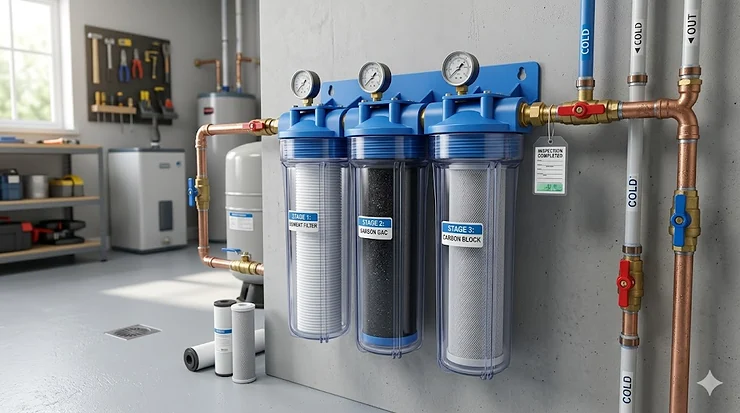
A 3 stage whole house water filter intercepts these contaminants right where your main line enters your home — before they reach your shower, your coffee maker, your washing machine, or your ice dispenser. Unlike point-of-use filters that only treat one tap, whole house systems give you comprehensive protection at every fixture. The three-stage design isn’t arbitrary — it’s the sweet spot where you get serious filtration power without the complexity and maintenance headaches of 5+ stage systems.
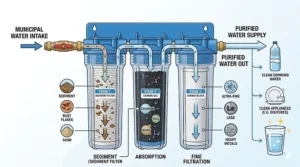
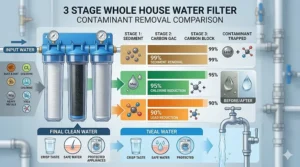
What most buyers overlook is this: the “stage” count matters less than what each stage actually does. A well-designed three-stage system tackles sediment in stage one (protecting everything downstream), removes chemical contaminants like chlorine and VOCs in stage two, and polishes your water in stage three with fine carbon filtration or specialized media for heavy metals. This guide breaks down exactly which systems deliver on that promise and which ones cut corners you’ll regret six months in.
Quick Comparison Table
| System | Flow Rate | Filter Lifespan | Best For | Price Range |
|---|---|---|---|---|
| Express Water Essential | 15 GPM | 6-12 months | Budget-conscious families | $300-$400 |
| iSpring WGB32B | 15 GPM | 12 months | Municipal water users | $350-$450 |
| Waterdrop WHF3T-PG | 15 GPM | 12 months | Lead reduction priority | $400-$500 |
| HQUA WF3-01 | 15 GPM | 6 months | Heavy metal removal | $450-$550 |
| Home Master HMF3SDGFEC | 15 GPM | 12 months | Well water with iron | $600-$750 |
| Express Water Anti-Scale | 15 GPM | 6-12 months | Hard water areas | $350-$450 |
| Aquaboon 3-Stage | 8 GPM | 6 months | Small homes/condos | $200-$300 |
Looking at this comparison, you’ll notice every system claims 15 GPM except the Aquaboon — and that matters more than you’d think. An undersized filter causes pressure drops that you’ll feel every time multiple fixtures run simultaneously. The iSpring and Waterdrop models justify their mid-range pricing with full-year filter lifespans, cutting your annual maintenance costs nearly in half compared to the 6-month replacement cycles on budget options. If hard water scale is your primary concern, the Express Water Anti-Scale’s polyphosphate third stage prevents mineral buildup that standard carbon filters can’t touch.
💬 Just one click — help others make better buying decisions too! 😊
Top 7 3 Stage Whole House Water Filters — Expert Analysis
1. Express Water Essential 3-Stage System
The Express Water Essential positions itself as the entry point for families who want whole-home filtration without the $800+ investment of premium systems. Built around a stainless steel free-standing frame, this system uses standard 20″ x 4.5″ filters in a configuration that’s become the industry benchmark.
The first stage uses a 5-micron sediment filter to capture rust, silt, and particulates before they reach your downstream filters — think of it as your system’s bodyguard, extending the life of everything that follows. Stage two employs granulated activated carbon (GAC) that immediately strips chlorine taste and smell from municipal water. What the spec sheet won’t tell you is that GAC works through adsorption, meaning contaminants stick to the massive surface area of the carbon granules, but this media saturates faster than compressed carbon blocks, which is why you’re replacing filters every 6-12 months instead of annually.
The third stage uses another carbon block for final polishing. Express Water built their reputation on systems that “just work” for municipal water users who primarily battle chlorine and aesthetic issues. This isn’t the system for well water with iron problems or homes with serious heavy metal concerns — it’s designed for the 70% of Americans on city water who want clearer, better-tasting water throughout their home.
Customer feedback consistently mentions immediate improvement in shower water quality and elimination of the chlorine smell that bleaches towels in the laundry. The pressure gauges on each housing make it dead simple to know when filters need changing — when the differential increases by 5-10 PSI, it’s time.
✅ Pros:
- NSF-certified filters provide verified performance
- Free-standing stainless frame fits anywhere without wall mounting
- Pressure release buttons make filter changes cleaner
❌ Cons:
- Doesn’t reduce TDS (total dissolved solids)
- 6-12 month filter lifespan increases annual maintenance costs
Price: Around $350, with replacement filter sets in the $80-$120 range every 6-12 months
2. iSpring WGB32B 3-Stage Filtration System
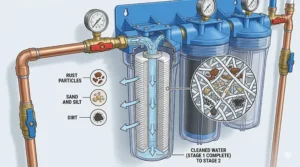
The iSpring WGB32B is what happens when a company actually listens to customer complaints about other systems. Instead of the single sediment + dual carbon setup that most competitors use, iSpring employs a 5-micron sediment pre-filter followed by two stages of CTO (chlorine, taste, and odor) carbon block filters using coconut shell carbon.
Why does that matter? Coconut shell carbon has a micropore structure that captures smaller organic contaminants than coal-based carbon, and the block format forces water through the entire filter media instead of channeling through gaps like loose GAC can. Independent testing shows this system removes up to 99% of chlorine — not the 95% you’ll see from budget models — which translates to noticeably softer shower water and laundry that doesn’t smell like a public pool.
The 1″ NPT inlet/outlet maintains robust flow up to 15 GPM even as filters load with contaminants, meaning you won’t notice pressure drops during simultaneous showers and dishwasher cycles. What sets iSpring apart in the mid-price segment is the 100,000-gallon filter capacity giving you a genuine 12-month service life. When you calculate $150-$180 annually for replacement filters versus $250+ for systems with 6-month cycles, the iSpring pays for its higher upfront cost within the second year.
For municipal water users — which is most of you reading this — the WGB32B handles the big three issues: sediment, chlorine, and VOCs. It won’t soften hard water or remove fluoride (you’d need RO for that), but it wasn’t designed to. This system excels at making city water pleasant to drink, cook with, and bathe in.
✅ Pros:
- 12-month filter life cuts maintenance frequency in half
- Third-party tested coconut shell carbon exceeds NSF standards
- Extended warranty with online registration
❌ Cons:
- Doesn’t address hardness or TDS
- Premium filters cost more upfront
Price: In the $380-$420 range, with annual filter replacement around $150-$180
3. Waterdrop WHF3T-PG 3-Stage Lead Reduction System
Waterdrop built the WHF3T-PG for homeowners who’ve seen the news about lead contamination and want verified protection beyond generic “reduces heavy metals” marketing claims. This system carries NSF/ANSI 372 certification specifically for lead-free materials in the housing itself — crucial because some cheaper filter housings leach the very contaminants you’re trying to remove.
The three stages work progressively: a 5-micron sediment filter protects against particulates, followed by a granular activated carbon stage for chlorine and organics, then a final carbon block with ion-exchange media specifically formulated for lead, copper, and mercury. What Waterdrop calls “7-stage filtration” is marketing speak for the multiple filtration mechanisms within these three cartridges, but don’t let the buzzword distract from genuine performance — this system legitimately reduces lead to levels that make it safe for children and pregnant women.
The WHF3T-PG passed 100,000+ water hammer tests, which matters if you have automatic appliances that create pressure spikes when valves snap shut. Cheaper systems develop leaks at connection points after 2-3 years of thermal cycling and pressure fluctuations; Waterdrop engineered this unit to survive those stresses. The 1″ inlet/outlet maintains 15 GPM flow even with the dense carbon block in the third stage.
For families in older homes with copper pipes joined using lead solder (common in pre-1986 construction), this system offers peace of mind that generic carbon filters can’t provide. The replacement filter schedule is 12 months at typical family usage, and Waterdrop’s customer service actually responds when you have questions — something you’ll appreciate when you’re troubleshooting installation.
✅ Pros:
- NSF 372 certified lead-free materials
- Specialized ion-exchange media for heavy metals
- 100,000 water hammer test durability
❌ Cons:
- Higher upfront cost than basic carbon systems
- Replacement filters run $180-$220 annually
Price: Around $450-$480, positions as premium protection against lead contamination
4. HQUA WF3-01 Heavy Metal Filtration System
The HQUA WF3-01 takes a different approach than carbon-only competitors by incorporating KDF (Kinetic Degradation Fluxion) media — copper-zinc alloy granules that remove heavy metals through redox reactions. This isn’t marketing fluff; KDF actually converts dissolved lead, mercury, nickel, and chromium into insoluble particles that get trapped in the filter, while standard carbon can only adsorb limited amounts.
Here’s the configuration: Stage one uses a multi-layer sediment filter (25-10-5-1 micron progression) that captures everything from visible rust down to microscopic silt. Stage two is where HQUA differentiates itself — a compound GAC+KDF filter that handles both organic contaminants like pesticides and inorganic heavy metals in a single cartridge. Stage three uses a carbon block for final polishing and chloramine reduction (chloramine is the chlorine alternative that many cities switched to because it doesn’t evaporate as easily, but it’s harder to filter).
The Big Blue 20″ x 5.5″ housings give you larger filter capacity than standard 20″ x 4.5″ systems, extending service life before pressure drops signal replacement time. HQUA includes multiple pressure gauges, 180-day countdown timers, pressure release valves, and even a housing cleaning brush — the kind of thoughtful details you appreciate during 2 AM filter changes when you’ve got a houseful of guests and someone just flushed the toilet during your shower.
This system shines for well water users dealing with agricultural runoff or industrial contamination, where heavy metals exceed what simple carbon can handle. The 3-15 GPM flow rate and 1″ FNPT connections make it suitable for most residential installations, though you’ll want to verify your well pump can maintain 25-116 PSI operating pressure.
✅ Pros:
- KDF media provides superior heavy metal removal
- Oversized 20″ x 5.5″ filters extend service intervals
- Comprehensive accessories and monitoring included
❌ Cons:
- Replacement filter sets cost $120-$150 every 6 months
- Overkill for municipal water with minimal contamination
Price: In the $480-$520 range, justified by specialized filtration media and well water capability
5. Home Master HMF3SDGFEC Well Water Specialist
The Home Master HMF3SDGFEC is purpose-built for well water’s unique challenges — iron, manganese, and hydrogen sulfide (that rotten egg smell) up to 3 ppm combined load. If you’ve been battling orange stains in your toilets and showers, this is the system that finally fixes it.
Stage one uses a 4-layer sediment filter progressing from 25 microns down to 1 micron nominal at the core. This matters for well water because you’re not just catching city-pipe rust; you’re filtering sand, silt, organic debris, and the oxidized iron particles that standard 5-micron filters let through. The multi-gradient design holds 3× more dirt than single-density cartridges, which is why you’re getting 12-month filter life instead of the 3-6 months that cheaper well systems require.
Stage two is the radial flow iron filter — a specialized media that treats both soluble (dissolved, invisible) and insoluble (already oxidized, visible) iron and manganese. Traditional filters only catch what’s already turned into particles; this media actually converts dissolved metals into solids that get trapped. Pair that with stage three’s radial flow carbon filter removing herbicides, pesticides, and VOCs commonly found in agricultural groundwater, and you’ve got a system that transforms well water into something you’d actually want to drink.
The 15 GPM flow rate maintains pressure even with the dense filtration media, and Home Master’s oversized housings reduce maintenance frequency to annual instead of quarterly. This isn’t for chlorinated city water — the system won’t handle chlorine properly and you’ll void the warranty. But for the 15% of Americans on private wells, particularly in agricultural areas, this system solves problems that generic carbon filters can’t touch.
✅ Pros:
- Specifically engineered for iron/manganese/sulfide removal
- Radial flow design maximizes media contact
- 12-month service intervals reduce maintenance burden
❌ Cons:
- Premium $200-$250 replacement filter cost annually
- Not suitable for chlorinated municipal water
Price: Around $650-$720, reflecting specialized well water treatment capability
6. Express Water Anti-Scale 3-Stage System
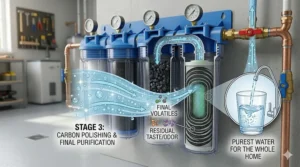
The Express Water Anti-Scale targets the problem that carbon filters ignore: hard water minerals. While most 3-stage systems focus on chlorine, sediment, and taste, this model adds a third-stage polyphosphate filter that prevents calcium and magnesium from bonding into scale deposits.
Here’s what that means in practice: without scale prevention, hard water minerals crystallize inside your water heater, reducing efficiency by 30-40% within 3-5 years and eventually causing failure. They coat heating elements in your dishwasher and washing machine, forcing them to work harder and die sooner. The polyphosphate sequestration in this system’s third stage keeps minerals suspended in solution instead of precipitating out as crusty white buildup.
Stages one and two follow the standard sediment + GAC configuration for particulate and chlorine removal. The free-standing stainless frame and 1″ connections deliver the same 15 GPM flow as Express Water’s Essential model. The key difference is that third-stage anti-scale cartridge, which costs about $10-$15 more per replacement but saves hundreds in appliance repairs and energy costs.
This system doesn’t soften your water — your shower won’t feel slippery like it does with a salt-based softener, and you’ll still have some mineral content. What it does is prevent that mineral content from destroying your plumbing and appliances. For homeowners in hard water regions (check your water report — anything above 120 mg/L total hardness benefits from scale prevention) who don’t want the salt, wastewater, and maintenance of a traditional softener, this is the practical middle ground.
✅ Pros:
- Polyphosphate prevents scale without salt or wastewater
- Protects appliances and extends water heater life
- Same robust Express Water build quality as Essential model
❌ Cons:
- Doesn’t actually remove hardness minerals
- Polyphosphate needs replacement every 6 months for effectiveness
Price: In the $360-$430 range, with filter sets running $90-$130 semi-annually
7. Aquaboon 3-Stage Compact System
The Aquaboon 3-Stage is what you install in a condo, small home, or vacation property where you need whole-house filtration but don’t have the flow demands of a 3-bathroom family residence. With 10″ x 4.5″ housings instead of the 20″ standard, this system fits in tight mechanical spaces while delivering 8 GPM — enough for simultaneous shower and kitchen sink use, but you’ll notice pressure drops if someone runs the washing machine at the same time.
The three stages use standard pleated sediment, carbon block, and polyphosphate filters in a configuration similar to full-size systems, just with smaller capacity. This means you’re replacing filters every 6 months maximum, possibly every 3-4 months if you have high sediment load or chlorine levels. The compact housings also mean there’s less filter media working for you, so while an Aquaboon will remove chlorine taste and prevent scale buildup, it won’t match the contaminant reduction of larger systems.
Where this system makes sense: rental properties where you want basic filtration without the cost and complexity of premium models, vacation homes with intermittent use, or condos where space constraints make 20″ housings impractical. The included pressure gauges, wrench, and bracket make installation straightforward, and Aquaboon’s customer service is surprisingly responsive for a budget brand.
What you sacrifice for the lower price and smaller footprint is filtration capacity and flow rate. If you’re a family of four with simultaneous water usage during morning routines, you’ll outgrow this system fast. But for a couple in a 1-bath home or a weekend cabin, it delivers genuine three-stage filtration at a price point that makes sense.
✅ Pros:
- Compact 10″ housings fit constrained spaces
- Budget-friendly entry into whole-house filtration
- Complete accessory package included
❌ Cons:
- 8 GPM flow insufficient for larger homes
- Frequent filter changes (3-6 months) increase maintenance
Price: Around $220-$280, with replacement filter sets in the $50-$70 range quarterly to semi-annually
Installation Reality Check: What the Manuals Don’t Tell You
Every manufacturer claims “easy DIY installation,” but here’s what you’ll actually encounter when you cut into your main water line. First, you need adequate space — most systems require 40-50 inches of vertical clearance and 24-30 inches of horizontal room for filter access. Measure twice, because relocating your install mid-project when you realize the housing won’t fit is a special kind of frustration.
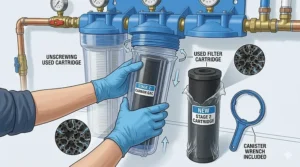
Second, shut off your main water valve and open all your fixtures to drain the line completely. You’ll still get residual water when you cut the pipe, so have towels and a bucket ready. Use two pipe wrenches — one to hold the fitting stationary while the other turns — to prevent torquing and cracking the filter housings. Over-tightening causes more leaks than under-tightening;
hand-tight plus one quarter turn with a wrench is the target.
Third, that Teflon tape on the threads? Wrap it clockwise (when viewing the threads from the end) so it tightens as you screw fittings together instead of bunching up. Use 3-4 wraps for 3/4″ connections, 4-5 wraps for 1″ NPT fittings. And here’s the critical step everyone skips: after installation, open your main valve slowly while monitoring every connection. A slow opening lets you catch drips before they become floods.
Budget 3-4 hours for a first install if you’re moderately handy, 6+ hours if you’ve never worked with plumbing. If you’re not confident cutting into pressurized pipes, the $200-$300 you’ll pay a plumber is money well spent compared to a flooded basement.
How to Choose Your 3 Stage Whole House Water Filter
1. Start with your water source. Municipal water needs sediment + carbon + additional carbon or polyphosphate. Well water requires sediment + iron/manganese + carbon. Don’t buy for contaminants you don’t have — test first.
2. Match flow rate to your home. 1-2 bathrooms need minimum 10 GPM. 3+ bathrooms require 15 GPM or you’ll notice pressure loss during peak usage. Undersized systems are the #1 complaint in reviews.
3. Calculate true annual cost. That $250 budget system with 3-month filter cycles costs $400 annually in replacements. The $450 system with 12-month filters costs $150 annually. Run the 5-year math before buying.
4. Verify certifications. NSF 42 (aesthetic), NSF 53 (health effects), NSF 372 (lead-free materials). If a system claims contaminant reduction without independent testing, pass.
5. Consider your DIY confidence. Systems with pressure gauges, release buttons, and included wrenches make filter changes dramatically easier. If you’re not mechanically inclined, spending extra for user-friendly features pays off every replacement cycle.
Common Mistakes When Buying a 3 Stage Whole House Water Filter
Installing without testing your water first is like buying prescription glasses without an eye exam. Your neighbor’s perfect system might be completely wrong for your water chemistry. Spend $30 on a water test kit before you drop $500 on a filter.
Undersizing for your household creates pressure problems that make you regret the entire investment. That 8 GPM system seems like a bargain until three people can’t shower simultaneously without turning the morning routine into a schedule negotiation.
Ignoring filter replacement costs in your budget calculation. Over five years, you’ll spend 2-3× the purchase price on replacement filters. Systems with longer service intervals save hundreds in labor and parts.
Buying for contaminants you don’t have. If your water doesn’t have iron, that expensive iron-removal system wastes money on media you’ll never use. Conversely, standard carbon won’t touch your iron problem no matter what the marketing copy promises.
Forgetting about installation access. Filter housings need clearance to unscrew. If you mount the system in a corner or against a wall with 2 inches of space, you’ll be cursing and cramping during every filter change.
3 Stage vs Single Stage: Why Three Stages Matter
Single-stage systems typically use a combined sediment and carbon cartridge that tries to do everything at once. The problem is physics: when sediment clogs the outer layers, water channels through gaps instead of filtering through all the carbon media. You end up with uneven treatment and premature filter failure.
Three-stage systems separate functions. Stage one catches sediment before it reaches your carbon, extending the life of stages two and three by months. Each subsequent stage handles progressively finer filtration without the dirt loading that kills single-stage performance. You get longer filter life, more consistent water quality, and visible monitoring of which stage is clogging first.
The exception: if you have pristine well water with only aesthetic issues, a single-stage carbon filter might suffice. But for typical municipal water or well water with multiple contaminants, three stages deliver dramatically better results.
Long-Term Cost & Maintenance Reality
Here’s the honest financial picture: you’ll pay $300-$700 upfront, then $80-$250 annually for replacement filters depending on the system and your water quality. Over ten years, that’s $1,100-$3,200 total cost of ownership.
Compare that to bottled water: a family of four drinking a gallon daily spends around $1,200 annually — $12,000 over ten years. Or consider appliance repairs: one water heater replacement costs $1,500-$2,000, and scale-damaged units fail 30% sooner than protected ones. A dishwasher killed by sediment and hard water runs $500-$900 to replace.
The filter system pays for itself through reduced appliance replacement, eliminated bottled water costs, and extended plumbing life. But only if you actually maintain it. Set calendar reminders for filter changes. Skipping replacements to save money is false economy — you’re drinking increasingly dirty water and risking pressure drops that damage appliances.
For maintenance budgeting: budget $15-$25 monthly for replacement filters. You’ll pay in batches (full filter set every 6-12 months), but monthly mental accounting keeps you honest about true costs.
What to Expect: Real-World Performance
In the first week after installation, you’ll notice immediate aesthetic changes — clearer water, no chlorine smell, better-tasting coffee and ice. Sediment that used to clog your faucet aerators vanishes. Your shower water feels slightly softer (not from softening, but from chlorine removal reducing that dried-out feeling).
At 3-6 months, check your pressure gauges. If differential pressure increased 5+ PSI from baseline, plan filter replacement within the next month. Don’t wait for flow reduction — by the time you notice pressure loss, your filters are severely compromised.
Around 12 months (or sooner with heavy usage), you’ll replace filters. The sediment cartridge will look disgusting — brown, orange, or gray depending on your water source. That’s validation the system is working. If your sediment filter is still white after 6 months, either your water is exceptionally clean or something’s bypassing the filter.
Long-term (3-5 years), you’ll appreciate not descaling your water heater, not replacing dishwasher heating elements, and not seeing rust stains in toilets. These are subtle savings that add up to hundreds annually.
Safety & Compliance: What Actually Matters
NSF/ANSI certifications aren’t marketing fluff — they’re independent verification that filters perform as claimed. NSF 42 covers aesthetic contaminants (chlorine, taste, odor). NSF 53 addresses health-related contaminants (lead, cysts, VOCs). NSF 372 certifies lead-free materials in the housing itself.
Systems without certification might work fine, or they might have leaching plastic that adds contaminants to your water. The $50 you save buying uncertified filters could cost you in health effects and filter failure. Spend the extra money for certified components.
The EPA regulates municipal water at the treatment plant, but it doesn’t control what happens between the plant and your faucet. Lead leaching from service lines, corrosion from pipes, and contamination from cross-connections all happen after EPA-compliant water leaves the treatment facility. Whole house filtration is your last line of defense against these post-treatment problems.
For private well owners: the EPA doesn’t regulate your water at all. You’re responsible for testing and treatment. If you’re on well water and don’t know your current contaminant levels, stop reading and order a water test kit today. You cannot choose appropriate filtration without knowing what you’re filtering.
Frequently Asked Questions
❓ How often should I replace filters in a 3 stage whole house water filter?
❓ Can a 3 stage water filtration system remove fluoride?
❓ What's the difference between sediment carbon system filters?
❓ Do I need professional installation for whole house 3 stage filter systems?
❓ Will a 3 stage filter reduce water pressure in my home?
Conclusion
Choosing a 3 stage whole house water filter comes down to matching filtration capability to your specific water source and household needs. Municipal water users benefit most from sediment + dual carbon configurations like the iSpring WGB32B or Waterdrop WHF3T-PG, while well water demands specialized media like the HQUA WF3-01’s KDF heavy metal reduction or Home Master’s iron removal.
The systems reviewed here represent genuine value at their respective price points — the Express Water Essential delivers solid chlorine removal for under $400, while the Home Master commands premium pricing because it solves well water problems that cheaper systems can’t touch. Your job is determining which contaminants you’re actually fighting.
Test your water before you buy, match flow rates to your household size, and calculate long-term filter replacement costs before making a final decision. The right 3-stage system protects your plumbing, extends appliance life, and delivers cleaner water at every fixture for years to come. The wrong system wastes money on features you don’t need while failing to address your actual water quality issues.
Recommended for You
- Best 7 Sulfur Removal Whole House Filter – 2026
- 7 Best Whole House Filter for Well Water 2026
- 7 Best Whole House Filter for City Water – 2026
Disclaimer: This article contains affiliate links. As an Amazon Associate, I earn from qualifying purchases. If you purchase products through these links, we may earn a small commission at no additional cost to you.
✨ Found this helpful? Share it with your friends! 💬🤗
