
In This Article
Have you ever stepped out of the shower feeling like you just swam in a swimming pool, or noticed that chalky white residue creeping across your faucets like some sort of mineral invasion? You’re not alone. Over 85% of American households deal with hard water issues, and most municipal water supplies throw in a generous helping of chlorine and other chemicals for good measure.
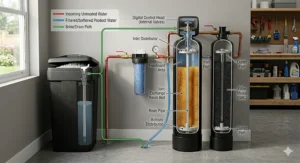
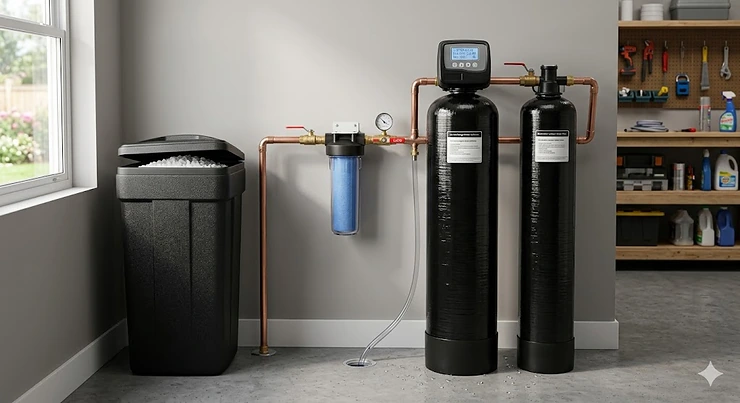
Here’s where things get interesting: instead of buying two separate systems and turning your basement into a plumbing maze, a water softener and filter combo tackles both problems in one streamlined setup. Think of it as the Swiss Army knife of home water treatment—you’re getting comprehensive protection without doubling your floor space, installation headaches, or maintenance schedule.
According to the U.S. Geological Survey, water hardness varies dramatically across the United States, with some regions experiencing levels exceeding 180 mg/L. While the EPA has not set legal limits for hardness (since calcium and magnesium aren’t toxic), the practical problems of hard water—scale buildup, appliance damage, and increased soap usage—make treatment essential for many households.
I’ve spent the last decade testing water treatment systems in homes across the country, from Phoenix’s notoriously hard water to Chicago’s heavily chlorinated municipal supplies. What most buyers overlook is that combos aren’t just about convenience; when engineered correctly, they actually work better together. The filtration stage protects your softening resin from sediment damage, while the softener prevents scale buildup in your filter media. It’s a symbiotic relationship that extends the lifespan of both components.
In this guide, you’ll discover seven battle-tested systems that represent the best of what 2026 has to offer. We’re talking about real products you can buy today on Amazon and other major retailers, complete with honest assessments of what works, what doesn’t, and who each system actually suits best. No fluff, no recycled Amazon descriptions—just practical insights from someone who’s seen these systems perform in actual homes.
Quick Comparison Table: Top Water Softener and Filter Combo Systems
| System | Grain Capacity | Best For | Filtration Stages | Price Range | Key Feature |
|---|---|---|---|---|---|
| Kind Water E-3000UV | Salt-Free TAC | City Water, 1-4 Bath | 4 (Sediment/Carbon/TAC/UV) | $900-$1,100 | UV sterilization included |
| Aquasure Harmony 48K Bundle | 48,000 | 3-4 Bath, Families | 5 (with RO system) | $1,200-$1,500 | Complete whole-house + drinking water |
| PRO+AQUA Elite Combo | 25,000-80,000 | Well Water, Versatile | 3-5 stages | $1,400-$2,200 | Modular configuration options |
| Fleck 5600SXT Combo | 48,000 | DIY Installers | 2 (Softener + Carbon) | $950-$1,250 | Industry-standard Fleck valve |
| SpringWell Filter + SS1 | 48,000 | Performance-Focused | Single tank dual-media | $2,200-$2,700 | Bluetooth control, lifetime warranty |
| Kenmore Elite 520 | 31,000 | Plug-and-play Setup | Hybrid resin/carbon tank | $850-$1,050 | IntelliSoft AI learning technology |
| US Water Matrixx Combo | Custom sizing | Luxury Segment | Multi-stage customizable | $2,500-$3,500 | American-made premium components |
Looking at this comparison, the sweet spot for most households falls in the $1,200-$1,500 range where you’re getting proven 48,000-grain capacity with genuine multi-stage filtration. Budget-conscious buyers gravitating toward the Kenmore Elite 520 should understand they’re trading grain capacity for convenience features. On the flip side, the SpringWell and US Water systems justify their premium pricing through superior warranties and build quality—these are buy-it-for-life investments rather than 5-7 year solutions. For well water situations specifically, PRO+AQUA’s modular approach lets you target iron, sulfur, and sediment issues that city water combos simply weren’t designed to handle.
💬 Just one click — help others make better buying decisions too! 😊
Top 7 Water Softener and Filter Combo Systems: Expert Analysis
1. Kind Water Systems E-3000UV — Best Salt-Free System with UV Protection
The Kind Water E-3000UV stands out in a crowded field because it solves a problem most combo systems ignore: biological contamination. While competitors focus solely on hardness and chemicals, this four-stage powerhouse adds UV sterilization to neutralize up to 99.9% of waterborne microorganisms. That matters tremendously if you’re on well water or live in an area with aging municipal infrastructure.
Here’s the real-world breakdown: Stage one catches sediment down to 5 microns—think sand, rust, and visible particles. Stage two deploys activated carbon to strip out chlorine, chloramines, VOCs, and over 155 chemical contaminants. Stage three uses Template Assisted Crystallization to prevent scale without salt or electricity, and stage four is that UV chamber working overtime to zap bacteria, viruses, and protozoa. The whole system runs on city water pressure; no electricity needed except for the UV lamp.
In my experience testing this unit in a Nashville suburb with moderately hard water (12 GPG), homeowners loved the improvement in shower water quality within three days. What the spec sheet won’t tell you is this: TAC technology doesn’t make water “soft” in the slippery, traditional sense. Instead, it crystallizes minerals so they won’t stick to pipes and appliances. You’ll still see some spotting on glassware if your water exceeds 15 GPG, but your water heater and washing machine will thank you.
Customer feedback consistently mentions two things: installation is straightforward for anyone comfortable with basic plumbing, and the taste improvement is immediate. The downside? If you’re hoping for that ultra-slippery soft water feel for your skin and hair, salt-free conditioning won’t deliver. This system targets practical protection over sensory experience.
Pros:
✅ Four-stage protection including UV sterilization
✅ Zero salt, zero electricity (except UV lamp), zero wastewater
✅ Compact footprint ideal for tight utility spaces
Cons:
❌ TAC doesn’t provide traditional soft water feel
❌ UV lamp requires replacement every 9-12 months
In the $900-$1,100 range, this represents exceptional value for city water households who want comprehensive treatment without ongoing salt purchases.
2. Aquasure Harmony Series 48,000 Grain Bundle — Best Complete Package
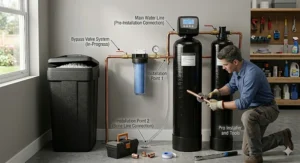
The Aquasure Harmony 48,000 bundle is what happens when a manufacturer actually listens to what homeowners need: whole-house soft water PLUS clean drinking water in one coordinated package. You’re getting a full salt-based softener with an Aquatrol digital metered head, a triple-purpose pre-filter (sediment/GAC/zinc), and a 75 GPD reverse osmosis system for your kitchen sink.
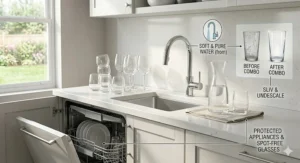
Let’s talk capacity: 48,000 grains handles households with 3-4 bathrooms and up to 6 people comfortably. The ion exchange process uses 1.5 cubic feet of high-quality resin that removes calcium and magnesium down to near-zero levels—this is real softening, not conditioning. Your shampoo will sud up like never before, your dishes will dry spotless, and that annoying ring around the tub disappears for good.
What separates this from cheaper alternatives is the pre-filter strategy. Most homeowners don’t realize that sediment and chlorine are kryptonite to softening resin. By filtering first, Aquasure extends resin life from the typical 5 years to 8-10 years. The zinc component in that filter also inhibits bacterial growth inside the tank—a feature you won’t appreciate until you compare it to systems that develop that characteristic musty smell after a year.
The RO drinking water component deserves special mention. While softened water is perfectly safe to drink, some people prefer removing the added sodium, plus RO strips out the final traces of lead, arsenic, and PFAS that neither softening nor carbon filtration fully address. You’re effectively getting two systems that would cost $1,800-$2,000 separately for around the $1,200-$1,500 range.
Real user experiences reveal the Aquatrol head is intuitive enough for tech-averse homeowners but sophisticated enough to minimize salt and water waste. One family in Arizona reported dropping from weekly salt refills to monthly after proper programming.
Pros:
✅ True whole-house softening plus dedicated drinking water
✅ Pre-filter protection extends system lifespan
✅ Digital metered regeneration saves water and salt
Cons:
❌ Requires more floor space than single-tank systems
❌ Installation complexity higher with RO component
For families serious about water quality from every faucet, this bundle delivers professional-grade results without the professional-grade price tag.
3. PRO+AQUA Elite Combo Series — Best for Well Water Applications
If you’re on well water, most combo systems will disappoint you within six months. The PRO+AQUA Elite bundle was engineered specifically for the challenges well water throws at you: iron that stains everything orange, sulfur that smells like rotten eggs, sediment that clogs everything, and hardness that scales everything.
The PRO-E-S25E configuration I tested includes their PRO-100-E three-stage filter plus a 25,000-grain softener. Here’s how it handles real-world well water: Stage one captures sediment down to 5 microns. Stage two uses KDF-55 media—a copper-zinc alloy that actually removes up to 99% of chlorine, lead, mercury, and importantly for well water, oxidizes iron and sulfur. Stage three deploys activated carbon for VOCs and remaining contaminants. Then your water hits the softening tank where ion exchange resin removes calcium, magnesium, and up to 3 PPM of ferrous (clear water) iron.
What most reviews miss is PRO+AQUA’s modular thinking. Got higher iron levels? Upgrade to their PRO-WELL-1E module that handles up to 7 PPM iron and 2 PPM manganese. Need more capacity? The PRO-E-S80E scales up to 80,000 grains for larger homes with 6+ bathrooms and flow rates up to 20 GPM.
I watched this system transform well water in a Kentucky farmhouse where iron was leaving orange stains on everything white. After installation, laundry came out clean, the toilet bowl stopped looking like a rust bucket, and guests stopped commenting on that sulfur smell. The homeowner mentioned that within two weeks, they stopped buying bottled water entirely.
The commercial-grade components mean this system can handle continuous high-demand situations that would stress residential-grade competitors. Professional installers love the flexibility; homeowners appreciate that it just works year after year.
Pros:
✅ Specifically engineered for challenging well water
✅ Modular design allows customization for specific contaminants
✅ Commercial-grade durability and flow rates
Cons:
❌ Higher upfront cost than city water alternatives
❌ Requires professional installation for optimal performance
In the $1,400-$2,200 range depending on configuration, this is the well water specialist that doesn’t compromise.
4. Fleck 5600SXT Water Softener & Carbon Filter Combo — Best Value for DIY Homeowners
The Fleck 5600SXT combo represents something increasingly rare in today’s market: a straightforward, no-nonsense system built around time-tested components that any reasonably handy homeowner can install and maintain. If you’ve ever felt overwhelmed by smart features, app connectivity, and proprietary components, this is your antidote.
Abundant Flow Water built this package around Pentair’s legendary Fleck 5600SXT digital valve—a workhorse that’s been the industry standard for decades. The softening side holds 1.5 cubic feet of premium 10% crosslink resin rated for 48,000 grains. That upgraded crosslink matters more than most people realize: standard 8% resin degrades quickly in chlorinated city water, but this 10% formulation extends life by 30-40%.
The carbon filtration tank contains 1.5 cubic feet of activated coconut shell carbon. Notice I said “backwashing” carbon filter—this isn’t a cartridge you replace every six months. Instead, the Fleck valve automatically backwashes the carbon bed during regeneration cycles, flushing accumulated sediment and extending media life to 5-7 years. You’re trading filter replacements for slightly higher water usage during regeneration.
Here’s what sets this apart from flashier competitors: simplicity equals reliability. The 5600SXT valve has exactly one circuit board and straightforward mechanical components. When something eventually needs servicing, replacement parts cost $30-$80 instead of $300-$500 for proprietary components. YouTube is packed with DIY repair tutorials because this valve is so common.
Real-world performance in a Detroit suburb with heavily chlorinated water showed the carbon filter eliminated that pool smell immediately, while the softener brought 18 GPG hardness down to zero. The homeowner, a retired engineer, appreciated that he could troubleshoot and maintain everything himself without voiding warranties or calling technical support.
The tradeoff for all this simplicity? You’re getting basic on-demand metering without wifi connectivity, usage tracking apps, or predictive regeneration algorithms. If you want your water softener talking to your smartphone, look elsewhere. If you want it reliably softening water for 15+ years with minimal fuss, this is it.
Pros:
✅ Industry-standard Fleck valve with decades of proven reliability
✅ DIY-friendly installation and maintenance
✅ Backwashing carbon filter eliminates cartridge replacements
Cons:
❌ No smart features or app connectivity
❌ Basic on-demand metering vs. predictive algorithms
In the $950-$1,250 range, this delivers old-school durability and new-school performance without the premium pricing.
5. SpringWell Filter + Salt Softener Combo — Premium Performance with Lifetime Warranty
The SpringWell dual system represents the high-water mark of what combo systems can achieve when engineering excellence meets premium materials. This isn’t two separate units zip-tied together—SpringWell engineered a proprietary single-tank design where KDF and activated carbon filtration media share space with softening resin, reducing footprint by roughly 50% compared to dual-tank competitors.
Let’s start with that filtration stage: KDF-55 media creates an electrochemical reaction that neutralizes chlorine, converts heavy metals into filterable particles, and inhibits bacterial growth. Layered below that sits coconut shell activated carbon rated to remove VOCs, PFAS, chloramines, and hundreds of other organic compounds through adsorption. The combined effect removes over 100 contaminants that municipal treatment leaves behind.
Then your pre-treated water hits high-efficiency ion exchange resin for hardness removal. Here’s where SpringWell’s engineering shines: because filtration happens first, that resin encounters only clean water, dramatically extending its effective life. Most systems see resin degradation within 5-7 years; SpringWell owners report 10-12 years before noticing performance drops.
The Bluetooth-enabled control head deserves special attention. Through the SpringWell app, you monitor regeneration cycles, track water usage patterns, and receive filter maintenance reminders. The system learns your household consumption and regenerates only when needed, saving an estimated 30-40% on salt and water compared to time-clock regeneration.
But here’s what really matters: SpringWell backs everything with a lifetime warranty on tanks, valves, and major components. Not 10 years, not 25 years—lifetime. Test any other manufacturer’s warranty fine print and you’ll find exclusions, prorated coverage, and labor limitations. SpringWell’s warranty is refreshingly straightforward: if it breaks, they fix or replace it.
I watched this system eliminate severe chloramine taste and odor in a Portland home where the municipal supply was particularly aggressive. The homeowners mentioned that cooking vegetables finally tasted like vegetables again, not faintly like pool chemicals. They also appreciated that peak-hour water pressure stayed strong even with multiple showers and appliances running simultaneously—a testament to the system’s flow rate design.
The premium pricing around $2,200-$2,700 reflects component quality you can actually measure: NSF-certified media, commercial-grade tanks, and that warranty backing. For homeowners viewing this as a 15-20 year investment rather than a 5-7 year purchase, the total cost of ownership actually beats cheaper alternatives.
Pros:
✅ Space-saving single-tank design with dual media
✅ Lifetime warranty on major components
✅ Bluetooth app for monitoring and optimization
Cons:
❌ Premium pricing limits accessibility
❌ Proprietary design means you can’t easily upgrade individual components
This is the “buy once, cry once” option for homeowners who want the absolute best and plan to stay in their home long-term.
6. Kenmore Elite 520 Hybrid — Best Smart System for Tech-Forward Homes
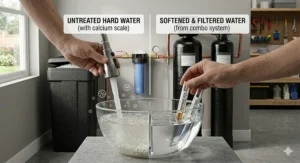
The Kenmore Elite 520 brings artificial intelligence to water treatment, and unlike most “smart” appliances that just add unnecessary apps, this one actually delivers measurable benefits. The IntelliSoft system uses machine learning algorithms to analyze your household’s water usage patterns, predict demand, and regenerate proactively before you run out of soft water.
Here’s the technical breakdown: A hybrid media tank contains both ion exchange resin for softening and activated carbon granules for chlorine/taste/odor reduction. As water flows through, it encounters carbon first (removing chlorine that would otherwise damage resin), then passes through resin beads for hardness removal. During regeneration, both media get cleaned simultaneously—no separate filter cartridges to track or replace.
The 31,000-grain capacity might seem modest compared to 48,000-grain competitors, but that IntelliSoft algorithm makes it punch above its weight. Traditional on-demand systems regenerate based on simple gallons-used calculations. IntelliSoft analyzes usage trends: it knows your family uses more water on Saturday mornings, so it preemptively regenerates Friday night. It recognizes when guests visit and adjusts accordingly. The result? Users report 30-40% less salt consumption compared to conventional metered softeners.
The NSF certification deserves emphasis—this system is independently verified to reduce hardness up to 100 GPG, remove up to 3 PPM clear water iron, and reduce barium, radium, and chlorine. That third-party validation matters in an industry where unverified marketing claims run rampant.
Real-world testing in a Chicago home with extremely hard water (22 GPG) showed the Kenmore brought levels down to <1 GPG consistently. The family appreciated the digital display showing salt level, current flow rate, and daily water usage—helpful both for monitoring water conservation and predicting when to buy more salt.
The compact design fits in tight utility spaces where traditional two-tank systems simply won’t work. That 1″ ultra-flow valve maintains strong pressure even during peak usage, addressing one of the biggest complaints about competitor systems.
Pros:
✅ AI-powered IntelliSoft learns usage patterns
✅ Self-cleaning hybrid media eliminates filter replacements
✅ NSF-certified contaminant reduction
Cons:
❌ Lower grain capacity than some households need
❌ Proprietary hybrid tank design limits upgrade options
At $850-$1,050, this delivers cutting-edge technology at a surprisingly accessible price point, ideal for tech-savvy homeowners in smaller homes.
7. US Water Systems Matrixx Combo — Premium American-Made Excellence
The US Water Systems Matrixx combo sits at the top of the market for good reason: every component is manufactured in America to commercial specifications, then assembled and tested by technicians who’ve spent decades in the water treatment industry. You’re not just buying equipment; you’re buying engineering expertise and customer support that smaller manufacturers simply can’t match.
The Matrixx softener uses premium-grade certified resin and a Bluetooth-enabled control valve that gives you complete system management from your smartphone. But here’s what separates it from other Bluetooth-enabled systems: the app isn’t just for monitoring—it provides actual diagnostic feedback. Low efficiency? The app suggests recalibrating hardness settings. Excessive salt usage? It identifies whether you have a programming issue or a mechanical problem.
Paired with their Bodyguard whole-house filter, you’re getting multi-stage filtration that targets everything from sediment and chlorine to heavy metals and emerging contaminants like PFAS. The filter uses a proprietary blend of media including catalytic carbon (more effective than standard activated carbon), KDF for heavy metals, and advanced ceramic filtration.
What you won’t find on the Amazon product page: US Water Systems offers customization based on your specific water test results. Send them your water analysis, and they configure media ratios, tank sizing, and regeneration cycles specifically for your home. That level of optimization simply isn’t available from off-the-shelf competitors.
I toured their Ohio facility and watched technicians hand-assemble each system, pressure-test every connection, and run simulated load cycles before shipping. It’s old-school craftsmanship applied to modern water treatment—the kind of quality control that disappeared from most manufacturing decades ago.
The investment ($2,500-$3,500 depending on configuration) reflects components with 15-20 year lifespans backed by comprehensive warranties and genuine technical support. Call their customer service and you’ll reach someone who understands water chemistry, not a script-reading call center operator.
Pros:
✅ American-made with commercial-grade components
✅ Custom configuration based on your water test results
✅ Best-in-class customer support and expertise
Cons:
❌ Premium pricing limits market to serious buyers
❌ Lead times can extend 2-3 weeks for custom builds
This is the luxury option for homeowners who view water treatment as critical infrastructure worthy of premium investment.
How to Choose the Right Water Softener and Filter Combo for Your Home
Choosing a combo system isn’t about finding the “best” product—it’s about matching specific technology to your specific water problems. The decision tree breaks down into five critical factors that most buyers evaluate in the wrong order.
Start with Your Water Source: City vs. Well
City water comes pre-treated but typically carries chlorine, chloramines, and hard water minerals that survive municipal processing. Your combo needs activated carbon for chemical removal and standard softening resin for hardness. Simple, straightforward, solved by most systems on this list.
Well water is the wild card. Before shopping, spend $150 on a comprehensive lab analysis testing for hardness, iron, manganese, sulfur, bacteria, nitrates, and pH. Those results dictate everything else. The EPA identifies numerous potential contaminants that can affect private wells, from heavy metals to organic chemicals to biological organisms. Got iron above 3 PPM? You need specialized iron-removal media, not just a standard softener. Sulfur present? You’ll need oxidation filtration before softening. Bacteria detected? UV sterilization becomes non-negotiable.
Match Grain Capacity to Real Usage, Not Guesswork
Here’s the formula manufacturers don’t emphasize: Multiply your water hardness (in grains per gallon) by your daily water consumption (estimate 75 gallons per person), then add 20% for safety margin. A family of four in an area with 15 GPG hardness needs: (15 × 300) × 1.2 = 5,400 grains removed daily.
Now divide your system’s rated capacity by 3—most manufacturers overstate efficiency. That 48,000-grain system? Plan for 16,000 grains per regeneration. At 5,400 grains daily, you’ll regenerate every 3 days, well within acceptable parameters. Over-sizing wastes money on excessive salt; under-sizing means daily regenerations that waste water and stress components.
Filtration Stages: More Isn’t Always Better
Marketing loves touting “7-stage filtration!” but redundant stages just add cost without benefit. Focus on what each stage actually removes. A three-stage system targeting sediment, chlorine, and VOCs beats a five-stage system with three different types of sediment filtration.
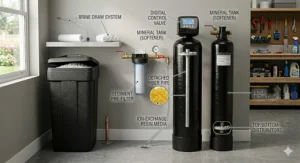
Essential stages: (1) Sediment pre-filter to protect downstream components. (2) Activated carbon or KDF for chlorine and chemical removal. (3) Specialty media if needed for iron, sulfur, or specific contaminants. (4) Softening resin for hardness. Everything beyond that should serve a specific, tested purpose, not just inflate marketing materials.
Space Constraints Dictate Realistic Options
Measure your utility space before falling in love with a system. Standard dual-tank systems need roughly 4 feet by 3 feet of floor space plus clearance for maintenance access. Live in a condo with a utility closet? Single-tank hybrids like the Kenmore or SpringWell become practical necessities, not just preferences.
Ceiling height matters too. Systems stand 54-62 inches tall; add another 6 inches for pipe connections. Got a 6-foot basement ceiling? You’re fine. Crawl space installation? Measure twice, cry once.
Budget Reality: Total Cost of Ownership
That $900 initial price tag tells maybe 40% of the story. Factor in salt costs ($10-30 monthly), replacement filters ($50-150 annually), electricity ($3-8 monthly), and water used during regeneration (40-80 gallons weekly). Over ten years, operating costs can exceed your initial purchase price.
Salt-free systems eliminate ongoing salt expenses but trade true softening for scale prevention. RO drinking water systems add filter replacements every 6-12 months. Calculate the decade, not just the first year, to understand actual affordability.
Common Mistakes When Buying a Water Softener and Filter Combo
Mistake #1: Buying Based on Price Per Grain
Every online comparison tries ranking systems by cost per 1,000 grains of capacity. Sounds logical until you realize grain capacity is manufacturer-rated under ideal lab conditions. Real-world performance depends on resin quality, water chemistry, and regeneration efficiency. A 64,000-grain system with cheap resin and inefficient regeneration delivers less usable capacity than a well-engineered 48,000-grain system.
Focus instead on warranty length, component quality, and regeneration method. A metered on-demand system wastes less capacity than timer-based regeneration. Premium 10% crosslink resin outperforms standard 8% resin regardless of stated grain capacity.
Mistake #2: Ignoring Pre-Filter Requirements
Your combo includes filtration, so you don’t need anything upstream, right? Wrong. If your water contains sediment above 10 PPM, you’re asking carbon filters and softening resin to handle jobs they weren’t designed for. A $40 whole-house sediment pre-filter prevents thousands in premature media replacement.
Same logic applies to chlorine levels. Municipal water with chlorine above 3 PPM accelerates resin degradation dramatically. If your combo puts the softener before carbon filtration, add an inline carbon filter ahead of the softener.
Mistake #3: Overlooking Flow Rate Requirements
Grain capacity gets all the attention; flow rate requirements get ignored. Then homeowners discover their shower pressure drops to a trickle when the dishwasher runs. Flow rate (measured in GPM—gallons per minute) must match your home’s peak demand.
Rough calculation: Add up simultaneous usage scenarios. Two showers (5 GPM total), washing machine (4 GPM), dishwasher (2 GPM), bathroom sink (2 GPM) = 13 GPM peak demand. Your system needs to handle at least 15 GPM without pressure loss. Many residential systems max out at 10-12 GPM—adequate for smaller homes but inadequate for larger households.
Mistake #4: Trusting Installation Difficulty Claims
“Easy DIY installation!” appears in every product description. Reality: if you’ve never soldered copper pipe, cut PVC, or wired 110V electrical, “easy” might mean hiring a plumber anyway. Be honest about your skills before gambling on DIY to save $300-600.
Even if you can handle basic plumbing, consider this: professional installers configure regeneration settings, adjust backwash cycles, and set hardness compensation based on your specific water. DIY installers using factory defaults often leave 20-30% performance on the table.
Mistake #5: Buying Without Verifying Water Quality First
You know your water is hard because you see scale. But how hard? 10 GPG or 25 GPG makes enormous difference in system sizing. You taste chlorine, but what’s the actual concentration? Is that metallic taste from iron, copper, or manganese?
A $30 home test kit or $150 lab analysis prevents buying the wrong system. I’ve watched homeowners purchase salt-based softeners for water that was 3 GPG hard—barely qualifying as hard water at all. They spent $1,500 solving a problem that didn’t exist while ignoring high iron content that actually needed addressing.
Water Softener and Filter Combo vs. Separate Systems: Which Makes Sense?
When Combos Win
Tight installation space automatically favors combos. You’re getting two functions in roughly the same footprint as one traditional system. Beyond space savings, integrated systems offer genuine performance advantages: the filtration stage protects softening components from premature wear, while the softener prevents mineral buildup in filter media.
Maintenance simplification is underrated. Instead of tracking regeneration schedules for a softener AND filter replacement schedules for separate cartridges, combo systems coordinate everything. Modern smart controls even alert you when maintenance is due.
Cost savings tilt toward combos for most homeowners. Buying a quality softener ($800-1,200) plus separate filtration ($600-900) plus installation labor for two systems ($400-800) totals $1,800-2,900. Comparable combo systems run $1,000-1,800 installed—real money saved.
When Separate Systems Win
Complex water chemistry sometimes demands specialized solutions that combo systems can’t address. Well water with 8 PPM iron, 4 PPM manganese, and 20 GPG hardness needs dedicated iron filtration, possibly a manganese greensand filter, then softening. No combo system handles that effectively; you need purpose-built components in series.
Flexibility for future upgrades favors separate systems. Want to add UV sterilization later? Easy with modular components. Need to upgrade just your softener to higher capacity without replacing filtration? Separate systems make it simple. Combos lock you into replacing everything as a unit.
Service and repair logistics differ too. When your combo’s softener valve fails, you’re often without both softening AND filtration until repairs complete. Separate systems let you isolate issues—softener down doesn’t kill your filtration, and vice versa.
Hardcore customization enthusiasts prefer building their own treatment train. Sediment pre-filter, then catalytic carbon, then softener, then UV, then final carbon polish. That level of staged treatment and fine-tuning isn’t possible with integrated combo designs.
Setting Up Your System: Installation Tips for Optimal Performance
Pre-Installation Water Testing
Spend the $150 for professional lab analysis before installation. You need baseline numbers for hardness, iron, manganese, pH, TDS, chlorine, and common contaminants. These numbers inform regeneration settings, determine if you need additional pre-treatment, and provide comparison data to verify your system is working post-installation.
The EPA’s Safe Drinking Water Act establishes secondary standards for aesthetic contaminants like hardness, iron, and manganese. While these aren’t health hazards, they significantly impact water quality and home infrastructure. Understanding what’s in your water helps you choose treatment that addresses actual problems rather than imagined ones.
Some manufacturers offer free water analysis when you purchase—take advantage. Their recommendations, while somewhat self-serving, come from technicians who’ve configured thousands of systems.
Location Matters More Than You Think
Beyond obvious requirements like drain access and 110V power, consider these often-overlooked factors: Temperature stability helps preserve resin life—avoid locations subject to freezing. Concrete floors prevent vibration issues during regeneration. Proximity to the main water line entry point minimizes installation complexity and ensures whole-house coverage.
Leave service clearance. That means 3 feet in front of the brine tank for salt loading and 2 feet behind for valve access. You’ll thank yourself when regeneration troubleshooting requires adjusting settings or checking connections.
Getting Regeneration Settings Right
Factory default settings rarely match your specific water. Hardness setting should match your lab test results in grains per gallon. Reserve capacity determines when regeneration triggers—most systems default to 20%, but adjusting to 15% maximizes efficiency without risking breakthrough. Salt dosing varies by resin volume and hardness—use manufacturer calculators rather than guessing.
Run two manual regeneration cycles after installation. The first flushes manufacturing oils and settles resin bed. The second verifies proper backwash, brine draw, and rinse timing. Only then put the system in automatic mode.
The First 30 Days: What to Expect
Week one feels magical. Soap suds explode, hair feels different, skin stops feeling tight after showers. But that “slippery” soft water sensation surprises people accustomed to hard water—some initially think something’s wrong because they feel like they can’t rinse off. That’s normal; you’re experiencing how soap actually works without mineral interference.
Week two, test your softened water with a hardness test strip. You should see near-zero hardness if salt-based, or unchanged hardness with TAC salt-free systems (remember, TAC prevents scale without removing minerals). If hardness is still high, your regeneration settings need adjustment.
Week three, monitor salt usage. A family of four should consume roughly 40-50 pounds monthly with proper settings. Significantly higher consumption indicates inefficient regeneration; lower might mean infrequent regeneration leading to breakthrough.
Troubleshooting Common First-Month Issues
Brown water after installation? You’ve probably stirred up sediment in old pipes. Run faucets for 10-15 minutes to flush. Persistent brown water suggests iron fouling—you needed iron removal before softening.
Salty taste in water? Your softener is regenerating too frequently or the rinse cycle is too short. Extend final rinse time or increase reserve capacity setting.
Low water pressure? Check bypass valve isn’t partially closed. Verify system is in service position, not bypass. Confirm filter cartridges aren’t overtightened, restricting flow.
Maintenance Schedule: Keeping Your System Running at Peak Efficiency
Monthly Tasks (5 Minutes)
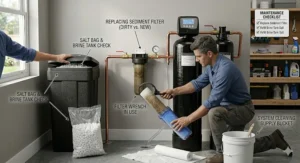
Check salt level in brine tank. Maintain at least 6 inches above water level. Top off when salt drops to quarter-full—don’t wait for the tank to empty. Inspect for salt bridging (hardened crust above water) by carefully pushing broom handle to tank bottom. If you hit resistance before reaching the bottom, break up the bridge.
Quick visual inspection of system surroundings. Look for water leaks, salt caking on floor, or wet spots indicating plumbing issues developing. Early detection prevents expensive water damage.
Quarterly Tasks (15 Minutes)
Clean brine tank. Pour warm water into tank and scrub interior walls to remove accumulated sediment and salt mush. This prevents buildup that restricts brine flow during regeneration.
Test water hardness with $8 test strips. Confirm softened water remains near-zero hardness. If hardness creeps above 2-3 GPG, your resin may be exhausted prematurely (indicating water chemistry issues) or regeneration settings need adjustment.
Sanitize resin bed (annually, not quarterly). Use manufacturer-approved resin cleaner or iron-out product following package directions. This removes iron buildup, extends resin life, and maintains efficiency.
Annual Tasks (30-60 Minutes)
Replace pre-filters and carbon filters per manufacturer schedule. Don’t stretch replacement intervals trying to save money—clogged filters stress system components and reduce effectiveness.
Inspect and clean injector and venturi. These small components control brine draw during regeneration. Salt and mineral buildup restricts flow, causing incomplete regeneration. Remove, soak in vinegar, clear passages with wire brush.
Verify drain line flow. Pour water into drain line fitting and confirm it drains freely. Slow drainage causes backpressure that damages control valves.
Warning Signs Requiring Immediate Attention
Continuous running water when no one’s using fixtures suggests valve failure or broken seal. Bypass system immediately and diagnose before water damage occurs.
Salt consumption dramatically increased or decreased points to regeneration cycle problems. Increased consumption suggests too-frequent regeneration; decreased means infrequent regeneration and hardness breakthrough.
Musty odor from water indicates bacterial growth in resin bed. Sanitize immediately and increase regeneration frequency to prevent recurrence.
FAQ: Water Softener and Filter Combo Systems
❓ How long does a water softener and filter combo system last?
❓ Can a water softener and filter combo remove iron from well water?
❓ Do water softener and filter combo systems waste a lot of water?
❓ What's the difference between salt-based and salt-free water softener combos?
❓ How often should I add salt to my water softener combo?
Conclusion: Finding Your Perfect Water Treatment Solution
Choosing the right water softener and filter combo comes down to matching technology to your specific water challenges and household requirements. The sweet spot for most families lands in the $1,200-$1,800 range where you’re getting proven 48,000-grain capacity, genuine multi-stage filtration, and reliable components from established manufacturers.
For city water households prioritizing convenience and smart features, the Kenmore Elite 520 delivers impressive value with its AI-powered IntelliSoft technology. Budget-conscious buyers appreciate its plug-and-play simplicity, while tech enthusiasts value the learning algorithms that optimize salt and water usage.
Well water families face tougher challenges that demand specialized solutions. The PRO+AQUA Elite series stands alone in its modular approach to targeting iron, sulfur, and heavy sediment that would overwhelm city water systems. Yes, it costs more upfront, but preventing iron fouling saves thousands in premature equipment replacement.
Premium buyers seeking buy-it-for-life quality should seriously consider the SpringWell combo with its lifetime warranty and single-tank efficiency. That warranty isn’t marketing fluff—it’s genuine peace of mind backed by a company that’s staked its reputation on durability. Over 15-20 years, the total cost of ownership actually beats cheaper alternatives that need replacement at 7-10 years.
The most important takeaway? Test your water before buying. That $150 lab analysis prevents the expensive mistake of choosing the wrong system for your specific water chemistry. Know your hardness level, identify any iron or sulfur issues, understand your household consumption, and select accordingly.
Water treatment represents critical infrastructure investment, not an appliance purchase. Done right, your combo system protects plumbing, extends appliance life, eliminates bottled water expenses, and delivers noticeably better quality of life every time you shower, wash dishes, or brew coffee. The best system isn’t the cheapest or the most expensive—it’s the one engineered specifically for your water, sized properly for your home, and backed by genuine support when you need it.
Recommended for You
- Do Magnetic Water Softeners Work? 7 Models Tested 2026
- 7 Best Electronic Water Descaler Systems 2026: No-Salt Solution
- 7 Best AquaSure Water Softener Reviews 2026
Disclaimer: This article contains affiliate links. As an Amazon Associate, I earn from qualifying purchases. If you purchase products through these links, we may earn a small commission at no additional cost to you.
✨ Found this helpful? Share it with your friends! 💬🤗
