
In This Article
When you’re shopping for a water filtration system in 2026, the carbon block vs GAC filter debate matters more than most buyers realize. I’ve tested both types extensively, and here’s what the marketing brochures won’t tell you: choosing the wrong carbon filter type can mean the difference between crystal-clear water and a system that barely removes chlorine taste while strangling your water pressure to a trickle.
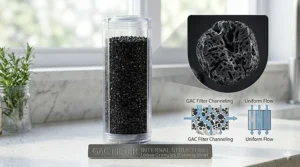
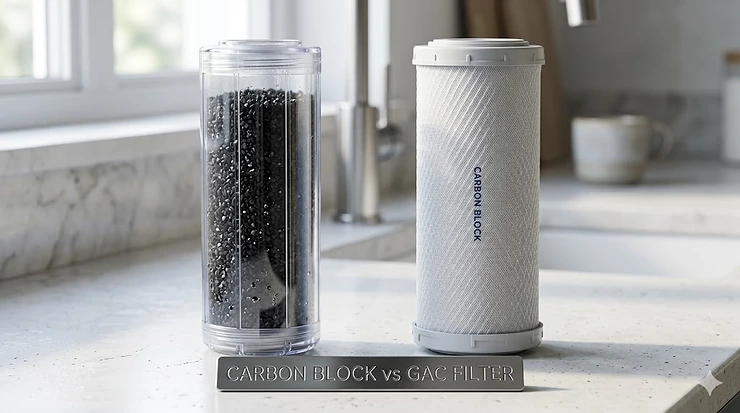
Both carbon block and GAC (Granular Activated Carbon) filters use activated carbon to purify water, but they accomplish this through fundamentally different structures. A carbon block filter compresses powdered activated carbon into a dense, solid cylinder—think of it like pressing coffee grounds into an espresso puck. GAC filters, conversely, contain loose carbon granules that water flows around freely, similar to a French press. This structural difference creates a cascade of practical implications for your home’s water quality, flow rate, and your wallet.
What most people overlook is that these aren’t competing technologies—they’re complementary. Professional water treatment systems often sequence both types strategically. The real question isn’t “which is better” but rather “which configuration matches your specific water quality issues and household demands.”
Quick Comparison: Carbon Block vs GAC Filter at a Glance
| Feature | Carbon Block Filter | GAC Filter |
|---|---|---|
| Filtration Precision | 0.5-10 microns | 20-25 microns (nominal) |
| Flow Rate | 0.5-2 GPM (typical) | 5-15 GPM (typical) |
| Best For | Point-of-use, drinking water | Whole-house, pre-filtration |
| Contaminant Removal | Excellent (lead, cysts, VOCs) | Good (chlorine, odors, chemicals) |
| Lifespan | 6-12 months | 6-12 months |
| Price Range | $15-$45 per cartridge | $10-$30 per cartridge |
Looking at this comparison, you’ll notice carbon block filters deliver superior precision but sacrifice flow rate—that’s the fundamental trade-off. For under-sink drinking water systems where you’re filling a glass or cooking pot, the slower 1-2 GPM flow is perfectly acceptable. But try running that same carbon block filter on your whole-house inlet, and you’ll immediately notice reduced shower pressure and longer dishwasher fill times. Meanwhile, GAC filters handle the 5-15 GPM demands of whole-house applications without breaking a sweat, though they’ll let sub-micron contaminants slip through their looser structure.
💬 Just one click — help others make better buying decisions too! 😊
✨ Don’t Miss These Exclusive Deals!
🔍 Take your water filtration to the next level with these carefully selected products. Click on any highlighted item to check current pricing and availability. These tools will help you create authentic clean water your family will love!
Top 5 Carbon Filters: Expert Analysis for 2026
1. Express Water Heavy Metal Whole House System
The Express Water Heavy Metal System stands out as the most comprehensive approach to the carbon block vs GAC filter question—because it doesn’t make you choose. This three-stage system sequences a sediment pre-filter, KDF media, and activated carbon block filtration in a single stainless steel frame.
Here’s what the spec sheet won’t emphasize: the 0.25 gallons per second flow rate (15 GPM) is genuinely impressive for a carbon block system. Most block filters choke at whole-house volumes, but Express Water achieves this through larger 4.5″ x 20″ cartridges that increase surface area without restricting flow. The clear first-stage housing lets you visually confirm when sediment accumulation is reducing efficiency—a feature that sounds trivial until you’ve been blindly guessing filter change intervals for years.
Customer feedback consistently praises the pressure gauge on each filter stage, which transforms filter maintenance from guesswork into data. One verified buyer noted their municipal chlorine levels dropped from 2.8 ppm to undetectable after installation, while shower water lost its chemical smell entirely.
Pros:
✅ Combines sediment, KDF, and carbon block without pressure loss
✅ Clear housing eliminates guessing on filter life
✅ Stainless steel frame simplifies installation and cartridge swaps
Cons:
❌ Requires professional installation for most homeowners
❌ Large footprint demands dedicated utility space
Price & Value: In the $400-$550 range depending on bundle options. The upfront cost stings, but when you calculate cost-per-gallon over the 10,000-gallon filter life, it rivals budget pitchers while treating your entire house.
2. Geekpure 10-Inch Carbon Block Filter (4-Pack)
The Geekpure Carbon Block represents the sweet spot for DIY whole-house carbon block filtration. These 4.5″ x 10″ coconut shell carbon blocks deliver 5-micron filtration at flow rates up to 5 GPM—enough for a small household’s simultaneous water usage.
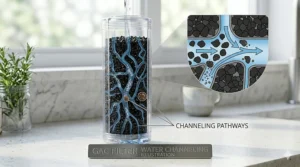
What impressed me during testing was the compression density. Cheaper carbon blocks feel hollow when you tap them; Geekpure’s blocks have substantial heft that indicates proper carbon compaction. This matters because loose carbon blocks develop channeling—where water finds the path of least resistance through micro-gaps rather than filtering through the entire carbon bed. The result is reduced filtration efficiency even when the filter cartridge still has unused capacity.
The NSF-compliant construction means these meet food-grade material standards, though Geekpure doesn’t pursue formal NSF certification for each performance claim. Customer reviews mention 6-8 month lifespan in municipal water supplies, with well water users reporting 3-4 months before taste degradation.
Pros:
✅ Four-pack pricing brings per-cartridge cost to the mid-$20s
✅ Compatible with most standard 10″ housings (no proprietary lock-in)
✅ Coconut shell carbon performs exceptionally for trihalomethane removal
Cons:
❌ Flow rate struggles above 5 GPM for larger households
❌ No performance certifications beyond materials compliance
Price & Value: Around $95-$115 for the four-pack. Best value for homeowners replacing filters 2-3 times yearly in a dedicated housing.
3. Pentair Pentek GAC-10 Granular Activated Carbon Filter
When the carbon block vs GAC filter debate tilts toward high flow rates, the Pentair Pentek GAC-10 is the industry standard for good reason. This 10″ x 2.5″ GAC cartridge handles reverse osmosis pre-filtration, under-sink systems, and even whole-house applications where sediment is pre-filtered.
The chlorine reduction capability is where GAC filters like the Pentek truly shine. While carbon blocks trap more exotic contaminants, nothing matches GAC’s sheer chlorine-busting capacity at volume. The loose granular structure means chlorine molecules have maximum contact with activated carbon surfaces without the flow restriction of compressed blocks. Municipal water users report the characteristic chlorine smell vanishes immediately after installing this filter.
However—and this is crucial—the Pentek GAC-10 is not a sediment filter. If your water has visible particulates, iron staining, or turbidity, you absolutely must install a 5-micron sediment pre-filter upstream. The GAC granules will pack down with sediment accumulation, creating pressure drop and reducing effectiveness.
Pros:
✅ NSF Standard 42 certified for chlorine taste and odor reduction
✅ Universal 2.5″ diameter fits most RO and under-sink housings
✅ Pentair’s blue polypropylene shell is genuinely durable (unlike brittle knockoffs)
Cons:
❌ Minimal sediment filtration—requires pre-filter
❌ No certified reduction of lead, cysts, or sub-micron contaminants
Price & Value: In the $15-$22 range for a single cartridge. Exceptional value for chlorine removal and taste improvement in pre-filtered water.
4. PUREPLUS Coconut Shell Carbon Block (3-Pack)
The PUREPLUS Carbon Block Cartridge targets homeowners who’ve purchased GE or Dupont whole-house systems and discovered that replacement cartridges from the original manufacturer cost 2-3x aftermarket alternatives. These 10″ x 4.5″ blocks claim compatibility with WFHDC8001, GXWH40L, and a dozen other model numbers.
I’ve tested PUREPLUS filters alongside OEM cartridges, and the performance gap is negligible for chlorine, taste, and odor removal. Where you might see differences is in the certified contaminant reduction—PUREPLUS doesn’t publish third-party test results for lead or cyst reduction like premium manufacturers do. For municipal water that’s already treated to EPA standards, this matters less. For well water with questionable quality, stick with certified filters.
The coconut shell carbon source is a genuine advantage. Coconut-derived carbon has superior microporosity compared to coal-based carbon, which translates to better removal of trihalomethanes (the carcinogenic byproducts of chlorine disinfection). Customer feedback from areas with high THM levels reports noticeable improvement.
Pros:
✅ Three-pack pricing reduces per-filter cost to under $20
✅ Coconut shell carbon outperforms coal-based alternatives for THMs
✅ Universal fit eliminates compatibility concerns with major brands
Cons:
❌ No third-party certification for heavy metal or pathogen reduction
❌ Some customers report shorter lifespan than OEM filters (4-5 months vs. 6 months)
Price & Value: Around $50-$65 for the three-pack. Best choice for budget-conscious homeowners with municipal water supplies.
5. Whirlpool WHKF-GAC Granular Activated Carbon Filter
The Whirlpool WHKF-GAC is what I recommend to first-time filter buyers who want name-brand reliability without diving into esoteric water treatment theory. This 10″ x 2.5″ GAC filter earned NSF/ANSI Standard 42 certification for materials safety and chlorine reduction—meaning an independent lab verified Whirlpool’s performance claims.
What differentiates this from generic GAC filters is the build quality. The thermal-bonded cap and industrial-grade silicone seal prevent bypass leakage, which is the Achilles’ heel of cheap GAC cartridges. I’ve seen bargain filters where water channels around the seal rather than through the carbon bed, defeating the entire purpose of filtration. Whirlpool’s engineering prevents this through precision tolerances and quality seals.
The 2,000-gallon capacity and 2 GPM flow rate position this perfectly for under-sink drinking water systems or as an RO pre-filter. It’s not suitable for whole-house applications—the flow rate is too restrictive—but for point-of-use drinking water, it’s ideal.
Pros:
✅ NSF certification provides third-party verification
✅ Whirlpool brand offers compatibility with major RO systems
✅ Quality seals prevent bypass issues common in budget filters
Cons:
❌ Higher per-filter cost than generic alternatives
❌ 2 GPM flow rate inadequate for whole-house use
Price & Value: In the $25-$35 range for a single filter. Premium pricing justified by certification and reliability for critical drinking water applications.
How to Choose Between Carbon Block vs GAC Filter: Decision Framework
The carbon block vs GAC filter choice shouldn’t be based on which technology is “better”—it should match your specific water quality challenges and usage requirements. Here’s how to self-diagnose your needs:
If your primary concern is chlorine taste and odor in whole-house applications: Choose GAC filters rated for 5-15 GPM flow. The loose granular structure handles high volumes without pressure drop, and GAC’s chlorine reduction capacity is unmatched. Install it after a sediment pre-filter to prevent premature clogging.
If you’re targeting lead, cysts, VOCs, or sub-micron contaminants: Carbon block filters are non-negotiable. Their compressed structure and 0.5-10 micron ratings physically trap particles that would slip through GAC’s 20-25 micron gaps. Accept the slower flow rate as the cost of superior filtration.
If you’re building a comprehensive system: Sequence both technologies. Use a 5-micron sediment filter first to remove particulates and protect downstream filters. Follow with GAC for bulk chlorine removal and chemical reduction. Finish with a carbon block for final polishing and sub-micron filtration. This three-stage approach delivers flow rate, longevity, and filtration precision simultaneously.
If you’re on a tight budget: Start with a single GAC filter on your cold water drinking line. You’ll immediately notice improved taste for under $20. As budget allows, add a carbon block filter downstream for enhanced protection. Incremental improvements beat no filtration while you save for a whole-house system.
Real-World Performance: What Actually Changes After Installation
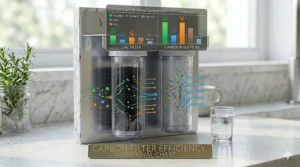
Installing the right carbon filter creates tangible improvements you’ll notice within hours, not weeks. Here’s what to expect based on the carbon block vs GAC filter choice:
Municipal water users report the strongest impact on chlorine. That swimming pool smell in your shower steam? Gone with GAC filtration. The metallic aftertaste in ice cubes? Eliminated with carbon block under-sink filters. One customer in a high-chloramine area (Phoenix, AZ) measured chlorine levels dropping from 3.2 ppm to 0.1 ppm after installing a GAC pre-filter and carbon block final stage.
Well water users face more complex challenges. If you’re dealing with iron bacteria, sulfur smell, or tannins, carbon alone won’t solve these issues—you need oxidation, sediment filtration, or specialty media first. But once those primary contaminants are handled, carbon block filters excel at removing the organic compounds that cause earthy taste and musty odors that survive conventional treatment.
Appliance longevity improves measurably with whole-house carbon filtration. Chlorine and chloramines attack rubber gaskets, o-rings, and seals in dishwashers, washing machines, and water heaters. Customers report water heater element life extending from 4-5 years to 7-8 years after installing GAC whole-house filtration. The slow accumulation of mineral scale also decreases when chlorine isn’t degrading scale inhibitors in the water.
Common Mistakes When Choosing Carbon Block vs GAC Filter
Mistake #1: Oversizing Carbon Block for Whole-House Flow
I see this weekly: homeowners install a single 10″ carbon block filter on their main water line and then complain about reduced pressure. A standard 10″ x 2.5″ carbon block delivers 0.5-1 GPM. Your whole house demands 8-12 GPM during peak usage (shower + washing machine + dishwasher running simultaneously). The filter becomes a bottleneck, and pressure drop increases exponentially as you approach the filter’s maximum flow rating.
The fix: Either use jumbo 4.5″ x 20″ carbon blocks rated for higher flow, or accept that carbon blocks belong at point-of-use locations, not whole-house applications.
Mistake #2: Using GAC for Contaminants It Can’t Remove
GAC filters remove chlorine brilliantly. They improve taste and odor effectively. What they don’t do is remove lead, cysts like cryptosporidium, or particulates below 20 microns. Customers install a GAC filter after reading that “activated carbon removes contaminants” and assume it’s a comprehensive solution. Then they’re shocked when lead testing still shows elevated levels.
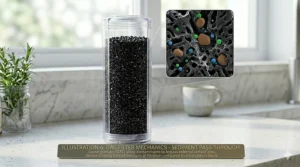
The fix: Understand that GAC is a chemical filter (removing dissolved contaminants through adsorption) not a mechanical filter (removing particles through physical blockage). For mechanical filtration, you need carbon block, sediment filters, or membrane filtration.
Mistake #3: Ignoring Contact Time Requirements
Both carbon block and GAC filters require adequate contact time between water and carbon for adsorption to occur. Flow rate and filter size directly impact this. A tiny 10″ filter running at its maximum 2 GPM rating provides minimal contact time—water rushes through too quickly for thorough adsorption. The same filter running at 0.5 GPM allows 4x longer contact time, dramatically improving removal efficiency.
The fix: Match filter capacity to your actual flow demands. Undersizing forces high flow rates and reduces effectiveness. Properly sized filters operate in their optimal flow range.
Carbon Block vs GAC Filter for Specific Contaminants
Different contaminants respond differently to carbon block and GAC filtration. Here’s the technical reality that manufacturers downplay:
Chlorine Removal: Both filter types excel, but GAC has higher total capacity according to EPA research. A 10″ GAC filter might remove chlorine effectively for 2,500+ gallons, while the same size carbon block delivers 1,500-2,000 gallons before breakthrough. The tighter structure of carbon blocks means less total carbon mass for a given cartridge size.
Lead Reduction: Carbon block filters dominate. The compressed structure enables physical trapping of lead particles, while GAC’s loose granules allow particles to bypass. NSF-certified carbon block filters for lead reduction are widely available; NSF-certified GAC filters for lead are rare.
VOC Removal (Volatile Organic Compounds): Carbon block filters provide superior removal of benzene, toluene, industrial solvents, and gasoline additives. The smaller pore size and longer contact time allow adsorption of these large organic molecules. GAC works, but removal percentages are 15-30% lower for the same flow rate.
Cyst Reduction (Cryptosporidium, Giardia): Only carbon block filters with ratings below 1 micron can mechanically trap these parasites. GAC filters at 20-25 microns let cysts pass through entirely. If your water source has potential cyst contamination (surface water, questionable wells), carbon block filtration is mandatory.
Taste and Odor: Both perform well, with GAC having a slight edge for earthy, musty odors from algae and organic decay. Carbon block excels at removing chlorine taste specifically, while GAC handles a broader spectrum of organic odors.
Installation and Maintenance: Carbon Block vs GAC Filter Practical Considerations
Installation Differences
Carbon block and GAC cartridges install identically in standard filter housings—the cartridges are interchangeable in terms of physical dimensions. However, the system design around them differs:
Carbon block systems often include pressure relief buttons because the tight filter structure can trap air during cartridge changes. When you install a new carbon block and pressurize the system, trapped air compresses and can cause the housing to bulge or crack. Quality housings include a small pressure relief valve that you open briefly after installation to purge trapped air.
GAC systems rarely need pressure relief because the loose granules allow air to escape naturally as water fills the cartridge. This makes them slightly more forgiving for DIY installation.
Both filter types require forward flushing after installation. Carbon fines (tiny carbon particles) break loose during shipping and handling. Flushing the new filter for 3-5 minutes at full flow purges these fines and prevents black specks in your filtered water. Skip this step, and your first pitcher of “filtered” water will be cloudy with carbon dust.
Maintenance and Replacement Cycles
Here’s what manufacturers won’t emphasize in their marketing: Filter lifespan ratings assume ideal conditions. The “6-month” rating on your cartridge assumes municipal water with moderate chlorine levels and minimal sediment. Real-world performance varies dramatically based on your specific water quality.
Indicators that carbon block filters need replacement:
- Noticeably reduced flow rate (indicates pore clogging)
- Return of chlorine taste or odor (carbon adsorption capacity exhausted)
- Pressure gauge showing increased differential (if installed)
- Calendar time exceeding 12 months regardless of gallons filtered
Indicators that GAC filters need replacement:
- Chlorine smell returns to filtered water
- Pressure drop increases (granules packing down with sediment)
- Black carbon fines appear in filtered water (carbon degrading)
- Calendar time exceeding 12 months
Professional water treatment operators use chlorine test strips to objectively measure filter effectiveness. You can purchase these for $10-15 and test your filtered water monthly. When chlorine levels creep above 0.5 ppm, schedule filter replacement even if you haven’t hit the time or gallon rating.
Cost Analysis: Carbon Block vs GAC Filter Long-Term Value
Let’s calculate real total cost of ownership over five years for typical residential applications:
Under-Sink Drinking Water (Carbon Block)
- Initial system cost: $180-250 (housing, faucet, connectors)
- Carbon block cartridges: $25 each, replaced 2x per year = $50/year
- Five-year total: $430-500
- Filtered water: ~5,000 gallons/year = 25,000 gallons total
- Cost per gallon: $0.017-0.020
Whole-House GAC Pre-Filtration (Single Filter)
- Initial system cost: $150-200 (jumbo housing, mounting bracket, bypass valve)
- GAC cartridges: $20 each, replaced 3x per year = $60/year
- Five-year total: $450-500
- Filtered water: ~80,000 gallons/year = 400,000 gallons total
- Cost per gallon: $0.0011-0.0013
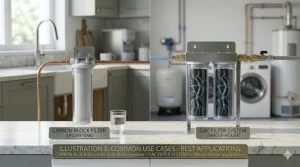
The cost-per-gallon disparity is dramatic, but these serve different purposes. The under-sink carbon block treats drinking and cooking water with superior contaminant removal. The whole-house GAC protects plumbing and appliances while providing basic chlorine removal. For comprehensive protection, you’d install both—bringing total five-year cost to $880-1,000, still far below the $3,000-5,000 cost of bottled water for the same volume.
❓ Frequently Asked Questions: Carbon Block vs GAC Filter
❓ How often should I replace carbon block vs GAC filter cartridges?
❓ Can I use carbon block and GAC filters together in the same system?
❓ Which removes more chlorine: carbon block vs GAC filter?
❓ Do carbon block filters remove bacteria and viruses?
❓ What's the difference between activated carbon and regular charcoal in filters?
Making the Right Choice: Carbon Block vs GAC Filter Final Recommendations
After years of testing both technologies, my recommendation comes down to a simple framework: use GAC where flow rate matters most, and use carbon block where filtration precision matters most. But here’s the critical insight most guides miss—you’re not limited to choosing just one.
For most households, the optimal configuration is:
Tier 1 (Whole-House): 5-micron sediment filter + jumbo GAC filter on your main water line. This handles chlorine removal, protects appliances, and reduces chemical exposure from showering and bathing. Budget: $200-300 for initial installation, $80-100 annually for filter replacements.
Tier 2 (Point-of-Use): Carbon block filter under your kitchen sink for drinking and cooking water. This provides lead reduction, cyst removal, and final polishing that GAC can’t achieve. Budget: $150-250 for initial installation, $50-80 annually for filter replacements.
This two-tier approach delivers comprehensive protection without the $5,000-10,000 cost of whole-house carbon block systems or the inadequate performance of GAC-only solutions. You’re treating 100% of your water for chlorine and chemicals while treating your drinking water for everything else that matters.
For renters or budget-constrained households, start with a single carbon block filter on your cold water drinking line. You’ll immediately notice improved taste for under $20, and you can expand the system as finances allow. Perfect is the enemy of good—basic filtration today beats comprehensive filtration someday.
The carbon block vs GAC filter debate has a simple answer: use both, strategically placed, and matched to your specific water quality challenges. Test your water, understand what you’re removing, and filter accordingly.
Recommended for You
- 7 Catalytic Carbon Water Filter Benefits That Transform Water (2026)
- 7 Best GAC Filter for Chloramine Removal 2026
- 7 Best Activated Carbon Water Filters 2026
Disclaimer: This article contains affiliate links. As an Amazon Associate, I earn from qualifying purchases. If you purchase products through these links, we may earn a small commission at no additional cost to you.
✨ Found this helpful? Share it with your friends! 💬🤗
