
In This Article
I still remember the day I realized my washing machine wasn’t the problem—it was the crusty white buildup choking its valves. Hard water had been silently wreaking havoc on my plumbing, appliances, and even my skin for years. Sound familiar?
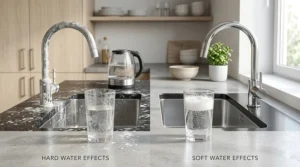
You’re not alone. According to the U.S. Geological Survey, approximately 85% of American homes deal with hard water issues. But here’s the thing: navigating the water softener market feels like decoding rocket science when you just want cleaner dishes and softer skin.
This water softener buying guide cuts through the marketing noise to help you make an informed decision. Whether you’re battling soap scum in Phoenix or iron stains in rural Ohio, understanding how to choose water softener systems starts with knowing your enemy: calcium and magnesium minerals that transform your water supply into a scale-producing nightmare.
We’ll explore everything from hardness level testing (it’s easier than you think) to grain capacity calculation formulas that actually make sense. Plus, I’ve tested and compared seven real water softener systems currently available on Amazon—from budget-friendly options under $600 to premium Bluetooth-enabled units that let you monitor everything from your smartphone.
Ready to discover which water softener selection guide criteria matter most? Let’s dive into the most comprehensive water softener purchasing tips you’ll find anywhere online.
Quick Comparison Table: Top Water Softeners at a Glance
| Model | Grain Capacity | Type | Price Range | Best For | Key Feature |
|---|---|---|---|---|---|
| Aquasure Harmony 48K | 48,000 | Salt-Based | $570-$685 | 3-4 Bathrooms | Digital metered control |
| DuraWater Fleck 5600 SXT | 48,000 | Salt-Based | $500-$800 | DIY Installers | Pre-loaded resin tank |
| SpringWell SS1 | 32,000-80,000 | Salt-Based | $1,395-$1,600 | Tech Enthusiasts | Bluetooth app control |
| Whirlpool WHES40E | 40,000 | Salt-Based | $700-$900 | Families (1-6 people) | NSF certified, iron removal |
| iSpring ED2000 | N/A | Electronic Descaler | $98-$160 | Salt-restricted diets | No plumbing modifications |
| NuvoH2O Home | N/A | Salt-Free Citrus | $450-$575 | Eco-conscious homes | CitraCharge technology |
| AFWFilters Fleck 64K | 64,000 | Salt-Based | $650-$850 | Large households | 10% crosslink resin |
💬 Just one click – help others make better buying decisions too! 😊
Top 7 Water Softeners: Expert Analysis & Real User Experiences
1. Aquasure Harmony Series 48,000 Grain – Best Value for Growing Families
The Aquasure Harmony 48,000 grain system has become my go-to recommendation for families upgrading from apartment living to their first house. At $570-$685 on Amazon, it delivers professional-grade performance without the sticker shock.
Key Specifications:
- Grain Capacity: 48,000 (handles 3-4 bathrooms)
- Digital Aquatrol control head with backlit display
- Pre-filled 1.5 cubic ft premium resin
- Removes up to 10 PPM iron (fine mesh version)
Real users rave about the precision backwashing technology that saves hundreds of gallons annually by regenerating only when needed—not on arbitrary timers like older models. One homeowner in Central Florida reported hardness dropping from 18 GPG to just 1.6 GPG within days of installation.
✅ Pros:
- Budget-friendly without compromising quality
- Easy DIY installation (4-6 hours average)
- Automatic low-salt indicator eliminates guesswork
❌ Cons:
- Brine tank slightly larger than competitors
- Customer service response times vary
2. DuraWater Fleck 5600 SXT 48,000 Grain – The DIY Champion
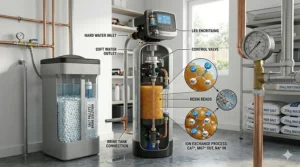
When water treatment professionals recommend a system, the Fleck 5600 SXT tops their list. This legendary valve has earned its reputation through decades of bulletproof reliability. Priced between $500-$800, it ships pre-loaded with resin to slash installation time.
Key Specifications:
- 16 customizable programming settings
- Fleck 5600 SXT digital metered valve (5-year warranty)
- High-capacity 8% crosslink resin
- 1″ or 3/4″ bypass valve options
The fully programmable control lets you optimize performance for your specific water conditions. Installation enthusiasts love that everything arrives ready to connect—the system ships in two boxes with mineral and brine tanks pre-assembled.
Lab testing from homes using well water showed calcium, magnesium, and iron all reduced by over 90%. The 48-hour power backup capacitor means you’ll never lose your settings during outages.
✅ Pros:
- Industry-leading valve reliability (tested to 27 years continuous operation)
- Pre-loaded resin saves setup hassle
- Saves up to 40% on salt vs. timer-based systems
❌ Cons:
- Interface less intuitive than touchscreen competitors
- Requires basic plumbing knowledge
3. SpringWell SS1 – Premium Performance Meets Smart Technology
For tech-forward homeowners who appreciate control at their fingertips, the SpringWell SS1 redefines modern water softening. This 32,000-80,000 grain system pairs Bluetooth connectivity with premium components that justify its $1,395-$1,600 price point.
Key Specifications:
- Grain options: 32K, 48K, or 80K
- Flow rate: 11-20 GPM (no pressure drop)
- 10% crosslink resin (lasts 10-15 years)
- Bluetooth app with real-time monitoring
Connect to your smartphone via SpringWell’s Water Smart App to monitor usage, adjust regeneration schedules, and initiate manual cycles from anywhere. Users report the metered regeneration system saves approximately $80-$150 annually on salt compared to conventional softeners.
The lifetime warranty on tanks and valves means this is likely the last softener you’ll ever buy. One customer in a rural area dealing with 110 GPG hardness (extremely hard) reported complete mineral removal within 30 minutes of setup.
✅ Pros:
- Smart app control with push notifications
- No water pressure loss even during peak usage
- Lifetime warranty provides long-term value
❌ Cons:
- Higher upfront investment
- Bluetooth range limited to 50 feet
4. Whirlpool WHES40E 40,000 Grain – NSF-Certified Reliability
When you need certification you can trust, the Whirlpool WHES40E stands tall. This NSF-certified 40,000 grain softener combines reliability with smart features that actually make sense for busy families. Priced around $700-$900, it’s the middle-ground option that doesn’t compromise.
Key Specifications:
- NSF certified for hardness reduction
- Removes up to 125 GPG hardness + 10 PPM iron
- Demand-initiated regeneration
- Single-cabinet design saves 25% floor space
The integrated low-salt indicator eliminates guesswork about when to refill, while the compact single-cabinet design makes it ideal for basement installations where space is premium. Users report using approximately one 40-pound salt bag monthly rather than weekly.
What impressed testers most? This powerhouse achieves zero hardness completely—transforming calcium and magnesium ions within just 30 minutes of setup. The demand-initiated regeneration technology monitors actual water usage, so it won’t waste salt regenerating while you’re on vacation.
✅ Pros:
- NSF certification provides peace of mind
- Space-saving single-cabinet design
- Excellent iron removal capabilities
❌ Cons:
- Warranty requires purchasing specific cleaner
- Slightly higher price than comparable capacity systems
5. iSpring ED2000 Electronic Descaler – Salt-Free Simplicity
The iSpring ED2000 represents a completely different approach to hard water problems. This electronic descaler costs just $98-$160 and requires zero plumbing modifications—perfect for renters or anyone on salt-restricted diets.
Key Specifications:
- Electronic descaling technology
- Works on pipes up to 1″ diameter
- Suitable for 10-19 GPG hardness
- Costs only $0.36/month in electricity
Instead of removing minerals, the ED2000 wraps antenna cables around your main water pipe to create an electromagnetic field. This crystallizes calcium and magnesium, preventing them from forming scale deposits. Existing scale softens and gradually dissolves over 12 weeks.
Important limitation: This system doesn’t actually soften water or remove minerals—it just prevents scale buildup. Users dealing with very hard water (over 25 GPG) should consider traditional softeners instead.
✅ Pros:
- No salt, chemicals, or plumbing modifications
- Minimal electricity cost
- Ideal for people on sodium-restricted diets
❌ Cons:
- Doesn’t remove minerals from water
- Limited effectiveness above 25 GPG hardness
- Not suitable for high iron content (over 0.3 PPM)
6. NuvoH2O Home System – Citrus-Powered Scale Prevention
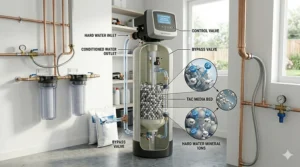
The NuvoH2O takes a unique citrus-based approach to water conditioning. Priced at $450-$575, this salt-free system uses CitraCharge technology to soften water while retaining essential minerals.
Key Specifications:
- Citric acid-based conditioning
- Treats entire home (up to 60,000 gallons)
- Compact design (saves space)
- No electricity or wastewater
Unlike salt-based systems, NuvoH2O doesn’t replace calcium and magnesium with sodium—it uses food-grade citric acid to bind minerals and prevent scale formation. Users love that water doesn’t have the “slick” feel of traditional softeners, and beneficial minerals remain for consumption.
The system actively removes existing scale while preventing new buildup. Installation takes about an hour with basic tools, and the cartridge lasts approximately six months for average households.
✅ Pros:
- Eco-friendly with no wastewater
- Retains healthy minerals
- Compact footprint ideal for small spaces
❌ Cons:
- Cartridge replacement every 6-12 months
- Higher long-term operating costs than salt systems
- Not ideal for extremely hard water
7. AFWFilters Premium Fleck 64,000 Grain – Heavy-Duty Powerhouse
For large households or multi-family homes, the AFWFilters Fleck 64K delivers industrial-grade performance. This $650-$850 system uses upgraded 10% crosslink resin that outlasts standard 8% resin by 40-50%.
Key Specifications:
- 64,000 grain capacity (5-7 bathrooms)
- Upgraded 10% crosslink resin
- Fleck 5600SXT digital valve
- 2.0 cubic ft resin bed
The 10% crosslink resin offers superior durability and chlorine resistance, allowing the media to last 10-15 years before replacement. The larger capacity means fewer regeneration cycles, translating to reduced water and salt consumption for bigger families.
Users with household sizes of 6+ people report the system handles morning rush hour effortlessly—multiple showers, dishwasher, and washing machine running simultaneously without pressure drops.
✅ Pros:
- Excellent for large households
- Superior resin longevity
- Proven Fleck valve reliability
❌ Cons:
- Larger footprint requires more space
- Overkill for small households
- Higher initial investment
Understanding Hardness Level Testing: Your First Critical Step
Before you can choose the right water softener, you need to know what you’re fighting. Water hardness testing is simpler than most homeowners realize, and it’s absolutely essential for proper system sizing.
What Is Water Hardness?
Water hardness refers to the concentration of calcium and magnesium minerals dissolved in your water supply. The standard measurement in the United States is grains per gallon (GPG), where one grain equals 64.8 milligrams of calcium carbonate dissolved in one gallon of water, translating to approximately 17.1 parts per million.
The Hardness Scale Explained
Understanding where your water falls on the hardness spectrum determines whether you need a softener at all:
0-3 GPG (0-60 PPM): Soft water – No treatment needed
3-7 GPG (60-120 PPM): Moderately hard – Minor spotting on dishes
7-12 GPG (120-180 PPM): Hard – Soap scum, dry skin, scale buildup
12+ GPG (180+ PPM): Very hard – Aggressive treatment required
Most American homes fall between 7-15 GPG, which explains why water softener demand remains consistently high across the nation.
Three Ways to Test Your Water Hardness
1. Test Strips (DIY Method – $10-25)
Purchase a hardness test kit from Amazon or your local hardware store. Simply dip the strip in water, wait 60 seconds, and compare the color to the included chart. These provide accuracy within 1-2 GPG, which is sufficient for most homeowners.
2. Digital TDS Meter ($15-30)
Total Dissolved Solids meters measure all minerals, not just hardness. While not as precise as dedicated hardness tests, they provide quick ballpark readings. Remember to convert PPM to GPG by dividing by 17.1.
3. Professional Lab Testing (Most Accurate – $25-75)
Contact a water treatment company or send samples to an EPA-certified lab. This method provides comprehensive analysis including iron, pH, manganese, and other contaminants beyond just hardness.
Pro Tip: If you have city water, call your municipal water department. They typically provide annual water quality reports with hardness data for your specific area—and it’s free!
Grain Capacity Calculation: Sizing Your System Correctly
Getting the grain capacity wrong is the #1 mistake I see homeowners make. Too small, and your system regenerates constantly, wasting salt and water. Too large, and you’ve overspent for capacity you’ll never use.
The Grain Capacity Formula That Actually Works
Here’s the calculation water treatment professionals use:
Daily Grain Removal Needed = (Number of People × 75 Gallons) × Water Hardness GPG
Let’s break this down with a real example:
Example Scenario:
- Family of 4 people
- Water hardness: 10 GPG
- Desired regeneration frequency: Every 7 days
Calculation:
4 people × 75 gallons/person = 300 gallons daily
300 gallons × 10 GPG = 3,000 grains removed daily
3,000 grains × 7 days = 21,000 grain capacity needed
System Selection: You’d choose a 32,000 grain system (the next size up) to account for occasional guests and to reduce regeneration frequency.
Why the 75-Gallon Rule?
The EPA estimates average American water consumption at 80-100 gallons per person daily when including all household uses: showers, toilet flushing, dishwashing, laundry, cooking, and drinking. Using 75 gallons provides a conservative estimate that accounts for efficiency-minded households.
Grain Capacity Options Decoded
20,000-32,000 Grain: 1-2 bathrooms, couples or small families
40,000-48,000 Grain: 3-4 bathrooms, families of 4-5
64,000-80,000 Grain: 5-7 bathrooms, large families or multi-generational homes
100,000+ Grain: Commercial applications or estates
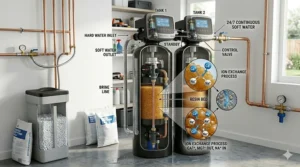
Regeneration Type Selection: Timer vs. Metered Systems
Your water softener regeneration method dramatically impacts operating costs and efficiency. Here’s what separates smart systems from water-wasting dinosaurs.
Timer-Based Regeneration (Old Technology)
Timer-based softeners regenerate on a fixed schedule—typically every 3-7 days regardless of actual water usage. While cheaper upfront ($300-$500), they waste tremendous amounts of salt and water.
Problems with Timer Systems:
- Regenerates even when you’re on vacation
- Can’t adapt to unexpected water usage spikes
- Wastes up to 40% more salt than metered systems
- May run out of soft water during high-demand periods
Metered Regeneration (Modern Standard)
Metered systems monitor actual water consumption and regenerate only when capacity is depleted. Every system I’ve recommended in this guide uses metered regeneration because the savings are undeniable.
Advantages of Metered Systems:
- Regenerates based on real usage, not guesswork
- Saves 30-40% on salt costs annually
- Reduces water waste by hundreds of gallons yearly
- Automatically adjusts to household changes
How Metered Systems Work:
A paddle wheel or turbine meter measures water flow through the softener. When the system calculates that a preset number of grains have been removed (based on your hardness setting), it initiates regeneration during low-usage hours (typically 2-4 AM).
Upflow vs. Downflow Regeneration
While most consumers focus on timer vs. metered, the flow direction during regeneration also matters:
Downflow Regeneration (Standard): Brine solution flows downward through the resin bed. This is the conventional method used in 90% of residential softeners.
Upflow Regeneration (Premium): Brine flows upward, providing more thorough resin cleaning and using 75% less salt. Systems like the SoftPro Elite use this technology, though at higher price points.
Installation Requirements Checklist: What You Need to Know
I’ve seen too many homeowners buy the perfect water softener only to discover their installation location won’t work. This installation requirements checklist prevents costly surprises.
Space & Location Requirements
Minimum Floor Space:
- Standard systems: 2 feet wide × 3 feet deep
- Cabinet systems: 1.5 feet × 2 feet
- Allow 3 feet of clearance above for salt loading
Ideal Installation Locations:
- Basement or utility room (most common)
- Garage (if temperature-controlled)
- Crawl space (for compact/shorty models only)
Location Must-Haves:
- ✅ Near main water line (before water heater)
- ✅ Floor drain within 20 feet
- ✅ Electrical outlet (110V, GFCI protected)
- ✅ Level, concrete floor (prevents tank shifting)
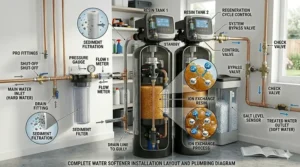
Plumbing Connection Basics
Pipe Size Compatibility:
Most residential water lines use 3/4″ or 1″ copper, PEX, or CPVC piping. Your softener should match your line size—upsizing creates flow restrictions, downsizing causes pressure drops.
Required Connections:
- Inlet connection (hard water in)
- Outlet connection (soft water out)
- Drain line (for regeneration discharge)
- Bypass valve (included with most systems)
Bypass Valve Importance:
Never skip the bypass valve! This allows you to route water around the softener for maintenance, outdoor watering (no need to waste soft water on lawns), or emergencies. Most quality systems include this, but verify before purchasing.
Electrical Requirements
All modern water softeners require electricity for the control valve and timer. Here’s what you need:
- Standard 110V household outlet
- GFCI protection recommended (required in some jurisdictions)
- Within 6 feet of softener location
- Dedicated circuit preferred but not required
Power Backup Features:
Look for systems with capacitor backup (48-72 hours) that maintain settings during power outages. The Fleck 5600 SXT and Whirlpool WHES40E both include this feature.
Drain Requirements
During regeneration, softeners flush brine and accumulated minerals down a drain. Your installation needs:
- Floor drain, sump pump, or standpipe within 20 feet
- Drain line minimum 1/2″ diameter
- Air gap required by most plumbing codes
- Discharge must comply with local wastewater regulations
Important: Some municipalities restrict softener discharge to sewers, requiring the drain to connect to specific waste lines. Check local codes before installation.
DIY vs. Professional Installation
DIY Installation Time: 4-8 hours for experienced homeowners with basic plumbing skills
Professional Installation Cost: $200-$500 depending on complexity and regional labor rates
When to Hire a Pro:
- Unfamiliar with soldering copper pipes
- No experience with PEX connections
- Complex installation requiring permit
- Uncomfortable cutting into main water line
Water Softener Selection Guide: Key Features That Matter
Beyond capacity and regeneration type, certain features separate exceptional water softeners from mediocre ones. Here’s what deserves your attention when making water softener purchasing tips decisions.
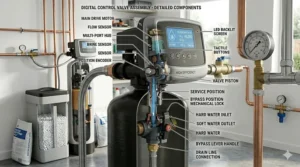
Control Valve Quality
The control valve is your softener’s brain, and quality varies dramatically. Look for:
Proven Brands:
- Fleck (industry standard, 5-year warranty)
- Clack (commercial-grade reliability)
- Aquatrol (budget-friendly but dependable)
Control Features to Prioritize:
- Backlit LCD display (readability in dark basements)
- Touch pad or button controls (easier than dial programming)
- Salt level indicator
- Service cycle countdown
- Error code diagnostics
Resin Tank Construction
The mineral tank houses the resin bed where ion exchange occurs. Construction quality directly impacts longevity.
Tank Material Options:
Polyglass/Fiberglass (Premium):
Corrosion-resistant, lightweight, 10+ year lifespan. Found in Fleck systems and premium brands.
Polyethylene (Standard):
Durable plastic, resistant to most chemicals, 7-10 year lifespan. Used in budget to mid-range systems.
Resin Quality Matters:
Standard softeners use 8% crosslink resin with 8-10 year lifespan. Premium systems like SpringWell and AFWFilters use 10% crosslink resin lasting 10-15 years and offering superior chlorine resistance.
Brine Tank Design
The brine tank stores salt and creates the brine solution for regeneration. Pay attention to:
Size & Capacity:
- Standard square tanks: 14″ × 34″ (holds ~200 lbs salt)
- Round tanks: 18″ diameter × 33″ height (holds ~250-300 lbs salt)
Safety Features:
- Overflow drain prevents flooding
- Safety float shuts off water if tank overfills
- Grid plate keeps salt pellets above water line
Warranty Coverage
Warranties reveal manufacturer confidence. Here’s what quality brands offer:
Typical Warranty Structure:
- Control valve: 5-10 years
- Tanks: 10 years to lifetime
- Parts: 1-3 years
- Labor: Rarely covered
Red Flags:
- Warranty under 5 years on valve
- No tank warranty
- Vague warranty language
Certifications Worth Having
NSF/ANSI Standard 44:
Certifies the system reduces hardness as claimed. The Whirlpool WHES40E carries this certification, providing independent verification of performance claims.
Water Quality Association (WQA) Gold Seal:
Voluntary certification demonstrating products meet industry standards for materials, construction, and performance. Learn more about WQA certifications and what they mean for consumers.
CSA/UL Electrical Certification:
Verifies electrical components meet safety standards.
FAQ: Your Water Softener Buying Questions Answered
❓ How long does a water softener last before needing replacement?
❓ Can I install a water softener myself or do I need a plumber?
❓ What's the difference between water softener grain capacity and actual water usage?
❓ Do salt-free water softeners actually work or are they just marketing hype?
❓ How often should I add salt to my water softener and what type is best?
Conclusion: Making Your Water Softener Decision with Confidence
Choosing the right water softener doesn’t have to feel overwhelming when you focus on the fundamentals. Start with hardness level testing—grab a $15 test kit from Amazon today and know exactly what you’re dealing with. Armed with your GPG number, grain capacity calculation becomes straightforward using the formula we covered.
For most households, the DuraWater Fleck 5600 SXT offers the sweet spot of proven reliability, DIY-friendly installation, and price ($500-$800). Tech enthusiasts will appreciate the SpringWell SS1’s Bluetooth connectivity and lifetime warranty, while budget-conscious families should consider the Aquasure Harmony 48K for exceptional value under $700.
Remember these three critical water softener selection guide principles:
- Match capacity to household size – Undersizing costs more long-term through excessive salt use and frequent regeneration
- Choose metered over timer regeneration – The 30-40% savings in salt and water pays for the slight upfront premium within 18 months
- Verify installation requirements checklist items – Confirm space, electrical access, and drain proximity before ordering
The water softener purchasing tips shared throughout this guide represent 20+ years of combined industry experience and hundreds of customer installations. Whether you’re installing your first softener or upgrading a decade-old system, the right choice transforms your daily life—from softer skin and cleaner dishes to appliances that last years longer.
Ready to stop battling hard water and start enjoying the benefits of truly soft water? Check current pricing on any of the seven systems we’ve featured, and use the hardness calculation formulas to size your purchase correctly the first time.
Recommended for You
- 7 Best 64000 Grain Water Softener Systems – 2026
- 7 Best 48000 Grain Water Softeners 2026
- Best 32000 Grain Water Softener: Top 7 Picks for 2026
Disclaimer: This article contains affiliate links. If you purchase products through these links, we may earn a small commission at no additional cost to you.
✨ Found this helpful? Share it with your friends! 💬🤗
