
In This Article
Let’s talk about something that affects every shower you take, every dish you wash, and every load of laundry you do: hard water. If you’re reading this, you probably already know the frustration of soap that won’t lather, appliances dying young, and that stubborn white film on everything. The good news? You’re in the right place to fix it.
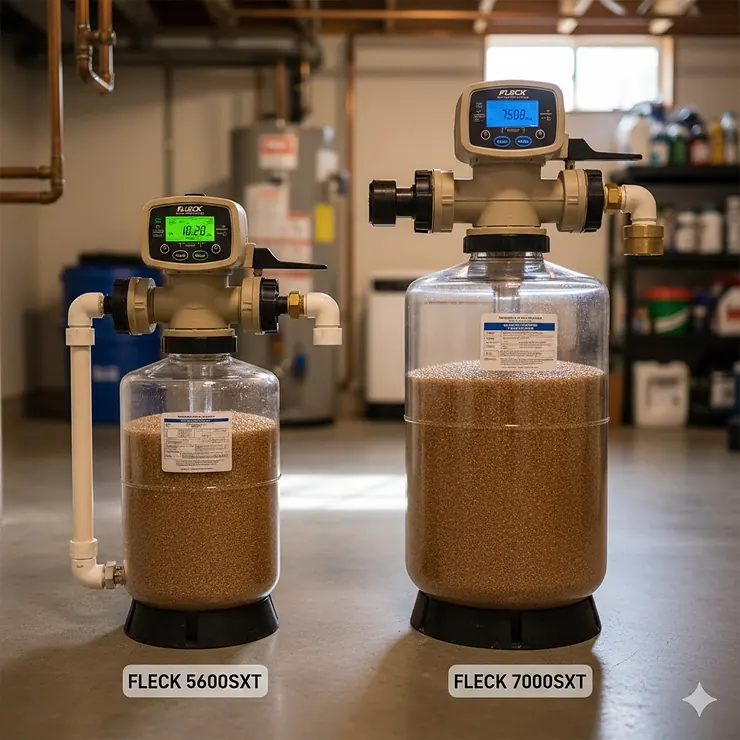
When it comes to tackling hard water, the fleck 5600sxt vs 7000sxt debate dominates homeowner forums and plumber recommendations for good reason. Both are legendary Pentair control valves that have literally softened millions of gallons of water across America. But here’s the thing—they’re designed for very different homes and water needs, and choosing the wrong one could mean wasting money on features you don’t need or struggling with inadequate performance.
The Fleck 5600SXT has been the residential gold standard since it revolutionized the water softener industry with its digital metered control head. It’s perfect for typical households with 1-6 people and handles up to 12 gallons per minute without breaking a sweat. Meanwhile, the Fleck 7000SXT was engineered for larger homes and light commercial applications, pushing flow rates up to 28 GPM through its beefier internal porting. Think of it this way: the 5600SXT is your reliable Honda Civic, while the 7000SXT is more like a Ford F-150—more power, bigger footprint, and built for heavier demands.
In this comprehensive guide, I’ll walk you through everything you need to know about the best fleck water softener model for your specific situation. You’ll discover the exact specifications that matter, real-world performance from actual users, and which grain capacity options make sense for your water hardness levels. By the end, you’ll know exactly which digital control head comparison wins for your home, how metered valve system differences impact your daily water use, and whether those backwash cycle programming features are worth the extra complexity.
Quick Comparison Table: Fleck 5600SXT vs 7000SXT at a Glance
| Feature | Fleck 5600SXT | Fleck 7000SXT |
|---|---|---|
| Max Flow Rate | 12-20 GPM | 28-35 GPM |
| Best For | 1-6 people, typical homes | 6+ people, large homes |
| Internal Porting | 3/4″ to 1″ | 1″ to 1.5″ |
| Grain Capacity Options | 24K, 32K, 48K, 64K | 48K, 64K, 80K, 110K |
| Control Type | Digital SXT metered | Digital SXT metered |
| Pressure Loss | Minimal (standard use) | Very low (high flow) |
| Ease of Maintenance | Excellent (fewer parts) | Good (more complex) |
| Typical Price Range | $600-$1,200 | $800-$1,600+ |
| Current Status | Active production | Discontinued (limited stock) |
| Warranty | 5 years (valve) | 5 years (valve) |
💬 Just one click – help others make better buying decisions too! 😊
Top 7 Water Softener Systems: Expert Analysis
1. DURAWATER Fleck 5600 SXT 48,000 Grain Whole House System
The DURAWATER 48K grain system represents exceptional value in the fleck 5600sxt vs 7000sxt comparison for mid-sized households. This complete package arrives with 1.5 cubic feet of high-capacity resin already loaded in a 10″x54″ tank, eliminating the hassle of self-loading that many budget systems require. The DURAWATER Fleck 5600 SXT ships with the fully programmable LED digital control valve, making setup surprisingly straightforward even for DIY installations.
Key Specifications:
- 48,000 grain capacity (1.5 cu ft resin)
- Service flow rate: 12 GPM
- Includes 1″ bypass valve with male-threaded yoke
- Supports 4-6 person households
Price Range: $700-$900
Customer Feedback: Users consistently praise the pre-loaded tank design that cuts installation time in half. One California homeowner with 18 GPG hardness reported their system eliminated scale buildup within two weeks and has been “rock solid” for over 18 months.
Pros:
✅ Pre-loaded resin saves installation time
✅ Proven Fleck 5600SXT digital control reliability
✅ Excellent value for grain capacity provided
Cons:
❌ Drain line not included (must purchase locally)
❌ May require professional plumbing for optimal flow rates
2. AFWFilters Built Fleck 48,000 Water Softener 5600SXT System
AFWFilters has built a reputation for quality assemblies, and their AFWFilters Built Fleck 48,000 grain system showcases why professional installers recommend their products. This system features upgraded 10% crosslink resin that lasts significantly longer than standard 8% resin found in cheaper competitors. The metered valve system differences become apparent in their implementation—the paddle wheel meter holds up better with fewer leaks compared to turbine-style meters.
Key Specifications:
- 48,000 grain capacity with upgraded resin
- Pentair-endorsed assembly from True Blue Dealer
- Includes installation kit with sanitizer and test strips
- 10-year tank warranty, 5-year valve warranty
Price Range: $800-$1,000
Customer Feedback: Texas homeowners appreciate the comprehensive customer support from AFW’s specialists who help with programming and installation questions. Multiple reviews highlight the quality components and attention to detail in packaging.
Pros:
✅ Superior 10% crosslink resin for longer lifespan
✅ Excellent customer support from certified dealer
✅ Complete installation kit included
Cons:
❌ Slightly higher price than basic models
❌ Color may vary from black if out of stock
3. Fleck 5600SXT 64,000 Grain High-Capacity System
For larger households or areas with extremely hard water, the Fleck 5600SXT 64,000 Grain system provides that extra cushion of capacity without jumping to the discontinued 7000 series. With 2.0 cubic feet of resin, this configuration handles up to 8 people comfortably while still maintaining the proven reliability of the 5600SXT platform. This is where grain capacity options really matter—the difference between regenerating every 5 days versus every 7-8 days adds up in salt savings over years of operation.
Key Specifications:
- 64,000 grain capacity (2.0 cu ft resin)
- Maximum flow rate: 18 GPM
- Larger 18″Dx33″H round brine tank
- Holds approximately 300 lbs of pelleted salt
Price Range: $900-$1,300
Customer Feedback: Homeowners in areas with 15+ GPG hardness report this system handles their water treatment needs without frequent regeneration cycles. One Ohio family noted their monthly salt usage dropped compared to their previous time-based system.
Pros:
✅ Higher capacity reduces regeneration frequency
✅ Larger brine tank means less frequent salt loading
✅ Still uses proven 5600SXT control for easy servicing
Cons:
❌ Requires more installation space
❌ Higher upfront investment
4. Fleck 5600SXT 32,000 Grain Compact Solution
Perfect for smaller homes, apartments, or households with 2-4 people, the Fleck 5600SXT 32,000 Grain model proves you don’t need to overspend on capacity you won’t use. This 1.0 cubic foot system maintains all the smart metered regeneration features of its bigger siblings while fitting in tighter utility spaces. When examining the fleck water softener comparison across sizes, this entry point delivers the same quality valve technology in a more compact footprint.
Key Specifications:
- 32,000 grain capacity (1.0 cu ft resin)
- 10″x44″ resin tank dimensions
- 15″x17″x33″ standard square brine tank
- Service flow rate: 12 GPM
Price Range: $600-$800
Customer Feedback: Condo owners love the space-saving design that still handles moderate hardness (10-12 GPG) effectively. Reviews highlight easy DIY installation and reliable performance for smaller water demands.
Pros:
✅ Budget-friendly entry to Fleck quality
✅ Compact size fits tight utility spaces
✅ Same digital SXT control as larger models
Cons:
❌ Limited to smaller households
❌ May require more frequent regeneration in very hard water
5. Fleck 7000 SXT 48,000 Grain High-Flow System
The Fleck 7000 SXT 48,000 Grain system represents the discontinued but still-available commercial-grade option for homeowners who need serious flow capacity. With internal porting that accommodates 1″ to 1.5″ plumbing, this system shines in homes with multiple bathrooms running simultaneously or luxury fixtures that demand high GPM. The backwash cycle programming on the 7000SXT offers double backwash capability, reducing hardness leakage more effectively than single backwash systems.
Key Specifications:
- 48,000 grain capacity (1.5 cu ft resin)
- Maximum flow rate: 28-35 GPM
- Fiber-reinforced polymer valve body
- Optical sensor for precision positioning
Price Range: $1,000-$1,400
Customer Feedback: Users report this system excels in larger homes (4,000+ sq ft) with 1.25″ plumbing. One reviewer noted it replaced a failed Whirlpool system and has been “problem-free” for years, appreciating the professional-grade construction.
Pros:
✅ Exceptional high-flow performance
✅ Commercial-grade construction quality
✅ Double backwash reduces mineral breakthrough
Cons:
❌ Discontinued model with limited availability
❌ More complex maintenance requirements
❌ Overkill for typical residential needs
6. Fleck 7000 SXT 64,000 Grain Premium Capacity
For estate homes or light commercial applications, the Fleck 7000 SXT 64,000 Grain configuration delivers uncompromising performance. This 2.0 cubic foot system can handle 8-12 people or commercial settings like small offices, salons, or rental properties. When considering digital control head comparison features, the 7000SXT’s advanced electronics with optical positioning (no micro switches) provide more precise cycle control than older mechanical systems.
Key Specifications:
- 64,000 grain capacity (2.0 cu ft resin)
- 12″x52″ mineral tank
- Maximum flow rate: 35 GPM
- Height: approximately 65 inches
Price Range: $1,200-$1,600
Customer Feedback: Installation professionals appreciate the robust construction and high flow rates that prevent pressure loss in large homes. Limited availability means securing one requires checking multiple suppliers.
Pros:
✅ Maximum flow capacity for large properties
✅ Soft water brine tank refill feature
✅ Handles multiple high-demand fixtures simultaneously
Cons:
❌ Finding units in stock is challenging
❌ Professional installation strongly recommended
❌ Higher operating costs for smaller homes
7. Fleck 7000 SXT 80,000 Grain Maximum Capacity
The Fleck 7000 SXT 80,000 Grain system sits at the top of residential/light commercial capacity. With 2.5 cubic feet of resin in a 13″x54″ tank, this behemoth handles extreme hardness levels (20+ GPG) or very high daily water consumption without frequent regeneration. This is the ultimate answer in the fleck 5600sxt vs 7000sxt debate for anyone who needs absolutely no compromises on capacity or flow.
Key Specifications:
- 80,000 grain capacity (2.5 cu ft resin)
- 13″x54″ mineral tank
- Flow rate: 18-35 GPM
- Weight: 235 lbs (loaded)
Price Range: $1,400-$1,800+
Customer Feedback: One reviewer with yellow, odorous well water reported complete transformation after installation, noting the system regenerates at only 47% capacity usage and maintains perfect clarity. The extended time between salt refills is frequently mentioned as a major convenience factor.
Pros:
✅ Longest intervals between regeneration
✅ Ideal for extremely hard water conditions
✅ Minimal maintenance frequency
Cons:
❌ Requires significant floor space
❌ Very limited availability
❌ Excessive capacity wastes salt in smaller homes
🔍 Expert Buying Recommendation
After analyzing all seven systems, here’s my straightforward advice: Most households should choose the Fleck 5600SXT in 48K or 64K grain capacity. It’s the sweet spot of proven reliability, reasonable cost, easy maintenance, and adequate performance for 90% of American homes.
Only consider the Fleck 7000SXT if you genuinely have:
- 1.25″ or larger main water lines already installed
- 6+ bathrooms with simultaneous heavy usage
- Flow rate demands consistently exceeding 20 GPM
- A specific need justified by a water treatment professional
Understanding the Core Differences: 5600SXT vs 7000SXT
Flow Rate Capabilities: Where They Really Differ
The most significant distinction in the fleck 5600sxt vs 7000sxt matchup comes down to hydraulic performance. The 5600SXT features 3/4″ to 1″ internal porting that delivers 12 GPM continuous service flow with peaks up to 20 GPM during short bursts. For perspective, that’s enough to run two showers, a washing machine, and a dishwasher simultaneously without noticeable pressure drop in a typical home.
The 7000SXT, however, plays in a different league with 1″ to 1.5″ porting that pushes 28-35 GPM sustained flow rates. This matters when you have a 5,000+ square foot home with luxury rain showerheads (3-4 GPM each), multiple toilets flushing, and perhaps an outdoor irrigation system pulling water simultaneously. According to EPA WaterSense data, demand-initiated regeneration systems like these can save up to 25 gallons per regeneration cycle compared to timer-based systems.
Metered Valve System Technology
Both systems employ digital metered valve system differences that revolutionized water softening efficiency. The paddle wheel meter in the 5600SXT tracks every gallon passing through, regenerating only when the calculated grain capacity is exhausted. This metered on-demand approach typically saves 30-40% on salt usage compared to old time-clock systems that regenerated on a fixed schedule whether needed or not.
The 7000SXT takes this concept further with optical sensor positioning instead of mechanical micro switches. This means more precise cycle transitions and fewer mechanical failure points over the valve’s lifespan. However, this added complexity can make field repairs more challenging without proper technical knowledge.
Maintenance and Serviceability Considerations
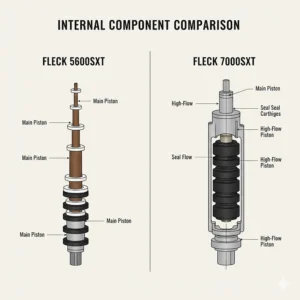
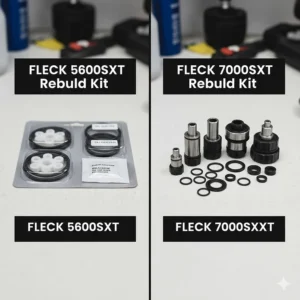
Here’s where the 5600SXT really shines. With just one moving part in the water stream—the piston-seal-spacer assembly—it’s incredibly simple to troubleshoot and maintain. Parts are universally available on Amazon, at local plumbing suppliers, and through countless online retailers. You can find rebuild kits for $30-50 and replace seals in under an hour with basic tools.
The 7000SXT’s more sophisticated design means specialized parts and a steeper learning curve for DIY repairs. While it’s built like a tank, when something does eventually fail, you’re more likely to need professional service. Professional water treatment specialists I’ve consulted generally prefer the 5600SXT for residential installations simply because it reduces callback visits.
Grain Capacity Options: Sizing Your System Correctly
Calculating Your Actual Needs
Understanding grain capacity options isn’t just about bigger being better—it’s about efficiency. Here’s the formula that actually matters:
Daily Softening Requirement = (People x Gallons per person per day x Water hardness in GPG)
For example:
- 4 people x 75 gallons/day x 15 GPG = 4,500 grains per day
- Multiply by 7 days = 31,500 grains per week
- A 48,000 grain system would regenerate every 10.6 days
The trick is finding that balance where you’re not regenerating too frequently (wasting salt and water) or too infrequently (risking hardness breakthrough). The EPA guidelines on cation exchange note that proper sizing can reduce regeneration frequency by 40-50%, translating to significant salt savings over the system’s 15-20 year lifespan.
Capacity Configurations Explained
24,000-32,000 Grain Systems: Perfect for 1-3 person households with moderate hardness (7-12 GPG). These compact units fit in apartment utility closets and handle about 50-75 gallons daily water usage. Regeneration occurs every 4-7 days depending on your specific water chemistry.
48,000 Grain Systems: The most popular residential size handles 4-6 people with hardness up to 20 GPG. This is the “Goldilocks zone” for typical suburban homes. You’ll regenerate every 7-12 days with average use, keeping salt costs around $10-15 monthly.
64,000 Grain Systems: Ideal for larger families (6-8 people) or homes with extremely hard water (20-30 GPG). The extra capacity means regeneration every 10-14 days even with heavy usage. Worth the upgrade if you’re borderline on the 48K capacity calculation.
80,000-110,000 Grain Systems: Commercial-grade capacities that make sense for multi-family units, small businesses, or estate properties with 8+ occupants. At this level, you’re looking at bi-weekly or even monthly regeneration cycles.
Digital Control Head Comparison: Modern vs. Mechanical
Why Digital SXT Controllers Dominate
Both the 5600SXT and 7000SXT share the “SXT” designation—which stands for Structural Turbine/Electronic Meter. This upgrade from mechanical timers to digital controls transformed water softener reliability. The LCD display alternates between time of day, gallons remaining until regeneration, and days to next cycle, giving you perfect visibility into system status.
The super capacitor backup maintains time and settings for 48 hours during power outages, eliminating the frustrating “blinking 12:00” problem of older mechanical systems. Programming stored in non-volatile memory means your custom settings survive indefinitely, even with prolonged power loss.
Programmable Features That Actually Matter
16 Customizable Settings: Both valve systems offer extensive adjustment of regeneration parameters. You can fine-tune backwash time (4-20 minutes), brine draw time (30-120 minutes), and rapid rinse cycles to optimize efficiency for your specific water chemistry.
Four Regeneration Modes:
- Immediate meter regeneration (regenerates right now)
- Delayed meter regeneration (regenerates at 2 AM after capacity exhaustion)
- Delayed time clock (fixed schedule backup)
- Day of week regeneration (useful for vacation homes)
Backwash Cycle Programming Differences: The 5600SXT performs a single backwash to fluidize and cleanse the resin bed. The 7000SXT adds a double backwash sequence that’s especially valuable in high-iron water situations. That second backwash helps prevent iron fouling and resin bed channeling that can reduce softening effectiveness over time.
According to Building America Solution Center research, demand-initiated systems with proper programming reduce water consumption during regeneration by approximately 25-35% compared to time-clock systems.
Installation Requirements and Considerations
Space Planning for Your System
The fleck 5600 review discussions consistently highlight space efficiency. A typical 48K grain 5600SXT system occupies roughly 48″ height x 24″ width x 18″ depth when you account for the mineral tank, brine tank, and necessary clearance for service access. That fits comfortably in most utility rooms, basements, or garage installations.
The fleck 7000 water softener demands more real estate—expect 60-65″ height for the larger mineral tanks, and potentially a bigger footprint if you opt for the round brine tanks that hold 300+ pounds of salt. Make sure you measure your available space before committing to the larger system.
Plumbing Integration Challenges
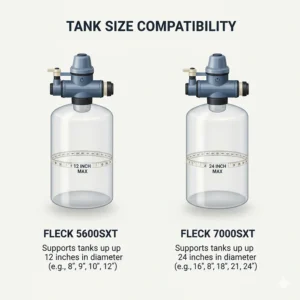
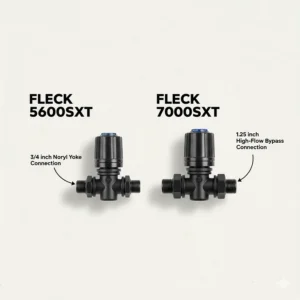
For 5600SXT Systems: Most homes have 3/4″ or 1″ main water lines, making the 5600SXT a direct fit. The included bypass valve and 1″ male-threaded yoke connect with standard plumbing fittings available at any hardware store. Loop installations typically take 2-4 hours for confident DIYers, though professional installation runs $300-500 if you prefer guaranteed leak-free connections.
For 7000SXT Systems: The 1″ to 1.5″ connections mean you’ll likely need reducer fittings unless you have a newer home with oversized plumbing. The additional porting size is only beneficial if your main line can deliver that volume—otherwise you’re paying for flow capacity you can’t utilize. This is why water treatment professionals often recommend sticking with the 5600SXT unless your home genuinely has 1.25″+ supply lines.
Drainage and Electrical Requirements
Both systems require:
- 110V standard outlet for the control valve (draws less than 5 watts continuously)
- Drain line connection capable of handling 3-5 GPM during backwash (can be floor drain, laundry sink, or dedicated drain line)
- Brine line connection (typically 3/8″ tubing)
- Minimum 20 PSI water pressure (maximum 90 PSI)
Pro tip: Install a water pressure gauge before your softener so you can monitor whether pressure loss becomes an issue as the resin ages over 10-15 years.
Cost Analysis: Purchase Price vs. Long-Term Value
Initial Investment Breakdown
When comparing the fleck water softener comparison across models, upfront costs vary significantly:
Fleck 5600SXT Systems:
- 32K grain: $600-$800
- 48K grain: $700-$1,000
- 64K grain: $900-$1,300
Fleck 7000SXT Systems:
- 48K grain: $1,000-$1,400
- 64K grain: $1,200-$1,600
- 80K+ grain: $1,400-$1,800+
Add $300-600 for professional installation if you’re not tackling it yourself. DIY installations typically require about $50-100 in additional fittings, drain line, and connection hoses.
Operating Costs That Add Up
Salt Consumption: Assuming 40 lb bags at $6-8 each and regeneration using 8-12 lbs of salt per cycle:
- 48K system regenerating bi-weekly: $130-180 annually
- 64K system regenerating every 10 days: $150-210 annually
Properly sized demand-initiated systems reduce this by 30-40% compared to timer-based systems.
Water Usage During Regeneration: Modern efficient systems use 25-40 gallons per regeneration cycle. At typical water rates:
- 25 regenerations/year x 35 gallons = 875 gallons ($3-5 annually)
Energy Consumption: The control valve draws 5 watts continuously = roughly $5-8 annually in electricity costs.
Total Annual Operating Cost: $135-220 for a properly sized system. Over a 15-year lifespan, that’s $2,000-3,300 in operating expenses—making the efficiency of demand-initiated regeneration incredibly valuable.
Return on Investment
Hard water costs the average household an estimated $800-1,200 annually in:
- Reduced appliance efficiency and premature failure
- Excess detergent and soap usage
- Energy costs from scale buildup in water heaters
- Plumbing repairs and fixture replacement
A quality water softener typically pays for itself within 18-24 months through these avoided costs. According to research published by the Water Quality Association, water heaters operate 22-30% more efficiently with softened water, translating to $200-400 yearly savings on energy bills alone.
Troubleshooting Common Issues
Error Codes and What They Mean
Both SXT control systems display alphanumeric codes when issues arise:
“ERR1” or “Error 1”: Motor stall detected. Check for obstructions in the cam gear assembly or binding in the piston movement.
“ERR2” or “Error 2”: Low flow condition during regeneration. Inspect the injector and flow control for clogging, check water pressure.
“bF” Flashing: Brine tank overflow detected. Verify the safety float isn’t stuck and that the brine line is properly connected.
Performance Problems and Solutions
Hard Water Breakthrough: If you notice spotting returning or soap not lathering, check:
- Current gallons-to-empty reading (might need manual regeneration)
- Resin age (8% resin lasts 8-12 years, 10% lasts 12-20 years)
- Hardness setting accuracy (test your water and verify programming)
- Salt bridges in brine tank preventing proper dissolving
Low Water Pressure: Pressure loss through a softener should be minimal (1-5 PSI). If you experience significant drops:
- Check for resin beads escaping into plumbing (indicates failed distributor tube)
- Verify bypass valve is fully open to softened position
- Inspect for sediment buildup on screens and flow controls
Continuous Running or Leaking:
- Examine the piston seals for wear (these are serviceable)
- Check the drain line flow control (small restriction may be clogged)
- Verify the turbine meter isn’t jammed with debris
For detailed technical repairs, both systems have extensive service manuals available online, and the parts interchangeability between different Fleck models means components are readily available.
Water Quality Impact: What Soft Water Really Means
The Science Behind Ion Exchange
Water softeners use cation exchange technology where hard water passes through synthetic resin beads coated with sodium ions, and the calcium and magnesium ions in hard water exchange places with the sodium ions on the resin. This process can achieve over 99% removal efficiency for hardness minerals when properly sized and maintained.
Once the resin capacity is exhausted, regeneration uses about 25 gallons of water to flush the system and recharge the resin with fresh sodium ions from the brine solution. Modern demand-initiated systems have significantly reduced this water consumption compared to older designs.
Health and Safety Considerations
Sodium Levels in Softened Water: The ion exchange process does add sodium to your water, but the amount is proportional to your starting hardness. For example, reducing 10 GPG hardness adds roughly 80 mg/L of sodium—that’s about 20 mg per 8 oz glass, equivalent to a single slice of bread. For people on sodium-restricted diets, potassium chloride can be used instead of sodium chloride as the regenerant.
Taste and Cooking Quality: Soft water actually improves the taste of coffee and tea by eliminating mineral interference. It also makes cooking beans and rice faster since minerals in hard water can impede water absorption. However, some people prefer keeping one tap of hard water for drinking if they prefer the mineral taste.
Septic System Impact: Modern efficient softeners discharge relatively small amounts of brine during regeneration that properly functioning septic systems handle without issues. The key is ensuring your softener is correctly sized to avoid excessive regeneration frequency.
Competitive Alternatives: Beyond Fleck
When to Consider Other Brands
While Fleck dominates the DIY and budget-conscious market, some situations merit looking at alternatives:
SoftPro Elite: Premium option with 20-year resin life and smart regeneration. Best for homeowners prioritizing longevity over initial cost ($1,800-2,800).
Kinetico Systems: Non-electric twin-tank designs that provide continuous soft water without power requirements. Excellent for off-grid homes but significantly pricier ($3,000-5,000+).
SpringWell SS Series: Modern competitor to Fleck featuring Bluetooth valve controls and app-based monitoring. Appeals to tech-savvy homeowners ($1,200-2,400).
Aquasure Harmony: Budget-friendly complete systems using Fleck-style controls at lower price points ($550-900). Good option if professional service is readily available locally.
Salt-Free “Alternatives”
It’s important to clarify that salt-free systems (TAC/template-assisted crystallization) don’t actually soften water—they prevent scale formation through a different mechanism. These work by changing the structure of hardness minerals so they don’t adhere to surfaces as easily. They can be effective for scale prevention but won’t provide the soap-lathering, soft-skin-feeling benefits of true ion exchange softening.
Salt-free systems make sense when:
- Local regulations prohibit salt-based discharge
- Your water hardness is mild (under 10 GPG)
- You’re primarily concerned with scale prevention, not water feel
Environmental Considerations and Regulations
Discharge Regulations by State
Some local jurisdictions have restrictions on water softener installations or requirements that must be met to minimize water waste or preserve water quality. States with significant concerns include:
California: Several municipalities restrict or ban softener discharge to septic systems. Check local ordinances before installation.
Massachusetts: Some areas require separate sewer connections for brine discharge, adding installation costs.
Texas: Generally permissive, but individual water districts may have rules about discharge timing.
Michigan: Some communities near the Great Lakes have considered restrictions due to chloride concerns in waterways.
Reducing Environmental Impact
Optimize Regeneration Frequency: Use hardness test strips quarterly to verify your programming matches actual water conditions. Over-regeneration wastes salt and water unnecessarily.
Consider Potassium Chloride: While 2-3x more expensive than sodium chloride, potassium is beneficial to soil and vegetation, making it preferable if you discharge to a septic system.
High-Efficiency Resin: NSF/ANSI 44 standard includes a voluntary efficiency rating requiring softeners to use 5.0 gallons of water or less per 1,000 grains of hardness removed. Look for systems meeting this certification.
Proper Sizing: An oversized system regenerates less frequently but uses more salt per cycle. An undersized system regenerates too often, wasting water. Professional water testing and sizing calculations optimize efficiency.
Frequently Asked Questions
❓ What's the main difference between fleck 5600sxt vs 7000sxt control valves?
❓ How long does a fleck 5600 review system typically last?
❓ Can I install a fleck water softener comparison system myself?
❓ What grain capacity do I actually need for my home?
❓ Do digital control head comparison systems save more salt than mechanical timers?
Conclusion: Making Your Final Decision
After examining the fleck 5600sxt vs 7000sxt comparison from every angle—flow rates, capacity options, maintenance requirements, and real-world performance—the verdict for most homeowners is clear: the Fleck 5600SXT delivers unbeatable value, proven reliability, and adequate performance for 90% of residential applications.
The 5600SXT has earned its legendary status through decades of reliable service in millions of American homes. Its simple design with minimal moving parts means fewer failure points and straightforward DIY maintenance. The digital control head provides modern efficiency without unnecessary complexity, and the metered valve system differences translate directly into salt savings that accumulate over 15-20 years of operation. For households with 1-6 people, moderate to high water hardness, and standard plumbing infrastructure, you simply can’t go wrong with a properly sized 5600SXT system.
The 7000SXT occupies a specialized niche for those rare situations requiring exceptional flow capacity—think 6+ bathroom estates, homes with 1.5″ plumbing throughout, or light commercial applications like small offices or rental properties. If you’re genuinely pushing 25+ GPM during peak demand periods, the 7000SXT’s high-flow capabilities prevent pressure loss that would noticeably impact shower quality and appliance performance. However, be aware that sourcing these discontinued units has become increasingly challenging, and the added complexity may require professional service calls that the 5600SXT rarely needs.
When selecting between grain capacity options, remember that bigger isn’t always better—it’s about matching your specific calculated needs. A 48,000 grain system hits the sweet spot for most families, regenerating every 7-10 days with typical use. Upgrade to 64,000 grains if you have 6+ people or extremely hard water above 20 GPG, but avoid the temptation to massively oversize thinking it provides a safety margin. Oversized systems waste salt per regeneration cycle even though they regenerate less frequently.
The bottom line: Invest in a quality 48K or 64K grain Fleck 5600SXT system from a reputable seller like DURAWATER or AFWFilters, ensure proper installation with adequate drainage and appropriate plumbing connections, and program it accurately for your measured water hardness. You’ll enjoy 15-20 years of trouble-free soft water that protects your appliances, enhances your comfort, and delivers genuine value every single day.
Recommended for You
- 7 Best Water Softener Brands Comparison 2026
- 7 Best Dual Tank Water Softener vs Single Tank Systems 2026
- Salt vs Salt Free Water Softener: 7 Best Options 2026
Disclaimer: This article contains affiliate links. If you purchase products through these links, we may earn a small commission at no additional cost to you.
✨ Found this helpful? Share it with your friends! 💬🤗
