
In This Article
Have you ever been mid-shower when the water suddenly feels different, leaving your skin dry and your hair tangled? That’s hard water breaking through during your softener’s regeneration cycle. If this sounds familiar, you’re probably dealing with a single tank system that can’t keep up with your family’s demands.
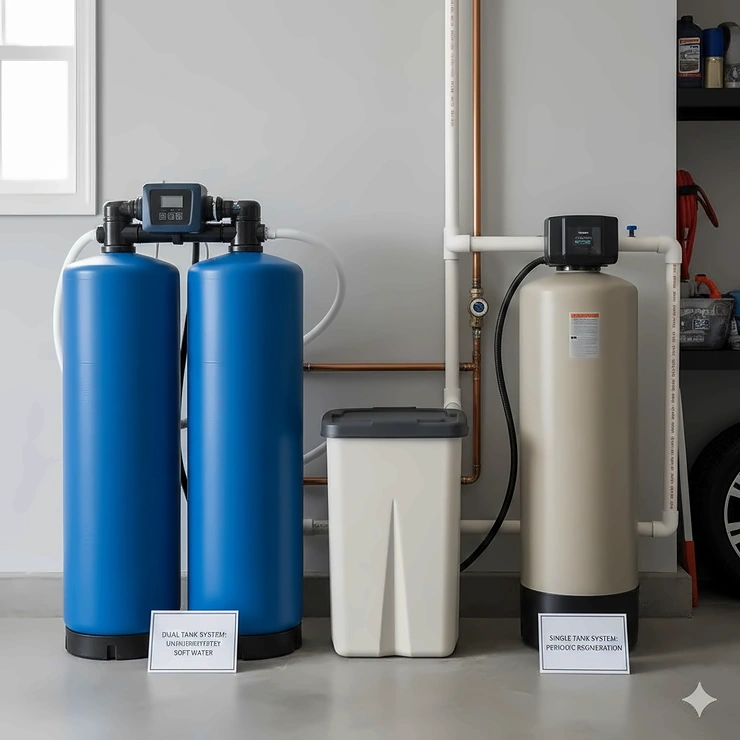
The battle between dual tank water softener vs single tank systems isn’t just about capacity—it’s about convenience, efficiency, and never running out of soft water again. While single tank systems pause softening during their regeneration cycle (typically 2-3 hours in the middle of the night), twin tank water softener benefits include 24/7 operation where one tank serves your home while the other regenerates.
According to the U.S. Geological Survey, approximately 85 percent of American households deal with hard water. The choice between single tank vs dual tank system configurations can dramatically affect your daily water quality experience. Dual tank configurations deliver continuous soft water supply through their alternating regeneration cycle, ensuring backup tank operation kicks in seamlessly when needed.
In this comprehensive guide, I’ll walk you through everything you need to know about these systems, compare seven real products currently available on Amazon, and help you decide which uninterrupted water flow system fits your home’s needs. Whether you’re a family of two or seven, understanding twin cylinder configuration benefits will transform how you think about water treatment.
Quick Comparison Table
| Feature | Single Tank System | Dual Tank System |
|---|---|---|
| Soft Water Availability | Interrupted during regeneration | 24/7 continuous supply |
| Regeneration Downtime | 2-3 hours (hard water during this time) | Zero downtime |
| Salt Efficiency | Standard usage | 15-30% more efficient |
| Water Waste | 5-10 gallons per cycle | Minimal waste |
| Initial Cost | $400-$900 | $1,200-$2,500 |
| Space Required | Compact (1-2 sq ft) | Larger (3-4 sq ft) |
| Ideal For | 1-3 people, moderate hardness | 4+ people, high hardness, commercial |
| Maintenance Complexity | Simple | Moderate |
💬 Just one click – help others make better buying decisions too! 😊
Top 7 Water Softeners: Expert Analysis
1. DuraWater Fleck 9100 SXT Dual Tank Softener
The DuraWater Fleck 9100 SXT represents the gold standard in twin tank water softener benefits. This powerhouse system features the industry-leading Fleck 9100 digital metered control valve, designed to provide truly uninterrupted water flow system performance 24 hours a day, seven days a week.
Key Specifications:
- Capacity: 24,000-80,000 grains (multiple sizes available)
- Control: Digital Fleck 9100 SXT valve
- Flow Rate: Up to 17 GPM
The twin cylinder configuration operates intelligently—while one tank serves your home, the other regenerates using soft water, creating a self-sustaining continuous soft water supply. Customer feedback consistently praises the system’s reliability, with one verified buyer noting they haven’t experienced hard water breakthrough in over two years of operation.
Price Range: $1,400-$2,200 depending on grain capacity
✅ Pros:
- True 24/7 soft water with alternating regeneration cycle
- 15% savings on both salt and water compared to single tank systems
- Valve tested to equivalent of 27 years of daily use
- Uses 100% of tank capacity before regenerating
❌ Cons:
- Requires significant installation space (3-4 square feet)
- Higher upfront investment than single tank models
Target Audience: Large families (5+ people), homes with very hard water, or anyone who can’t tolerate soft water interruptions.
2. AFWFilters Fleck 9100SXT Twin Tank Water Softener
The AFWFilters Fleck 9100SXT takes backup tank operation to the next level with its premium Purolite C100E resin. This upgraded resin provides superior hardness removal and longer lifespan compared to standard 8% crosslink resin found in most competitors.
Key Specifications:
- Capacity: 48,000 grains per tank (96,000 total)
- Resin: Premium Purolite C100E
- System: Complete dual metered on-demand
What sets this system apart is its metered regeneration—it only regenerates when actually needed based on water usage, not on a fixed timer. Customers appreciate the premium components and report consistent 0 GPG hardness readings even during heavy usage periods.
Price Range: $1,800-$2,100
✅ Pros:
- Premium resin for enhanced durability
- Complete system arrives ready to install
- Superior control over regeneration timing
- Excellent customer support from AFWFilters
❌ Cons:
- Premium pricing reflects quality components
- Installation requires professional plumbing knowledge
Target Audience: Homeowners seeking the best dual tank water softener with premium components and willing to invest for long-term performance.
3. SpringWell SS Salt-Based Single Tank Softener
For those considering the single tank vs dual tank system debate, the SpringWell SS represents the pinnacle of single tank design. This system uses upgraded 10% crosslink resin (compared to standard 8%) for better chlorine resistance and longevity.
Key Specifications:
- Capacity: 32,000-80,000 grains (SS1, SS4, SS+ models)
- Flow Rate: 11-20 GPM depending on model
- Resin: 10% crosslink for enhanced durability
The SS series features demand-initiated regeneration, making it more efficient than timer-based systems. Independent testing showed it removed 97.5% of calcium and magnesium. However, like all single tank systems, it provides no continuous soft water supply during its 2-hour regeneration cycle.
Price Range: $900-$1,400
✅ Pros:
- Lifetime warranty on tanks and valves
- Upgraded resin for better performance
- Multiple size options for different home sizes
- Strong brand reputation
❌ Cons:
- No backup tank operation during regeneration
- Soft water unavailable during 2-hour regeneration cycle
- May experience breakthrough during high-demand periods
Target Audience: Households with 1-4 people who can schedule water usage around regeneration cycles.
4. Aquasure Harmony Series Water Softener
The Aquasure Harmony Series offers exceptional value in the single tank category. Available in multiple capacities from 30,000 to 64,000 grains, this system includes integrated pre-filtration that removes sediment, chlorine, and other contaminants before the softening process.
Key Specifications:
- Capacity: 30,000-64,000 grains
- Control: Digital metered with LED display
- Pre-Filter: Triple-purpose sediment/GAC/zinc filter
Customer reviews highlight the easy programming and clear digital display. The system’s automatic backwash feature only activates when needed, conserving water. One reviewer noted dropping their hardness from 44 GPG to less than 1 GPG after installation.
Price Range: $600-$900
✅ Pros:
- Affordable entry into water softening
- Integrated pre-filtration extends resin life
- 5-year extended warranty available
- Pre-assembled for easier installation
❌ Cons:
- Single tank means no continuous soft water supply
- Pre-filter cartridges need replacement every 6-12 months
- Not suitable for very high iron content (>2 PPM)
Target Audience: Budget-conscious families seeking reliable softening without the premium cost of twin tank systems.
5. WaterBoss Model 900 Water Softener
The WaterBoss Model 900 breaks the mold with its incredibly fast regeneration—just 26 minutes compared to 2-3 hours for most single tank systems. This American-made unit includes a built-in self-cleaning whole-house filter, eliminating the need for separate filtration.
Key Specifications:
- Capacity: 36,400 grains
- Regeneration Time: 26 minutes (industry-leading)
- Built-in Filter: Self-cleaning sediment filter
- Iron Removal: Up to 10 PPM ferrous iron
The compact design fits in spaces where traditional softeners won’t, making it popular for homes with limited utility room space. The fast regeneration means less vulnerability to hard water breakthrough, though it still doesn’t match the uninterrupted water flow system performance of dual tank configurations.
Price Range: $550-$700
✅ Pros:
- Fastest regeneration cycle (26 minutes)
- Compact footprint saves space
- Handles high iron content
- Built-in whole-house filtration
❌ Cons:
- No alternating regeneration cycle like dual tanks
- Smaller capacity may require more frequent regeneration for large families
- Some customer reports of unit failures after 2-3 years
Target Audience: Homes with space constraints and moderate to high iron content in water supply.
6. WaterBoss Model 700 Compact Water Softener
The WaterBoss Model 700 serves as the compact alternative for smaller households. This system maintains the brand’s signature fast regeneration (just 19 minutes) while fitting into even tighter spaces than its larger sibling.
Key Specifications:
- Capacity: 22,000 grains
- Regeneration Time: 19 minutes
- Salt Usage: 2.5 lbs per regeneration
- Hardness Removal: Up to 70 GPG
Customer feedback emphasizes the easy DIY installation and efficient operation. One owner mentioned using only one 40-pound bag of salt per month for a family of three. The ultra-compact design makes it ideal for crawl spaces or small utility closets.
Price Range: $450-$600
✅ Pros:
- Ultra-compact for tight installations
- Extremely fast regeneration
- Low salt consumption
- Easy DIY installation with included kit
❌ Cons:
- Limited capacity unsuitable for large families
- No twin tank water softener benefits
- Lower hardness removal capacity (70 GPG max)
Target Audience: Singles, couples, or small families with limited space and moderate water hardness.
7. iSpring ED2000 Electronic Water Descaler
The iSpring ED2000 represents a completely different approach—it’s not technically a softener but a salt-free electronic descaler. Using electromagnetic waves, it prevents minerals from forming scale without removing them from the water.
Key Specifications:
- Type: Electronic descaler (not ion exchange)
- Installation: Wraps around existing pipes
- Maintenance: Zero—no salt, no filters
- Coverage: Up to 50 feet of plumbing
This system appeals to those on salt-restricted diets or environmental concerns, as it doesn’t add sodium or waste water during regeneration. However, it doesn’t remove hardness minerals—it only prevents them from adhering to surfaces. Customers report reduced soap scum and easier cleaning, though water still feels “hard.”
Price Range: $140-$180
✅ Pros:
- No chemicals, salt, or maintenance required
- Works on any pipe type (PEX, PVC, copper)
- Minimal electricity use (36 cents/month)
- Eco-friendly with no water waste
❌ Cons:
- Doesn’t provide actual soft water feeling
- No continuous soft water supply (it’s not a softener)
- Less effective on very hard water (>25 GPG)
- Won’t work with high iron content (>0.3 PPM)
Target Audience: Environmentally conscious homeowners, people on low-sodium diets, or those seeking scale prevention rather than true softening.
✨ Don’t Miss These Exclusive Deals!
🔍 Take your water quality to the next level with these carefully selected products. Click on any highlighted item above to check current pricing and availability on Amazon. These systems will help you achieve authentic soft water results your family will appreciate for years!
What Is Dual Tank Water Softener vs Single Tank?
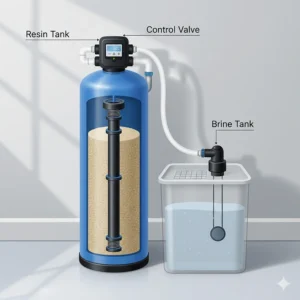
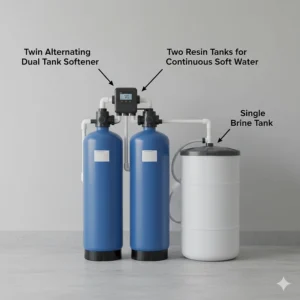
Dual tank water softener vs single tank refers to the fundamental architectural difference in how residential water softening systems maintain continuous operation. A single tank system contains one resin tank and one brine tank, requiring the entire household to receive hard water during the 2-3 hour regeneration process. In contrast, a dual tank configuration features two independent resin tanks sharing a single brine tank, with intelligent valve controls ensuring one tank always provides soft water while the other regenerates, creating truly uninterrupted service.
The distinction impacts daily life more than most homeowners realize. According to water treatment research, ion exchange water softening requires periodic regeneration where salt brine washes accumulated hardness minerals from the resin beads. Single tank systems schedule this process during low-usage hours (typically 2-4 AM), but unexpected demands—like teenage guests taking late showers—can trigger hard water breakthrough when the system needs to regenerate during high-use periods.
Twin tank water softener benefits become apparent in real-world scenarios. Imagine hosting weekend guests, running multiple loads of laundry, and needing showers throughout the day. A single tank system might exhaust its capacity and begin delivering hard water until it completes regeneration. Meanwhile, a dual tank system’s backup tank operation seamlessly activates, switching to the second tank while the first regenerates using already-softened water, which actually improves regeneration efficiency.
The alternating regeneration cycle in dual tank systems also provides 15-30% better salt efficiency compared to single tank models. How? Single tank systems must maintain a “reserve capacity” (typically 20-30% of total capacity) to ensure they don’t run out during regeneration scheduling. This reserve gets regenerated whether used or not, wasting salt. Dual tank systems use 100% of each tank’s capacity before switching, eliminating wasted regeneration cycles.
Space considerations matter too. Single tank vs dual tank system footprint differs significantly—single tank units typically occupy 1-2 square feet, while dual tank configurations require 3-4 square feet. For homes with cramped utility rooms, this could be a dealbreaker regardless of performance benefits.
How Single Tank Water Softeners Operate
Single tank water softeners follow a straightforward three-phase operational cycle. During the service phase, hard water enters the resin tank where negatively charged resin beads attract and capture positively charged calcium and magnesium ions, releasing sodium ions in exchange. This ion exchange process, first developed in the 1930s, remains the most effective method for true water softening.
When the resin becomes saturated with hardness minerals (typically after treating 20,000-50,000 gallons depending on system capacity), the regeneration phase begins. A concentrated salt brine solution flows through the resin tank, and the high concentration of sodium ions displaces the trapped calcium and magnesium, flushing them down the drain. This process takes 90-180 minutes and uses 40-70 gallons of water plus 6-15 pounds of salt.
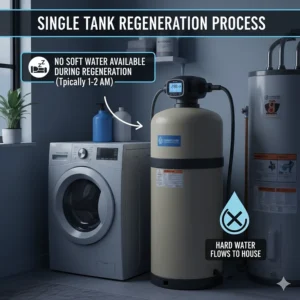
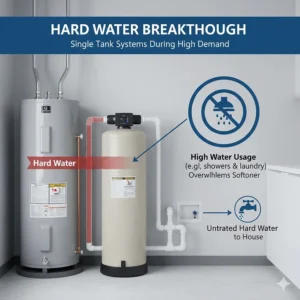
The backwash phase rinses residual brine from the resin tank, preparing it for the next service cycle. Here’s the critical limitation: during both regeneration and backwash, the system cannot provide softened water. Your household receives untreated hard water straight from the supply line.
Modern single tank systems use demand-initiated regeneration rather than fixed timers. A meter tracks water usage, and when consumption reaches a preset threshold (say, 75% of capacity), the system schedules regeneration for a programmed time, typically 2-3 AM when household water use is minimal. Some advanced models like the SpringWell SS even learn your usage patterns to optimize regeneration timing.
Temperature affects performance too. Research from the Water Quality Research Foundation shows cold water softening efficiency drops compared to warmer temperatures. Most systems perform optimally with inlet water temperatures between 40-120°F, though this rarely impacts residential installations.
The reserve capacity challenge remains single tank systems’ biggest drawback. To prevent running completely dry and serving hard water during high-demand periods, these systems must trigger regeneration before reaching 100% capacity. This safety margin—essentially unused capacity that still requires salt to regenerate—reduces overall efficiency by 15-25%.
Understanding Dual Tank System Advantages
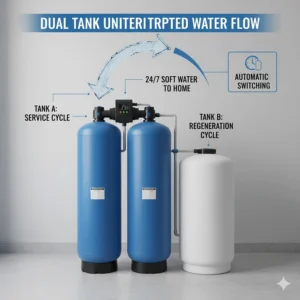
Dual tank systems revolutionize water softening through their twin cylinder configuration that eliminates the fundamental limitation of single tank designs. Each tank operates independently, controlled by sophisticated valve technology that monitors capacity in real-time. When Tank A approaches exhaustion, the control valve seamlessly switches water flow to Tank B within seconds—so quickly you’ll never notice the transition.
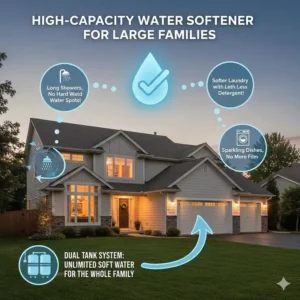
The continuous soft water supply creates practical benefits beyond mere convenience. Consider a large family’s Sunday: morning showers, brunch cleanup, laundry, car washing, and evening dishes. A single tank system might exhaust its capacity midday, forcing regeneration during active hours and delivering hard water for 2-3 hours. The dual tank configuration handles this scenario effortlessly, with Tank B serving the household while Tank A regenerates in the background.
Regeneration efficiency improves dramatically in twin tank water softener benefits scenarios. Remember those resin beads that capture hardness? They clean more effectively with soft water than hard water. Dual tank systems use already-softened water from the active tank to regenerate the offline tank, creating a cleaner, more thorough restoration of the resin’s ion exchange capacity. Single tank systems must regenerate with the same hard water they’re trying to treat, reducing effectiveness by an estimated 10-15%.
The alternating regeneration cycle optimizes resource utilization. According to data from Pentair’s Water Quality Division, dual tank systems achieve 20-30% better salt efficiency by using 100% of each tank’s capacity before regenerating. No wasted reserve capacity, no “just in case” regeneration cycles. Each tank runs to true exhaustion, then regenerates using soft water at an optimal time determined by actual usage, not arbitrary scheduling.
Commercial applications particularly benefit from uninterrupted water flow system performance. Restaurants, hotels, laundromats, and car washes cannot tolerate service interruptions. A café making espresso drinks all day needs consistently soft water to prevent mineral buildup in expensive equipment. Dual tank systems deliver this reliability, which explains their dominance in commercial water treatment despite higher upfront costs.
System longevity improves with twin tank configurations too. The alternating operation pattern means each tank works “part-time” compared to a single tank running continuously. This reduces mechanical wear on valves, extends resin life, and distributes operational stress across more components. Users report dual tank systems lasting 15-20 years compared to 10-15 years for single tank equivalents.
Energy efficiency gains surprise many homeowners. Regeneration cycles use electricity to power control valves and pumps. Single tank systems regenerate more frequently (often weekly for a family of four), while properly sized dual tank systems might regenerate each tank once every 10-14 days. This translates to roughly 30% less electrical consumption annually—small savings individually, but meaningful over a 20-year service life.
Comparing Installation Requirements
Installation complexity differs significantly between configurations. Single tank systems offer plug-and-play simplicity—one mineral tank, one brine tank, standard 3/4″ or 1″ plumbing connections, a nearby 120V outlet, and a drain connection. Most DIY-capable homeowners can complete installation in 3-4 hours following manufacturer instructions and basic plumbing tutorials available on YouTube.
Dual tank systems present moderate additional complexity. You’re essentially installing two softeners coordinated by a single control valve. Space planning becomes critical—these units need 3-4 square feet of floor space plus adequate clearance for salt loading (typically 30-36 inches above the brine tank). The DuraWater Fleck 9100 SXT, for example, measures approximately 48″ tall, 30″ wide, and 24″ deep when fully configured.
Plumbing connections remain standard size, but the dual tank arrangement requires careful positioning to minimize pipe runs between the control valve, tanks, and household plumbing. Professional installation costs typically run $300-600 for single tank systems, rising to $500-900 for dual tank configurations due to additional time and complexity.
Drainage considerations matter more than many realize. Regeneration wastewater must go somewhere—typically a floor drain, laundry sink, or exterior discharge point. Local codes vary on acceptable discharge methods. Some municipalities prohibit water softener discharge to septic systems due to salt content potentially affecting bacterial activity. Always check local regulations before installation, as the EPA provides specific guidelines for various scenarios.
Electrical requirements remain modest for both configurations—standard 120V household current suffices. However, power outages can disrupt operation. Most modern systems include battery backup maintaining programming and time settings for 48 hours. After prolonged outages, you may need to reprogram regeneration schedules, though capacity tracking typically resumes automatically when power returns.
Water pressure considerations affect system sizing. Homes with municipal water typically supply 50-70 PSI, easily handled by either configuration. Well water systems with pressure tanks should maintain at least 40 PSI for optimal flow rate. The flow restriction through a water softener is approximately 5-10 PSI—noticeable if you already have marginal pressure, but imperceptible in properly pressurized systems.
Salt and Water Efficiency Analysis
Resource consumption directly impacts operating costs over a water softener’s lifetime. Let’s break down the numbers with real-world math. A family of four using 300 gallons of water daily with 15 GPG hardness creates 4,500 grains of total hardness daily. Over a year, that’s 1,642,500 grains requiring removal.
Single Tank Efficiency:
- Typical 32,000-grain capacity system
- Regenerates approximately every 5-6 days with reserve capacity factor
- Annual regenerations: 60-70 cycles
- Salt per regeneration: 8-10 lbs
- Annual salt consumption: 480-700 lbs
- Water waste per regeneration: 50 gallons
- Annual water waste: 3,000-3,500 gallons
Dual Tank Efficiency:
- Typical 64,000-grain total capacity (32K per tank)
- Uses 100% of capacity before switching
- Regenerates each tank every 10-14 days
- Annual regenerations: 26-36 cycles per tank (52-72 total)
- Salt per regeneration: 6-8 lbs (using soft water improves efficiency)
- Annual salt consumption: 312-576 lbs
- Water waste per regeneration: 40 gallons (soft water regeneration reduces requirement)
- Annual water waste: 2,080-2,880 gallons
The numbers reveal 20-35% salt savings and 25-30% water waste reduction with properly sized dual tank systems. At current prices ($7-9 per 40-lb bag of salt), this translates to $30-70 annual savings on salt alone. Water costs vary by location, but at average rates of $1.50 per 1,000 gallons, you’ll save another $1.50-2.00 annually on wasted water.
These savings might seem modest, but remember the uninterrupted water flow system performance value. Never running out of soft water has no price tag—it’s the convenience you’re really paying for with dual tank systems. The efficiency gains just offset some of the higher initial investment.
Environmental impact matters to many homeowners. Reduced salt consumption means less chloride discharge into wastewater systems. Some regions with salt-sensitive ecosystems restrict water softener discharge or require chloride removal systems. The USGS estimates that residential water softeners contribute approximately 4% of total chloride in municipal wastewater—a small but measurable impact.
Potassium chloride offers an alternative to sodium chloride, producing potassium-softened water suitable for people on sodium-restricted diets. However, potassium chloride costs 3-4 times more than salt ($20-25 per 40-lb bag), making operational costs prohibitive for most households regardless of configuration.
Maintenance and Longevity Considerations
Both configurations require similar basic maintenance, but frequency and complexity differ. Monthly tasks include checking salt levels (keeping brine tank at least half full), inspecting for salt bridges (crusty formations preventing salt dissolution), and verifying the system regenerates on schedule. These tasks take 5-10 minutes and require no special tools.
Quarterly maintenance involves cleaning the brine tank and checking the venturi valve for salt buildup. The venturi creates suction drawing brine into the resin tank during regeneration—if salt clogs this critical component, regeneration fails. Cleaning takes 20-30 minutes and requires only a small brush and vinegar solution.
Annual service includes resin bed inspection and potential resin cleaner addition. Products like Res-Care or Iron-Out help remove iron, manganese, and organic buildup that gradually reduces resin efficiency. These cleaners cost $10-15 per bottle, and one bottle treats a typical residential system.
Major service intervals differ significantly between configurations. Single tank systems typically require resin replacement every 10-15 years, costing $150-300 in materials plus installation labor. Dual tank systems spread operational wear across two tanks, often extending resin life to 15-20 years. However, when dual tank resin replacement becomes necessary, you’re paying for two tanks—$300-600 in materials.
Control valve reliability varies by manufacturer. Fleck valves (used in DuraWater and AFWFilters systems) enjoy industry-leading reputations, with many units operating 20+ years without major repairs. The Fleck 9100 SXT specifically carries a 5-year warranty on electronics and valves, with reports of units exceeding 25 years of service life.
Bypass valves deserve mention—these simple devices let you route water around the softener during maintenance or repair. Every system should include a bypass, though quality varies. Three-valve bypasses (two shut-offs plus the bypass) offer maximum control and reliability compared to single-valve push-button designs.
Water quality affects maintenance frequency. Well water with high iron content (>3 PPM) accelerates resin degradation, requiring more frequent cleaning and earlier resin replacement. City water treated with chlorine also stresses resin, though less severely. The 10% crosslink resin found in premium systems (like SpringWell SS) specifically addresses chlorine degradation, lasting 30-40% longer than standard 8% crosslink resin in chlorinated water.
Sizing Your System Properly
Undersizing creates daily frustration; oversizing wastes money and efficiency. Proper sizing requires calculating your daily hardness grain removal requirement using this formula:
Daily Grain Removal = (People × Daily Water Usage) × Hardness Level
Example: Family of 5, each using 75 gallons daily, 12 GPG hardness
- 5 people × 75 gallons = 375 gallons daily
- 375 gallons × 12 grains = 4,500 grains daily removal required
For single tank systems, multiply daily removal by 10-14 days between regenerations:
- 4,500 grains × 10 days = 45,000-grain minimum capacity
- Choose a 48,000 or 64,000-grain system for safety margin
For dual tank systems, calculate per-tank capacity:
- 4,500 grains × 14 days = 63,000 grains total
- Divide by 2 tanks = 31,500 grains per tank
- Choose a system with 32,000-48,000 grains per tank (64,000-96,000 total)
Flow rate requirements ensure adequate pressure during peak demand. Calculate simultaneous usage—two showers (4 GPM each), dishwasher (2 GPM), washing machine (3 GPM) = 13 GPM peak flow. Add 20% safety margin: 13 × 1.2 = 15.6 GPM minimum system flow rate. This eliminates the common complaint of pressure drops when multiple fixtures operate simultaneously.
Hardness testing provides the critical input for these calculations. DIY test strips cost $10-20 for 50 tests and provide adequate accuracy for sizing decisions. Professional laboratory testing ($30-50) adds precision and tests for additional contaminants like iron, manganese, and pH that affect system performance and longevity.
Well water users should test regularly—twice annually minimum. Aquifer conditions change seasonally, and hardness can fluctuate 20-30% between wet and dry seasons. City water hardness appears in annual water quality reports (available online from your municipality), though levels rarely fluctuate significantly year to year.
System capacity ratings reflect ideal laboratory conditions—32°F mineral-free water with perfect pH. Real-world performance typically achieves 70-80% of rated capacity due to temperature, pH variation, and competing ions. Factor this into sizing decisions, choosing capacity 25-30% higher than calculated minimum requirements.
Installation Location Best Practices
Location dictates installation difficulty and long-term accessibility. The optimal location provides:
- Access to main water line before it branches to fixtures
- Nearby electrical outlet (within 6 feet)
- Floor drain or drain line within 20 feet
- Level floor supporting 300-500 lbs (water softener plus full brine tank)
- Climate-controlled space (40-110°F ambient temperature)
- Adequate clearance for salt loading (36″ above brine tank)
Basement installations offer ideal conditions—easy main line access, existing floor drains, ample space, and climate control. The main challenge involves salt delivery down stairs. Consider keeping salt near the entrance and carrying 2-3 bags at a time rather than bulk storage near the softener.
Garage installations work well in moderate climates. Ensure the space doesn’t freeze in winter or exceed 110°F in summer, as extreme temperatures reduce resin efficiency and can damage control valves. Some homeowners install insulated enclosures around garage-mounted softeners in extreme climates.
Utility room or laundry room installations maximize convenience, with easy salt storage and comfortable working conditions. However, space constraints often limit system size options. Measure carefully before purchasing—dual tank systems need 30-36 inches of width.
Crawl space or attic installations should be avoided. These locations create maintenance challenges and risk water damage from potential leaks. If no alternative exists, ensure adequate lighting, flooring, and access for service.
Outdoor installations require weatherproof enclosures protecting electronics and preventing freeze damage. Some manufacturers offer outdoor-rated models, but these cost 20-30% more than standard units. California and other mild climates commonly use outdoor installations.
Drain line routing deserves careful planning. The discharge line should:
- Have an air gap (2″ minimum) preventing backflow
- Maintain constant downward slope to the drain
- Avoid running more than 20 feet without increasing line size
- Never connect directly to septic systems where prohibited
- Use appropriate materials (PVC or flexible tubing rated for wastewater)
Cost-Benefit Analysis Over 15 Years
Let’s calculate total ownership costs for typical residential scenarios:
Single Tank System (Aquasure Harmony 48,000 grain):
- Initial Purchase: $800
- Professional Installation: $400
- Annual Salt (600 lbs @ $8/40lb bag): $120
- Annual Water Waste (3,200 gallons @ $0.0015/gal): $4.80
- Annual Electricity: $12
- Resin Replacement (year 12): $200
- Control Valve Service (year 8): $150
- 15-Year Total: $3,292
Dual Tank System (DuraWater Fleck 9100 SXT 64,000 grain total):
- Initial Purchase: $1,800
- Professional Installation: $600
- Annual Salt (450 lbs @ $8/40lb bag): $90
- Annual Water Waste (2,400 gallons @ $0.0015/gal): $3.60
- Annual Electricity: $15
- Resin Replacement (year 18): $0 (beyond analysis period)
- Control Valve Service (year 12): $150
- 15-Year Total: $4,254
The dual tank configuration costs $962 more over 15 years—about $64 annually. For this premium, you receive:
- Zero soft water interruptions (priceless for many families)
- Better appliance protection through consistent soft water
- Extended system lifespan beyond the analysis period
- Higher resale value (quality water treatment increases home value)
- Peace of mind from superior reliability
The value proposition shifts with household size. Larger families (5+ people) using 400+ gallons daily experience more frequent regeneration on single tank systems, increasing salt costs and regeneration frequency. For these households, dual tank systems approach cost parity while delivering superior performance.
Commercial applications demonstrate clear dual tank advantages. A small restaurant or laundromat cannot tolerate service interruptions. The productivity loss during 2-3 hour regeneration cycles far exceeds the modest cost premium of dual tank systems. Professional installers report nearly 100% dual tank specification for commercial applications despite 2-3× higher initial costs.
Common Problems and Solutions
Problem: Hard water breakthrough despite recent regeneration
- Cause: Undersized system, exhausted resin, or incorrect hardness setting
- Solution: Verify hardness level with test kit, check capacity setting in control valve, consider resin cleaner or replacement
Problem: Salt bridge formation in brine tank
- Cause: High humidity, wrong salt type, or overfilling tank
- Solution: Break up bridge with broom handle, switch to pellet salt, keep tank only 2/3 full
Problem: Excessive water in brine tank
- Cause: Faulty float valve or drain line obstruction
- Solution: Clean or replace float assembly ($15-30 part), check drain line for clogs
Problem: Resin beads in household water
- Cause: Damaged distributor tube or overtightened connections
- Solution: This requires professional service to replace internal components safely
Problem: Low water pressure throughout house
- Cause: Undersized system, clogged pre-filter, or partially closed valves
- Solution: Check and replace pre-filters (if equipped), verify all valves fully open, measure inlet and outlet pressure to confirm 5-10 PSI drop across system
Problem: Salty taste in softened water
- Cause: Incomplete rinse cycle or regeneration during water use
- Solution: Extend rinse cycle duration in control settings, ensure regeneration occurs during low-use hours
Problem: System not regenerating on schedule
- Cause: Power outage reset programming, meter stuck, or control valve failure
- Solution: Verify programming and current time, listen for motor during scheduled regeneration, test manual regeneration function
Dual tank-specific problems:
- Both tanks regenerating simultaneously: Control valve programming error—consult manual to reprogram alternating schedule
- System not switching between tanks: Valve actuator failure requiring professional service ($200-350 repair)
- Uneven salt usage between tanks: Normal if one tank has higher hardness load—monitor over several months to confirm issue
Prevention beats repair. Monthly visual inspections catch 80% of problems before they cause failures. Check for:
- Salt level above water line in brine tank
- No salt crust on brine tank walls
- Clean float mechanism
- Control valve displays normal indicators
- No unusual sounds during regeneration
- Soft water at all fixtures (test with soap lather)
Frequently Asked Questions
❓ What is the lifespan of dual tank water softener vs single tank systems?
❓ Can I install a twin tank water softener in a small utility room?
❓ How much salt does alternating regeneration cycle systems use monthly?
❓ Do continuous soft water supply systems require more maintenance?
❓ Is backup tank operation worth the extra cost for small families?
Conclusion: Making Your Final Decision
Choosing between dual tank water softener vs single tank systems ultimately hinges on your household’s unique circumstances. Single tank systems serve well for 1-4 person households with predictable water usage patterns, limited budgets, and space constraints. You’ll save $800-1,200 upfront and enjoy adequate soft water most of the time, accepting occasional hard water during regeneration as a reasonable tradeoff.
Dual tank configurations excel for larger families, homes with high water hardness, commercial applications, or anyone who values uninterrupted service above cost savings. The twin tank water softener benefits—24/7 soft water availability, improved efficiency, and extended lifespan—justify the premium investment for many homeowners. Think of it as insurance against the inconvenience of unexpected hard water breakthrough.
Consider these deciding factors:
- Household size: 5+ people strongly favor dual tank systems
- Water hardness: 15+ GPG benefits from continuous treatment capacity
- Budget flexibility: Can you justify $1,000-1,500 additional upfront cost?
- Space availability: Do you have 3-4 square feet for dual tank installation?
- Lifestyle patterns: Irregular schedules and frequent guests amplify dual tank advantages
The seven products reviewed represent the best options currently available in each category. For budget-conscious shoppers, the Aquasure Harmony Series delivers reliable single tank performance at entry-level pricing. Mid-range buyers should consider the SpringWell SS for premium single tank quality or the WaterBoss 900 for space-efficient operation. Those investing in dual tank superiority can’t go wrong with the DuraWater Fleck 9100 SXT or AFWFilters Fleck 9100SXT systems—both offer exceptional reliability backed by the industry’s most trusted control valve.
Remember that your local water quality dictates much of your experience. Have your water tested professionally before making final decisions, as high iron, manganese, or extreme hardness might necessitate specialized treatment beyond standard softening. Your investment in quality water treatment pays dividends in reduced appliance repair costs, lower detergent usage, softer skin and hair, and overall household comfort. Choose wisely, install properly, and maintain diligently for years of reliable service.
Recommended for You
- Salt vs Salt Free Water Softener: 7 Best Options 2026
- 7 Best Smart Water Softener with WiFi Systems (2026 Guide)
- 7 Best Portable Water Softener for RV 2026
Disclaimer: This article contains affiliate links. If you purchase products through these links, we may earn a small commission at no additional cost to you.
✨ Found this helpful? Share it with your friends! 💬🤗
