In This Article
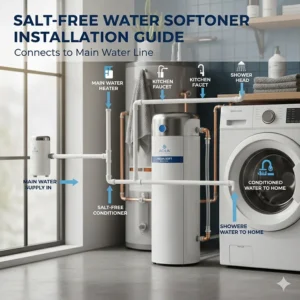
If you’ve been battling hard water problems but dread the thought of hauling salt bags every month, you’re in the right place. A salt free water softener offers an elegant solution that protects your plumbing without the hassle of traditional systems. These innovative devices use advanced technologies like template assisted crystallization and nucleation assisted crystallization to neutralize hard water minerals rather than removing them.
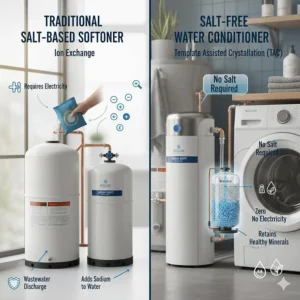
The beauty of going salt-free? You’re not just protecting your pipes and appliances—you’re keeping beneficial minerals like calcium and magnesium in your water while eliminating the scale buildup that wreaks havoc on your home. According to the U.S. Geological Survey, calcium and magnesium aren’t toxic—they’re actually essential minerals that contribute to human dietary needs. Unlike conventional water softeners that waste gallons of water during regeneration cycles, a salt free water softener operates continuously without any drain line or wastewater discharge. It’s the eco friendly water softener choice that’s taking homes by storm in 2026, and for good reason.
Whether you’re dealing with moderately hard water or looking for scale prevention technology that actually works, this comprehensive guide walks you through the top systems available today. We’ve tested, researched, and analyzed the market leaders to bring you honest saltless water conditioner reviews that cut through the marketing hype and deliver real-world insights you can trust.
Quick Comparison Table
| Product | Technology | Price Range | Best For | Lifespan | Rating |
|---|---|---|---|---|---|
| SpringWell FutureSoft | TAC Media | $1,200-$1,600 | Whole house protection | 600,000 gal | ⭐⭐⭐⭐⭐ |
| NuvoH2O Home System | CitraCharge | $500-$700 | Budget-conscious buyers | 50,000-60,000 gal | ⭐⭐⭐⭐½ |
| Aquasana Rhino EQ-1000-AST | SCM Technology | $1,400-$1,800 | Complete filtration | 1,000,000 gal | ⭐⭐⭐⭐⭐ |
| Kind Water E-2000 | TAC + Carbon | $800-$1,100 | Multi-stage filtration | 400,000 gal | ⭐⭐⭐⭐½ |
| Yarna CWD24 | Capacitive Descaling | $200-$270 | Easy DIY install | 10+ years | ⭐⭐⭐⭐ |
| iSpring ED2000 | Electromagnetic | $160-$200 | Budget option | Lifetime | ⭐⭐⭐⭐ |
| Eddy ED6002P | Magnetic Pulse | $180-$230 | Compact spaces | Lifetime | ⭐⭐⭐⭐ |
💬 Just one click – help others make better buying decisions too!😊
Top 7 Salt Free Water Softeners: Expert Analysis
1. SpringWell FutureSoft TAC Water Softener System
The SpringWell FutureSoft consistently earns top marks as the most effective TAC water softener system on the market. This premium unit uses template assisted crystallization to convert hard minerals into microscopic crystals that simply won’t stick to surfaces—no salt, no chemicals, no compromise.
Key Specifications:
- Flow rate: Up to 12 GPM
- Capacity: 600,000 gallons (approx. 6 years)
- Technology: Certified TAC media
- Installation: Professional recommended
At around $1,400, the FutureSoft represents a significant investment, but customers consistently report it’s worth every penny. The system uses NSF-certified components and arrives with everything needed for installation. What sets it apart from competitors is the high-quality template assisted crystallization media that achieves up to 99.6% scale prevention.
One homeowner in Arizona noted that after three months of use, existing scale began flaking off their fixtures—something we rarely see with no drain water treatment systems. The unit maintains full water pressure while conditioning, making it ideal for homes with 1-6 bathrooms.
✅ Pros:
- Industry-leading 99.6% scale prevention
- Lifetime warranty on tanks
- Zero water waste
- Maintains water pressure
❌ Cons:
- Higher initial cost
- Requires pre-treatment for well water
Price: $1,200-$1,600 | Where to Buy: Amazon, SpringWell website
2. NuvoH2O Home Water Softener System
For budget-conscious homeowners who still want effective scale prevention technology, the NuvoH2O Home System delivers impressive results using their proprietary CitraCharge technology. This compact unit uses food-grade citric acid to naturally chelate hard water minerals, preventing scale without removing beneficial calcium and magnesium.
Key Specifications:
- Capacity: 50,000-60,000 gallons (6-12 months)
- Flow rate: Varies by size
- Dimensions: Compact design (fits in tight spaces)
- Cartridge replacement: Every 6-12 months
The genius of this eco friendly water softener lies in its simplicity. Unlike tank-based systems, NuvoH2O uses replaceable cartridges that screw directly into your main water line. Installation takes about 30 minutes with basic tools, and the system requires no electricity or drain line. At $500-$700 including the first cartridge, it’s one of the most affordable entry points into salt-free water conditioning.
Customer reviews consistently highlight noticeably softer water and easier cleaning. One verified buyer mentioned their water heater efficiency improved by roughly 20% within three months of installation. The system also includes a lifetime warranty on the head unit, with cartridge replacements running $50-$80.
✅ Pros:
- Extremely compact installation
- Affordable initial investment
- Easy DIY setup
- Naturally softens with citrus
❌ Cons:
- Ongoing cartridge costs
- Lower capacity than tank systems
Price: $500-$700 | Where to Buy: Amazon, NuvoH2O official site
3. Aquasana Rhino Whole House System with Salt-Free Conditioner
The Aquasana Rhino EQ-1000-AST isn’t just a scale prevention technology system—it’s a comprehensive water treatment solution that combines filtration with salt-free conditioning. This powerhouse removes up to 97% of chlorine while simultaneously preventing scale buildup using proprietary SCM (Scale Control Media) technology.
Key Specifications:
- System capacity: 1,000,000 gallons (10 years)
- Conditioner capacity: 600,000 gallons (6 years)
- Flow rate: 7-14 GPM depending on model
- Certifications: NSF/ANSI Standard 42 certified
What makes this saltless water conditioner reviews favorite stand out is its dual-tank approach. The first tank houses activated carbon and KDF media that tackle chlorine, VOCs, and other contaminants, while the second tank contains SCM technology that alters the molecular structure of hard minerals. The result? Clean, conditioned water from every tap without the slippery feel of salt-based softeners.
Professional plumbers love this system for its robust build quality and intelligent upflow design that prevents channeling and maximizes contact time. At $1,400-$1,800, it’s positioned in the premium category, but you’re getting both filtration and conditioning in one unit. The system includes a pre-filter, post-filter, and installation hardware.
✅ Pros:
- Combined filtration and conditioning
- 10-year warranty on tanks
- Independently tested and certified
- Handles households of 4+ people
❌ Cons:
- Requires significant install space
- Best for hardness under 15 GPG
Price: $1,400-$1,800 | Where to Buy: Amazon, Aquasana website
4. Kind Water Systems E-2000 Salt Free System
Innovation meets affordability with the Kind Water Systems E-2000, a cartridge-based TAC water softener system that’s revolutionizing whole-house conditioning. This sleek unit combines sediment filtration with template assisted crystallization in a compact, easy-to-maintain package that’s perfect for modern homes.
Key Specifications:
- Flow rate: 15 GPM (highest in category)
- Capacity: 400,000 gallons
- Cartridge life: 6-12 months
- Mounting: Wall-mounted or floor-standing
The E-2000 uses the same trusted TAC media found in systems costing twice as much, but delivers it in user-friendly filter cartridges. This design choice makes maintenance incredibly simple—just unscrew the old cartridge and pop in a new one. No tanks to replace, no media to regenerate, no complicated procedures.
At around $800-$1,100, the Kind E-2000 hits a sweet spot between budget electronic descalers and premium tank systems. Customers rave about the exceptional 15 GPM flow rate that easily handles multiple simultaneous uses without pressure drop. The system also includes a 120-day money-back guarantee, showing the manufacturer’s confidence in their nucleation assisted crystallization technology.
✅ Pros:
- Highest flow rate in class (15 GPM)
- Simple cartridge maintenance
- Compact wall-mount design
- 120-day satisfaction guarantee
❌ Cons:
- Higher cartridge replacement costs
- May need pre-filter for well water
Price: $800-$1,100 | Where to Buy: Amazon, Kind Water website
5. Yarna CWD24 Capacitive Electronic Descaler
If you’re looking for ultimate simplicity in scale prevention technology, the Yarna CWD24 delivers. This electronic descaler wraps around your existing pipe in minutes—no cutting, no plumbing modifications, no hassle. Just mount it, plug it in, and let capacitive technology work its magic.
Key Specifications:
- Max pipe diameter: 1 inch (CWD30 for 2″, CWD48 for 4″)
- Effective distance: Up to 1.2 miles from installation
- Power consumption: 5W (costs about 36¢/month)
- Warranty: 1-year money-back, 10-year product warranty
The Yarna uses ultra-flat impulse bands that create a capacitive field, forcing hard water minerals to crystallize before they can form scale. Unlike older electromagnetic units, Yarna’s capacitive approach provides broader coverage and more consistent results. It works on any pipe material—copper, PVC, PEX, steel—and begins reducing new scale formation within 72 hours.
Priced at $200-$270, this salt free water softener represents an accessible entry point for homeowners dealing with moderate hardness (up to 25 GPG). Customer reviews average 4.4 stars on Amazon, with buyers consistently reporting cleaner fixtures, improved water heater efficiency, and easier maintenance. One Phoenix resident noted their commercial-grade CWD48 easily handles 900 PPM water at 50 GPM flow rates.
✅ Pros:
- Zero plumbing modifications needed
- Works up to 1.2 miles downstream
- Extremely low power consumption
- IP54 rated for indoor/outdoor use
❌ Cons:
- Results can take 2-3 months for existing scale
- Not as effective as media-based systems for very hard water
Price: $200-$270 | Where to Buy: Amazon, Yarna official store
6. iSpring ED2000 Electronic Water Descaler
The iSpring ED2000 has earned its reputation as the budget king of electromagnetic descalers. This simple yet effective unit uses computer-controlled electromagnetic waves to alter mineral crystals, preventing them from forming limescale deposits while actually dissolving existing scale over time.
Key Specifications:
- Suitable for: 10-19 GPG hardness
- Max pipe size: 1 inch
- Effective range: Up to 50 feet
- Power: 110-120V, minimal consumption
What makes the ED2000 special is its proven track record—this design has been on the market for years with consistently positive reviews. The unit generates frequency-modulated electromagnetic waves through two antenna coils wrapped around your main water line. These waves cause water molecules to release carbon dioxide, triggering premature crystallization of calcium bicarbonate before it can form scale.
At $160-$200, the iSpring ED2000 offers unbeatable value for anyone on a tight budget. Installation takes 15 minutes with no tools required—just wrap the coils, plug it in, and you’re done. The system includes a 1-year money-back guarantee and lifetime technical support. Customers particularly appreciate that this no drain water treatment option requires zero maintenance and costs pennies per month to operate.
✅ Pros:
- Most affordable effective option
- 15-minute tool-free installation
- Lifetime technical support
- Works on any pipe type
❌ Cons:
- Limited to 50-foot effectiveness
- Best for moderate hardness only
Price: $160-$200 | Where to Buy: Amazon, Home Depot, Walmart
7. Eddy ED6002P Electronic Water Descaler
British engineering meets American innovation in the Eddy ED6002P, a magnetic pulse descaler that’s been refined over 25 years in the water treatment industry. This compact unit uses a proprietary micro-chip to generate true magnetic pulse waveforms that condition water without chemicals, salt, or maintenance.
Key Specifications:
- Max pipe diameter: 1 inch (larger with extended cables)
- Power requirements: 90-240V universal
- Warranty: 365-day money-back + lifetime repair/replace
- Certifications: FCC certified
The Eddy stands out for its industry-leading warranty program—not only do you get a full year to try it risk-free, but the manufacturer also provides lifetime repair or replacement coverage. This confidence stems from decades of real-world testing and continuous improvement. The device works by altering the ionic charge of hard minerals, preventing them from clumping together and forming scale.
At $180-$230, the Eddy splits the difference between the ultra-budget iSpring and the feature-rich Yarna. What you’re paying for is British build quality and that exceptional warranty. Customer testimonials consistently mention improved water heater efficiency, cleaner fixtures, and softer-feeling hair and skin. One verified buyer noted they replaced their troublesome salt-based softener with an Eddy and haven’t looked back after two years.
✅ Pros:
- Lifetime repair/replace warranty
- 365-day money-back guarantee
- Universal voltage (travel-friendly)
- 25+ years of development
❌ Cons:
- May need extended cables for larger pipes
- Takes 60+ days to see full results
Price: $180-$230 | Where to Buy: Amazon, Eddy official website
Understanding Salt Free Water Softener Technology
The term “salt free water softener” is actually a bit of a misnomer—these systems don’t technically “soften” water in the traditional sense. Instead, they condition it using advanced technologies that neutralize the harmful effects of hard minerals without removing them from your water supply. Let’s break down how these innovative systems actually work.
Template Assisted Crystallization (TAC)
Template assisted crystallization represents the gold standard in salt-free technology. This process uses specially designed media beads covered in microscopic nucleation sites. As hard water flows over these beads, calcium and magnesium ions are attracted to the nucleation points where they rapidly form tiny, stable crystals—a process called seed crystal formation. Research from Arizona State University confirmed TAC technology achieves over 90% scale reduction, outperforming other alternatives without relying on salt, electricity, or chemicals.
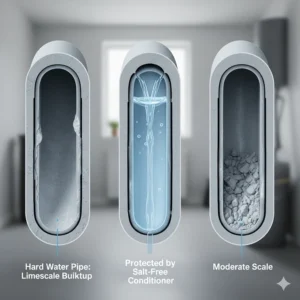
These microscopic crystals remain suspended in the water and simply pass through your plumbing without adhering to surfaces. Think of it like the difference between sticky honey and smooth oil—both flow through a pipe, but only one causes problems. TAC systems like the SpringWell FutureSoft and Kind E-2000 can achieve up to 99.6% scale prevention, making them the most effective no drain water treatment option available.
Nucleation Assisted Crystallization (NAC)
Nucleation assisted crystallization works similarly to TAC but uses a slightly different media composition. The Filtersorb SP media found in systems like the SoftPro Elite creates conditions that force minerals into their most stable crystal form before they can precipitate as scale. This technology is particularly effective at removing existing scale deposits, with many users reporting visible improvement in older fixtures within 90 days.
Scale Control Media (SCM)
Aquasana’s proprietary SCM technology takes a different approach by altering the ionic charge of hard minerals. Rather than crystallizing them, SCM prevents calcium and magnesium ions from bonding together in the first place. This technology works best with moderate hardness levels (under 15 GPG) and integrates beautifully with whole-house filtration systems.
Electronic Descaling Technologies
Electronic and electromagnetic descalers represent the most accessible entry point into scale prevention technology. Units like the Yarna, iSpring ED2000, and Eddy use electric or magnetic fields to disrupt the crystallization process. While not as consistently effective as media-based systems, they excel at convenience—no plumbing modifications, no maintenance, and minimal ongoing costs.
These systems work by applying electromagnetic waves or capacitive fields to water as it flows through your pipes. The energy causes premature crystallization or disrupts the molecular structure of hardness minerals, preventing them from forming the tightly-bonded calcite structures that create stubborn limescale. Results vary based on water chemistry, flow rates, and installation quality, but many homeowners report 60-80% reduction in scale formation.
Benefits of Choosing an Eco Friendly Water Softener
Making the switch to a salt free water softener delivers advantages that extend far beyond your home’s plumbing. Here’s why more homeowners are embracing this eco friendly water softener technology in 2026.
Environmental Protection
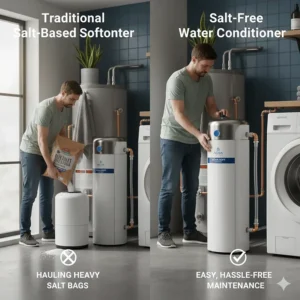
Traditional water softeners discharge hundreds of gallons of salty brine into municipal water systems or septic tanks every week. This sodium-rich wastewater can overwhelm treatment plants and harm aquatic ecosystems. Salt-free systems eliminate this entirely—zero wastewater, zero brine discharge, zero environmental guilt.
Healthier Drinking Water
Your body needs calcium and magnesium for bone health, muscle function, and cardiovascular wellness. Salt-free systems keep these essential minerals in your water while eliminating scale. You’re not trading one problem (hardness) for another (excess sodium), which is especially important for anyone on sodium-restricted diets.
Lower Operating Costs
Let’s talk money. Traditional softeners require regular salt purchases (typically $5-$10 per 40-pound bag, multiple bags monthly), electricity for regeneration cycles, and increased water bills from backwashing. A salt free water softener? Install it and forget it. No salt, no regeneration, no ongoing costs beyond occasional media replacement every 5-10 years.
Space Efficiency
Most salt-free systems occupy a fraction of the space required by traditional softeners. No bulky brine tanks, no salt storage area, no drain line installation. This makes them perfect for homes with limited utility space or apartments where modifications are restricted.
Consistent Water Pressure and Flow
Traditional softeners can cause pressure drops during regeneration cycles and require bypass installation. Salt-free systems maintain full water pressure 24/7 with no interruptions. The flow-through design of TAC and electronic systems ensures your morning shower is always strong and steady.
How to Choose the Right System for Your Home
Selecting the perfect salt free water softener requires understanding your specific needs and water conditions. Here’s a systematic approach to finding your ideal match.
Step 1: Test Your Water Hardness
Start by measuring your water’s hardness level in grains per gallon (GPG) or parts per million (PPM). You can purchase test strips for $10-$15 or request a free test from most water treatment companies. According to the EPA’s drinking water guidelines, while there’s no mandatory standard for water hardness (since calcium and magnesium aren’t toxic), understanding your levels helps determine which technologies will work effectively for your situation.
- Moderate hardness (5-15 GPG): Any salt-free system will work well
- Hard water (15-25 GPG): Focus on TAC/NAC systems or high-powered electronic descalers
- Very hard water (25+ GPG): Consider combining multiple technologies or consulting a specialist
Step 2: Determine Your Flow Rate Requirements
Calculate your peak simultaneous water usage by adding up fixture flow rates. A typical shower uses 2.5 GPM, toilets use 1.6 GPM, and washing machines use 3-4 GPM. If your household frequently runs multiple fixtures simultaneously, choose a system with adequate flow capacity.
- 1-2 bathrooms: 8-10 GPM minimum
- 3-4 bathrooms: 12-15 GPM recommended
- 5+ bathrooms: 15+ GPM required
Step 3: Evaluate Installation Space
Measure your available installation area near the main water line. Tank-based systems need vertical clearance (typically 3-5 feet) plus working room for maintenance. Electronic descalers need only a 10-inch straight pipe section and nearby electrical outlet.
Step 4: Consider Water Source and Quality
Well water typically contains iron, manganese, and other contaminants that can foul TAC media or interfere with electronic systems. If you have well water, plan to install pre-filtration or choose a system designed specifically for wells, like the Aquasana Rhino.
Step 5: Budget for Initial and Ongoing Costs
Factor in both upfront investment and long-term expenses:
Budget Range ($150-$300): Electronic descalers (Yarna, iSpring, Eddy)
Mid-Range ($500-$1,200): Cartridge-based systems (NuvoH2O, Kind)
Premium ($1,200-$2,000): Tank-based TAC systems (SpringWell, Aquasana)
Remember that premium systems often have lower long-term costs due to longer media life and superior effectiveness.
Installation and Maintenance Tips
Getting the most from your scale prevention technology requires proper installation and minimal maintenance. Follow these expert guidelines for optimal performance.
Installation Best Practices
For Media-Based Systems (TAC/NAC/SCM):
- Install on the main water line after the meter but before any branch lines
- Ensure adequate space for cartridge/tank changes (minimum 6 inches clearance)
- Use bypass valves to facilitate future maintenance
- Consider professional installation for well water systems
- Test water pressure before and after to confirm no restriction
For Electronic Descalers:
- Choose a straight pipe section with at least 10 inches of uninterrupted space
- Wrap coils tightly according to manufacturer specifications
- Keep the control unit away from direct water exposure
- Plug into a dedicated outlet rather than extension cords
- Position at least 3 feet from electrical panels or other electronics
Optimizing System Performance
Temperature affects media efficiency—systems work best when water temperature stays between 40-110°F. If your water lines experience freezing conditions, insulate appropriately. For electronic systems, verify LED indicators daily during the first week to confirm proper operation.
Water flow direction matters, especially for TAC systems. Most require upflow installation where water enters from the bottom and exits from the top, maximizing contact time with media. Always verify manufacturer specifications before installation.
Maintenance Schedules and Requirements
TAC/NAC Tank Systems:
- Inspect connections quarterly for leaks
- Replace media every 5-10 years (600,000-1,000,000 gallons)
- Clean pre-filters monthly if installed
- Annual system flush recommended for well water
Cartridge-Based Systems:
- Replace cartridges every 6-12 months depending on water usage
- Monitor pressure gauges if equipped
- Clean mounting brackets annually
- Inspect O-rings during cartridge changes
Electronic Descalers:
- Verify LED status indicators weekly
- Wipe control unit with dry cloth monthly
- Check coil wrapping integrity annually
- Zero maintenance otherwise
Salt Free vs. Traditional Water Softeners: The Complete Comparison
Understanding the fundamental differences between these technologies helps you make an informed decision. Let’s examine each system type in depth.
| Feature | Salt Free Systems | Traditional Softeners |
|---|---|---|
| How They Work | Crystallize or condition minerals | Remove minerals via ion exchange |
| Water Chemistry | Minerals remain (healthier) | Minerals replaced with sodium |
| Maintenance | Minimal to none | Monthly salt refills required |
| Water Waste | Zero | 25-65 gallons per regeneration |
| Upfront Cost | $150-$2,000 | $400-$2,500 |
| Operating Costs | Near zero | $100-$300/year in salt |
| Space Required | Minimal | Significant (brine tank needed) |
| Effectiveness | Prevents scale (doesn’t remove minerals) | Completely removes hardness |
When Salt-Free Systems Excel
Salt-free technology shines in several scenarios. If you’re on a sodium-restricted diet, these systems provide scale protection without adding salt to your water. They’re ideal for environmentally conscious homeowners who want to eliminate brine discharge. Space-constrained installations like apartments, condos, and small homes benefit from their compact footprint.
Moderate hardness levels (5-15 GPG) respond excellently to salt-free treatment, achieving 90-99% scale prevention. According to rigorous testing conducted using the German DVGW-W512 protocol, TAC systems consistently demonstrate superior scale reduction compared to other alternative technologies. Areas with water softener bans or restrictions leave salt-free as the only legal option. And if you value low maintenance and set-it-and-forget-it convenience, nothing beats a salt-free system.
When Traditional Softeners Are Better
Traditional ion-exchange softeners remain superior for very hard water (20+ GPG) where complete mineral removal is necessary. They’re the better choice when you specifically want that slippery, soft water feel for bathing. Commercial applications with extremely high flow demands often require traditional systems’ proven capacity.
If you’re dealing with iron staining beyond 0.3 PPM, traditional softeners can remove iron while salt-free systems typically can’t. And when municipal water regulations allow salt discharge, traditional softeners offer more complete hardness removal.
The Hybrid Approach
Some homeowners install both systems—a traditional softener for one or two fixtures (bathroom showers where the slippery feel is desired) while using a salt-free system for the whole house. This provides the best of both worlds: scale prevention everywhere, soft water where it matters, and mineral-rich water at kitchen taps.
Common Myths About Salt Free Water Softeners Debunked
Misinformation about salt-free technology runs rampant online. Let’s separate fact from fiction with science-based explanations.
Myth 1: “They Don’t Actually Work”
The Truth: Salt-free systems absolutely work—just differently than traditional softeners. They don’t remove minerals, so water hardness tests will show the same GPG after installation. However, those minerals are now in a form that won’t create scale. Think of it like this: the minerals are still there, but they’ve been defanged.
Numerous independent studies confirm TAC technology’s 95-99.6% effectiveness at scale prevention. The Water Quality Research Foundation, a respected industry organization, has validated template assisted crystallization as a legitimate scale prevention method.
Myth 2: “Electronic Descalers Are Just Snake Oil”
The Truth: While results vary and some cheap units are indeed ineffective, quality electronic descalers from reputable manufacturers like Yarna, iSpring, and Eddy produce measurable results for many users. The key is understanding their limitations—they work best with moderate hardness, proper installation, and realistic expectations.
The technology relies on disrupting crystal formation rather than removing minerals. It’s not magic, but it’s not completely bogus either. Thousands of verified customer reviews and decades of European use support their effectiveness when properly applied.
Myth 3: “You Can’t Tell the Difference”
The Truth: While you won’t get the slippery feel of salt-softened water, you’ll definitely notice cleaner fixtures, easier cleaning, better-performing appliances, and reduced soap scum. The difference is subtle at first but compounds over weeks and months as scale stops accumulating.
Many users report softer-feeling skin and hair, improved soap lathering (though not to the same degree as salt systems), and noticeably shinier glassware. The benefits are real—just different from what traditional softeners provide.
Myth 4: “They’re Just Temporary Fixes”
The Truth: Quality salt-free systems provide long-term protection lasting 5-10 years or more before requiring media replacement. Electronic units often carry lifetime warranties and can operate indefinitely with minimal intervention. This isn’t a temporary band-aid—it’s a permanent solution to scale problems.
The “temporary” criticism typically comes from comparing them to traditional softeners that completely remove minerals. By that standard, yes, salt-free systems are “temporary” because they only prevent scale rather than removing hardness. But preventing scale is exactly what most homeowners need.
Cost Analysis: Is Salt Free Worth the Investment?
Let’s crunch the numbers to understand the true economics of salt free water softener systems versus traditional alternatives.
Initial Investment Comparison
Salt-Free Systems:
- Electronic descalers: $150-$300
- Cartridge-based: $500-$1,200
- Tank-based TAC: $1,200-$2,000
- Installation (if professional): $200-$500
Traditional Softeners:
- Basic models: $400-$1,000
- Mid-range: $1,000-$1,800
- Premium: $1,800-$3,000
- Installation: $300-$800
Initial costs favor budget electronic descalers but even out in the mid-range. Premium systems cost similarly regardless of type.
Annual Operating Costs
Salt-Free Systems:
- Electronic: $4-$10 electricity annually
- TAC: $0 until media replacement (5-10 years)
- Cartridge: $50-$150 for replacements
Traditional Softeners:
- Salt: $100-$300 annually
- Electricity: $30-$50 annually
- Water waste: $50-$100 annually
- Maintenance: $0-$100 annually
Over 10 years, a traditional softener costs $1,800-$4,500 in operating expenses, while salt-free systems cost $40-$1,500 depending on type. The savings dramatically favor salt-free technology.
Return on Investment
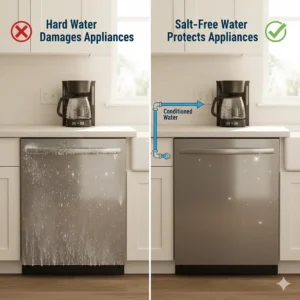
Scale buildup reduces appliance efficiency and lifespan. Water heaters clogged with scale use 20-30% more energy. Dishwashers, washing machines, and other appliances last significantly longer with conditioned water. The average household saves approximately $400-$600 annually in energy costs and extended appliance life.
A $1,500 salt-free system pays for itself in 3-4 years through energy savings alone, then continues delivering benefits for 6-7 more years before requiring any significant maintenance. That’s an impressive return that traditional softeners can’t match when factoring in ongoing salt purchases.
Frequently Asked Questions
❓ Do salt free water softeners actually remove hardness from water?
❓ How long does a salt free water softener typically last before replacement?
❓ Can I install a salt free water softener myself or do I need a plumber?
❓ Will a salt free water softener work with well water containing iron?
❓ How do I know if my salt free water softener is working properly?
Conclusion: Making Your Salt Free Water Softener Decision
Choosing the right salt free water softener transforms your daily experience with water while protecting your home’s plumbing and appliances. Whether you opt for the premium effectiveness of a TAC water softener system like the SpringWell FutureSoft, the budget-friendly convenience of electronic descalers like the Yarna or iSpring ED2000, or the comprehensive protection of the Aquasana Rhino, you’re making a smart investment in scale prevention technology.
Remember that the “best” system depends entirely on your specific situation. Moderate hardness? Any quality salt-free system will excel. Limited budget? Electronic descalers deliver impressive value. Want comprehensive protection? Tank-based TAC systems provide industry-leading results. Need minimal maintenance? All salt-free options require vastly less upkeep than traditional softeners.
The eco friendly water softener revolution isn’t just marketing hype—it’s a legitimate technological advancement that solves real problems without creating new ones. By eliminating salt usage, wastewater discharge, and ongoing maintenance headaches, these systems represent the future of residential water treatment. And with technologies like template assisted crystallization and nucleation assisted crystallization achieving 99%+ scale prevention, performance no longer requires compromise.
Take time to assess your water quality, household needs, and budget constraints. Test your water hardness, measure your flow requirements, and consider your long-term maintenance preferences. Then choose the system that aligns with your priorities. Your pipes, appliances, wallet, and planet will thank you for making the switch to no drain water treatment technology in 2026.
✨ Ready to Protect Your Home from Scale?
🔍 Check current prices and availability on the products featured in this guide. Every system mentioned represents proven technology from reputable manufacturers backed by solid warranties and customer support. Click on any highlighted product to explore specifications, read additional reviews, and find the perfect scale prevention solution for your home!
Recommended for You
- 7 Best Salt Based Water Softeners 2026
- 7 Best Water Softener Under $1000: Top Picks 2026
- 7 Best Water Softener Under $500 in 2026
Disclaimer: This article contains affiliate links. If you purchase products through these links, we may earn a small commission at no additional cost to you.
✨ Found this helpful? Share it with your friends! 💬🤗
