In This Article
Picture this: you step out of the shower, and your skin feels slick and soapy no matter how much you rinse. Or maybe you’re tired of scrubbing crusty white deposits off your faucets every week. You’ve decided it’s time to tackle your hard water problem, but now you’re stuck at a crossroads. Should you go with a traditional salt-based system or opt for the newer salt-free alternative?
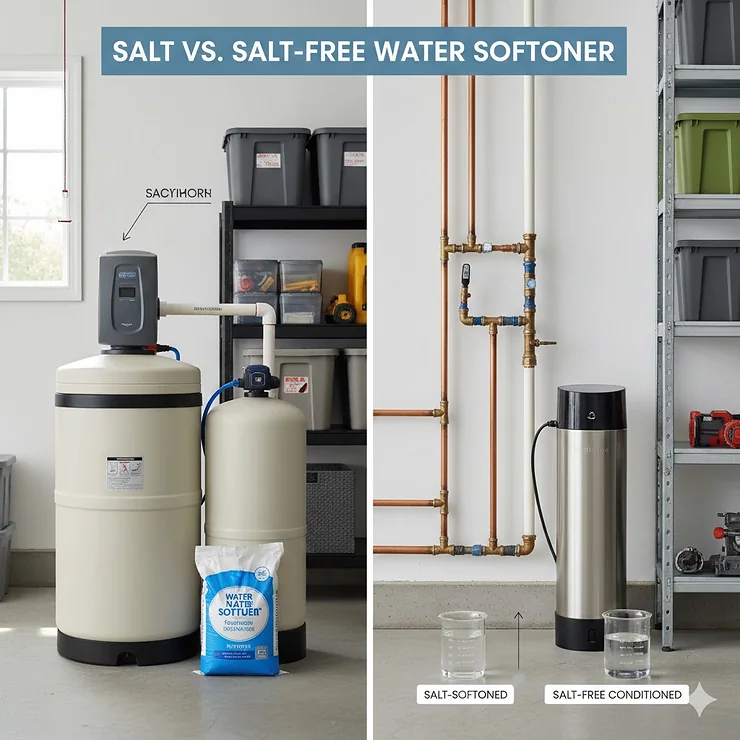
The debate about salt vs salt free water softener systems isn’t just about choosing between two similar products. It’s about understanding two fundamentally different approaches to handling hard water. One actually removes minerals from your water through chemistry, while the other changes how those minerals behave without taking them out. Both have passionate advocates and vocal critics.
I’ve spent countless hours researching these systems, talking to homeowners, and analyzing real-world performance data. What I’ve learned might surprise you. The “best” choice isn’t universal—it depends on your water hardness, household size, budget, local regulations, and even your personal preferences about how water should feel on your skin.
In this comprehensive guide, you’ll discover exactly how these systems work, what separates the winners from the disappointing underperformers, and which specific models deliver the best value in 2026. Whether you’re dealing with moderate hardness in the suburbs or extreme mineral content from a well, you’ll find actionable insights to make the right decision.
Quick Comparison Table
| Feature | Salt-Based Softener | Salt-Free Conditioner |
|---|---|---|
| How It Works | Ion exchange removes minerals | TAC crystallizes minerals |
| True Softening | Yes – removes Ca & Mg | No – conditions water |
| Maintenance | Monthly salt refills needed | Minimal to none |
| Operating Cost | $150-300/year (salt + water) | $10-50/year (electricity) |
| Installation | Requires drain line & power | Simple, no drain needed |
| Environmental Impact | High (brine discharge) | Low (no wastewater) |
| Feel on Skin | Slippery, soft feel | Normal water feel |
| Best For | Very hard water (>15 GPG) | Moderate hardness (<15 GPG) |
💬 Just one click – help others make better buying decisions too! 😊
Top 7 Water Softeners & Conditioners: Expert Analysis
1. SpringWell Salt-Based Water Softener (SS1) – Best Overall Traditional System
For homeowners who want genuine water softening with proven technology, the SpringWell SS1 delivers exceptional performance at a competitive price. This 32,000-grain capacity system uses 10% crosslink resin—a significant upgrade from the standard 8% resin found in most competitors.
Key Specifications:
- Capacity: 32,000 grains (also available in 48k and 80k)
- Flow rate: 11 GPM (sufficient for 1-3 bathrooms)
- Technology: Ion exchange with demand-initiated regeneration
Price Range: $1,200-1,500
The SS1 removes hardness-causing minerals through the proven ion exchange process. During my research, I found consistent reports of this system reducing hardness from 18 GPG down to 0 GPG. The Bluetooth-enabled digital control head makes programming straightforward, and the lifetime warranty provides peace of mind that cheaper alternatives simply can’t match.
Customer Feedback: Users consistently praise the SS1’s efficiency and build quality. One homeowner in Colorado reported their unit reduced 97.5% of calcium and magnesium, with the 200-pound salt tank requiring refills only monthly.
✅ Pros: Premium 10% crosslink resin, lifetime warranty, Bluetooth controls, excellent customer service
❌ Cons: Higher upfront cost, requires regular salt purchases, adds 400 gallons to monthly water usage during regeneration
Ideal for: Families with very hard water (>15 GPG) who want true softening and don’t mind maintenance
2. Aquasure Harmony Series 48,000 Grain – Best Value Salt-Based System
Budget-conscious shoppers don’t have to sacrifice quality. The Aquasure Harmony 48,000 grain softener offers professional-grade performance at a price that won’t make your wallet cry. This system handles 3-4 bathrooms comfortably while using advanced metered regeneration to minimize waste.
Key Specifications:
- Capacity: 48,000 grains
- Digital metered control head with LCD display
- Removes up to 2 PPM iron (standard resin)
Price Range: $500-700
The automatic digital control head calculates treated water volume and initiates backwash only when needed, potentially saving hundreds of gallons compared to timer-based systems. Installation is straightforward thanks to pre-assembled parts, though you’ll still need to connect a drain line and electrical source.
Customer Feedback: Over 3,000 Amazon reviews averaging 4.5 stars tell a compelling story. Users report dramatic improvements in soap lathering, reduced spotting on dishes, and softer skin within days of installation.
✅ Pros: Exceptional value for money, easy DIY installation, 5-year extended warranty when registered, handles moderate iron
❌ Cons: Plastic components less durable than premium brands, customer service can be slow to respond
Ideal for: Medium to large families on a budget who need reliable hardness reduction
3. WaterBoss Model 700 – Most Compact Salt-Based Option
Space-constrained homeowners finally have a serious solution. The WaterBoss 700 packs 22,000 grains of softening capacity into a cabinet measuring just 14.75″ wide and 25.75″ tall—perfect for tight crawl spaces, small utility rooms, or apartment installations.
Key Specifications:
- Capacity: 22,000 grains
- Built-in sediment filter (removes up to 10 PPM ferrous iron)
- Fast regeneration: Just 19 minutes
Price Range: $400-600
What sets the WaterBoss apart is its efficiency. It regenerates in under 20 minutes using only 1 pound of salt—significantly less than competing models. The integrated whole-house sediment filter eliminates the need for a separate pre-filter, saving both money and installation complexity.
Customer Feedback: Homeowners love the compact footprint and efficient salt usage. One reviewer noted using only 300-400 pounds of salt annually, compared to over 1,000 pounds with previous systems.
✅ Pros: Incredibly compact design, fast regeneration, minimal salt usage, American-made quality
❌ Cons: Lower capacity unsuitable for large families or very hard water (>70 GPG), some assembly quality issues reported
Ideal for: 1-4 person households with limited installation space and moderate hardness levels
4. SpringWell FutureSoft (FS1) – Best Salt-Free Conditioner
If you want scale prevention without the ongoing costs and maintenance of salt-based systems, the SpringWell FutureSoft represents the gold standard in Template Assisted Crystallization technology. This system prevents up to 99.6% of scale buildup while maintaining healthy mineral content in your water.
Key Specifications:
- Technology: TAC (Template Assisted Crystallization)
- Flow rate: 11-20 GPM depending on model
- Zero water waste, no electricity required
Price Range: $1,200-1,600
The FutureSoft doesn’t remove calcium and magnesium—it transforms them into microscopic crystals that won’t stick to pipes, appliances, or fixtures. You won’t get the “slippery” feel of traditional soft water, but you also won’t lose beneficial minerals that contribute to health and taste.
Customer Feedback: Users in areas with saltwater softener bans praise this system’s performance. One homeowner reported dramatic reduction in scale buildup on fixtures within two weeks, with existing deposits gradually dissolving over several months.
✅ Pros: No salt or electricity needed, zero wastewater, lifetime warranty, retains healthy minerals, legal everywhere
❌ Cons: Doesn’t provide true softening, water hardness tests remain unchanged, higher upfront cost
Ideal for: Health-conscious homeowners, areas with softener bans, those wanting minimal maintenance
5. NuvoH2O Home System – Best Citrus-Based Conditioning
The NuvoH2O Home System takes a unique approach to water conditioning using proprietary CitraCharge technology. Instead of salt or TAC media, this system uses citrus-based chelation to prevent scale while improving water taste and odor.
Key Specifications:
- CitraCharge cartridge technology
- Cartridge lifespan: 6 months (average household)
- Compact design suitable for tight spaces
Price Range: $500-700
NuvoH2O’s approach binds to hard minerals, preventing them from forming scale while keeping them in solution. The system installs without electricity or drain lines, making it one of the simplest options available. However, you’ll need to replace cartridges every 6 months, adding to ongoing costs.
Customer Feedback: Texas homeowners with notoriously hard water report significant improvements. One reviewer noted complete elimination of calcium buildup in toilets and fixtures after using the system for several months.
✅ Pros: Eco-friendly with no wastewater, easy installation, improves water taste, compact footprint
❌ Cons: Ongoing cartridge replacement costs, not as effective on extremely hard water, mixed long-term performance reviews
Ideal for: Small to medium homes, renters, those prioritizing ease of installation over maximum performance
6. Kind Water Systems E-2000 – Best Cartridge-Based Salt-Free System
The Kind E-2000 offers an innovative cartridge-based approach to salt-free conditioning. This system combines sediment filtration with TAC conditioning in a compact, easy-to-service package that outperforms many tank-based alternatives.
Key Specifications:
- 2-stage filtration (sediment + TAC conditioning)
- Flow rate: 15 GPM
- Filter life: 6-12 months depending on water quality
Price Range: $800-1,000
Unlike traditional tank systems, the E-2000 uses replaceable cartridges containing TAC media. This makes maintenance straightforward—simply unscrew the old cartridge and install a new one every 6-12 months. The high flow rate ensures no pressure drop even during peak usage times.
Customer Feedback: Users appreciate the simple maintenance and consistent performance. The cartridge design makes it easy to see when replacement is due, eliminating guesswork.
✅ Pros: High flow rate (15 GPM), simple cartridge replacement, compact design, no power or drain needed
❌ Cons: Higher ongoing costs than tank systems, cartridges create waste, may not suit very large homes
Ideal for: Homeowners who prioritize easy maintenance and don’t mind periodic cartridge costs
7. iSpring ED2000 Electronic Descaler – Best Budget Electronic Option
For homeowners seeking the most affordable entry into water conditioning, the iSpring ED2000 electronic descaler offers impressive results at a fraction of traditional system costs. This innovative device uses electromagnetic waves to alter mineral structure without any plumbing modifications.
Key Specifications:
- No plumbing modifications required
- Works on any pipe type (copper, PEX, PVC)
- Power consumption: ~$0.36/month
Price Range: $140-180
The ED2000 wraps antenna coils around your main water pipe, creating electromagnetic fields that agitate water molecules. This process triggers premature crystallization of calcium bicarbonate, preventing it from forming hard scale deposits. Installation takes about 15 minutes with no tools beyond the included materials.
Customer Feedback: Results vary significantly based on water hardness levels. Users with moderate hardness (10-15 GPG) report noticeable improvements within 2-3 weeks, while those with extreme hardness see limited benefits.
✅ Pros: Ultra-affordable, zero plumbing modifications, maintenance-free, suitable for renters, minimal electricity use
❌ Cons: Less effective than true softeners, limited to 15-19 GPG hardness, effectiveness decreases after 50 feet of pipe, not recommended with iron above 0.3 PPM
Ideal for: Renters, budget-conscious homeowners with moderate hardness, temporary solutions while saving for a full system
✨ Don’t Miss These Exclusive Deals!
🔍 Take your water quality to the next level with these carefully selected products. Click on any highlighted item to check current pricing and availability. These systems will help you create softer, scale-free water your family will love!
Understanding the Core Difference: Salt vs Salt Free
The fundamental distinction comes down to one question: Do you want to remove minerals or neutralize them?
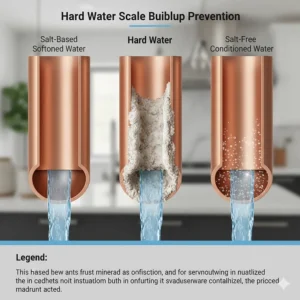
Traditional salt-based systems use ion exchange—literally removing calcium and magnesium and replacing them with sodium. This is true softening. Hardness drops from 15-20 grains per gallon to 0-1 GPG.
Salt-free conditioners use Template Assisted Crystallization or electromagnetic fields to change how minerals behave without removing them. The minerals stay in your water—they just won’t stick to surfaces. Hardness tests remain unchanged because minerals are still present.
Think of it this way: salt-based systems remove sugar from coffee, while salt-free systems prevent sugar from sticking to your spoon.
Salt-based systems provide that slippery, soft feel with abundant soap lathering and spot-free dishes. However, they discharge salty brine, add sodium to drinking water, and require ongoing salt purchases.
Salt-free systems maintain normal water feel without the slick sensation. They prevent scale buildup and extend appliance life without wastewater or electricity. The trade-off? No ultra-soft shower experience, and reduced effectiveness above 15-20 grains per gallon.
According to the U.S. Geological Survey, the hardest water is concentrated in the Southwest, Great Plains, and Rocky Mountain regions. If you have tested hardness above 15 GPG, ion exchange typically delivers better results.
How Ion Exchange Systems Work
Inside every salt-based softener sits a resin tank filled with polymer beads loaded with sodium ions. When hard water flows through, calcium and magnesium ions attach to the beads while sodium releases into the water stream.
Eventually beads become saturated and must regenerate. Concentrated brine flows backward through the resin, forcing hardness minerals off and flushing them down the drain.
Modern systems use demand-initiated regeneration, cleaning only when needed based on actual usage. This takes 20-30 minutes and uses 20-60 gallons per cycle. The salty wastewater explains why some municipalities restrict or ban these systems.
Sodium added to drinking water is minimal—typically 20-30 mg per liter for each grain of hardness removed. Those on strict low-sodium diets should consult physicians first.
TAC and Salt-Free Technology Explained
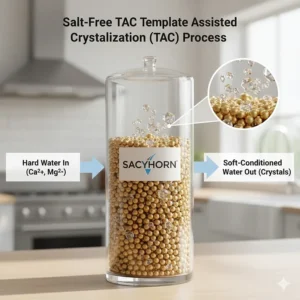
Template Assisted Crystallization provides nucleation sites where calcium and magnesium crystallize before reaching pipes. The TAC media consists of polymer beads with unique surfaces. As water flows over them, minerals precipitate and form microscopic crystals that release as harmless suspended particles.
The process is entirely physical—no chemicals, no sodium added, no minerals removed. Crystallized minerals remain in water, maintaining natural taste. This explains why TAC-treated water still tests as “hard.”
Effectiveness depends on water conditions. pH should be 7.0 or higher. Iron, manganese, or sulfur interference requires pre-filtration. Silica above 10 PPM reduces performance.
Electronic descalers use electromagnetic fields to vibrate water molecules, releasing carbon dioxide and causing premature calcium bicarbonate precipitation. Research from water treatment studies shows these systems reduce scale but are less effective than true softeners or TAC conditioners, especially in very hard water.
Comparing Costs: Initial Investment and Long-Term Expenses
Let’s talk money—because water treatment isn’t a one-time purchase, it’s an ongoing commitment.
Salt-Based Systems Initial Costs:
- Budget models: $400-700 (Aquasure Harmony, WaterBoss 700)
- Mid-range: $800-1,500 (Premium Aquasure, entry SpringWell)
- Premium: $1,500-3,000 (High-capacity SpringWell, SoftPro Elite)
- Professional installation: $200-500 if you don’t DIY
Salt-Based Annual Operating Costs:
- Salt: $100-200/year (depends on hardness and usage)
- Water for regeneration: $30-60/year
- Electricity: $10-20/year
- Maintenance/repairs: $0-100/year (occasional resin replacement)
- Total: $150-400/year
Salt-Free Systems Initial Costs:
- Electronic descalers: $140-250 (iSpring ED2000, similar models)
- Cartridge systems: $600-1,000 (NuvoH2O, Kind E-2000)
- Tank-based TAC: $1,200-1,800 (SpringWell FutureSoft, Pelican)
- Professional installation: $100-300 (simpler than salt systems)
Salt-Free Annual Operating Costs:
- Cartridge replacement (if applicable): $100-200/year
- Media replacement (tank systems): $0 for 5-8 years
- Electricity (electronic models): $5-10/year
- Maintenance: Minimal to none
- Total: $10-200/year depending on type
Over a 10-year lifespan, here’s the real cost comparison:
Salt-Based System (mid-range):
- Initial: $1,000
- Operating (10 years): $2,500
- Total: $3,500
TAC Tank System:
- Initial: $1,400
- Operating (10 years): $200
- Media replacement (once): $300
- Total: $1,900
The cost advantage of salt-free systems becomes more dramatic in areas with expensive water or salt, and particularly in households with high water usage. However, remember that you’re comparing fundamentally different treatments—true softening versus conditioning.
Installation Requirements Compared
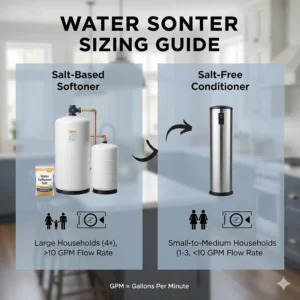
Salt-based systems require main water line access, drain connection, 120V outlet, bypass valve, and level surface. Drain discharge must reach floor drain, utility sink, or standpipe within 20 feet (or use condensate pump for higher lifts). DIY installation takes 3-6 hours for experienced homeowners.
Salt-free TAC systems need only main line access, bypass valve, and level surface—no drain or electricity required. Installation time: 2-4 hours.
Electronic descalers install in 15-30 minutes by wrapping coils around existing pipe and plugging into nearby outlet. Zero plumbing modifications needed.
Simplicity advantage clearly belongs to salt-free systems. However, don’t let installation difficulty alone drive your decision. Better long-term results justify extra installation effort or professional costs.
Maintenance Reality Check
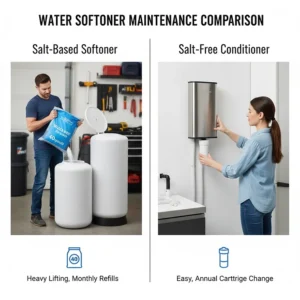
Salt-based systems require monthly salt refills (hauling 40-pound bags), annual brine tank cleaning, resin cleaning every 5-8 years, and full resin replacement after 8-12 years. Salt bridges—crusty formations preventing proper brine dissolution—require breaking up periodically.
TAC systems need quarterly leak inspections and media replacement every 5-8 years via simple cartridge swap. Cartridge-based models require replacement every 6-12 months.
Electronic descalers are essentially maintenance-free—just verify LED operation occasionally.
The maintenance advantage decisively favors salt-free systems with no heavy lifting or monthly chores.
Environmental Impact
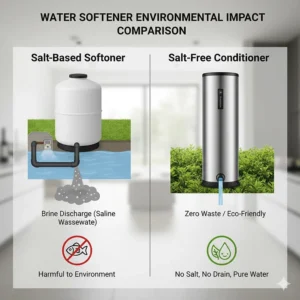
Salt-based softeners discharge concentrated brine during regeneration. In some California communities, softeners face bans due to groundwater contamination concerns.
A typical household system discharges 50-100 pounds of salt annually, plus 2,000-6,000 gallons of wastewater. Communities with thousands of softeners create significant environmental impact and complicate wastewater treatment.
Salt-free systems produce zero wastewater, use no salt requiring mining and transport, and don’t contribute to groundwater salinity. Electronic models consume minimal electricity (under $10 yearly).
Cartridge-based systems create plastic waste, though tank-based TAC systems are most environmentally friendly overall. For eco-conscious consumers in drought-prone regions, salt-free conditioning offers substantial advantages.
Feel, Taste, and Daily Use Differences
Salt-based water provides distinctly slippery, smooth feel with abundant soap lathering, zero spots on dishes, slight sodium taste (usually imperceptible), softer hair, and bright laundry without fabric softener. That slippery sensation is soap residue prevented from bonding with minerals.
Salt-free conditioned water feels normal without slickness, shows improved but not dramatic soap lathering, reduced scale with possible minor spotting, preserved natural mineral taste, and moderate hair/skin improvements.
The “normal” feel appeals to those who dislike traditional soft water’s slick sensation. For drinking and cooking, salt-softened water often tastes “flat” from mineral removal. Conditioned water retains beneficial minerals preferred by many for both taste and nutrition.
Coffee and tea enthusiasts note mineral content significantly affects flavor extraction. True softeners remove these beneficial minerals while conditioners preserve them for optimal taste.
FAQ: Your Water Softening Questions Answered
❓ Can I drink water from a salt vs salt free water softener system?
❓ Which type works better for extremely hard well water?
❓ Do salt free water conditioners actually remove existing scale buildup?
❓ How do I know my water hardness level to choose the right system?
❓ Are there areas where salt based systems are banned or restricted?
Conclusion: Making Your Decision
Choosing between salt vs salt free water softener systems ultimately comes down to priorities. If you have very hard water above 15 grains per gallon and want that luxurious, spot-free soft water experience, traditional ion exchange systems deliver unmatched performance. The SpringWell SS1 and Aquasure Harmony series represent excellent value in this category.
For moderate hardness, environmental consciousness, minimal maintenance, or areas with softener restrictions, salt-free conditioning makes perfect sense. The SpringWell FutureSoft leads this category with proven TAC technology and exceptional warranties.
Budget-constrained homeowners or renters can experiment with electronic descalers like the iSpring ED2000 for under $200. While less effective than full systems, they provide noticeable improvements for moderate hardness levels with zero commitment.
Don’t let perfect be the enemy of good. A mid-range system installed today delivers immediate benefits, while endless research postpones relief from hard water problems. Most quality manufacturers offer 30-90 day money-back guarantees, allowing you to test performance risk-free.
Consider your specific situation: water hardness level, household size, budget, environmental values, and maintenance willingness. Match these factors to the system characteristics we’ve covered, and you’ll make a confident decision you won’t regret.
The water flowing through your home affects everything from morning showers to appliance longevity. Investing in proper treatment—whether through mineral removal or conditioning—pays dividends in comfort, convenience, and reduced maintenance for years to come.
Recommended for You
- 7 Best Smart Water Softener with WiFi Systems (2026 Guide)
- 7 Best Portable Water Softener for RV 2026
- 7 Best Salt Free Water Softeners 2026
Disclaimer: This article contains affiliate links. If you purchase products through these links, we may earn a small commission at no additional cost to you.
✨ Found this helpful? Share it with your friends! 💬🤗
